Saturday Morning Tea

Wow, for the first time in 6 weeks, we actually got through a whole week with no significantly nasty weather to deal with. It was such a treat to not have to get up at zero dark thirty to dig myself out before work! Speaking of a treat, this morning’s tea is quite special. It’s a Darjeeling tea, not a black tea but a green tea, called Arya Emerald.
I wrote about the 2007 harvest lot of this tea here. The Arya estate, located in the Himalayan mountains of northeast India, produces special, hand processed tea lots with beautiful gemstone names like Ruby (black), Pearl (white) and Emerald (green). I reviewed Arya Ruby a couple of months ago here.

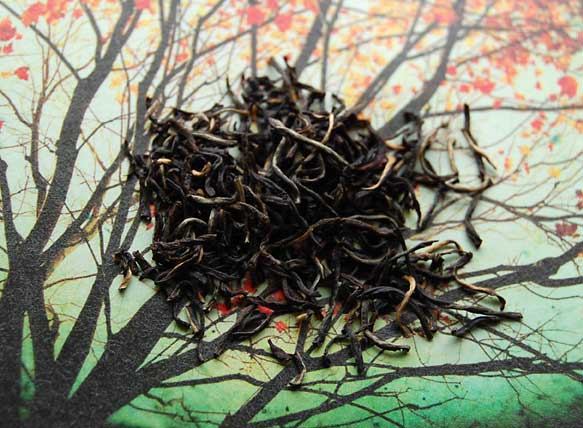
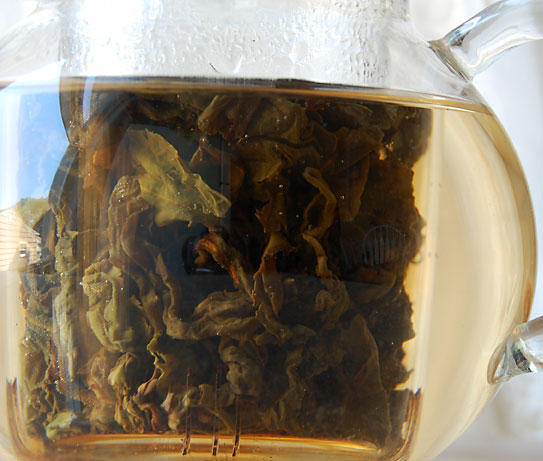
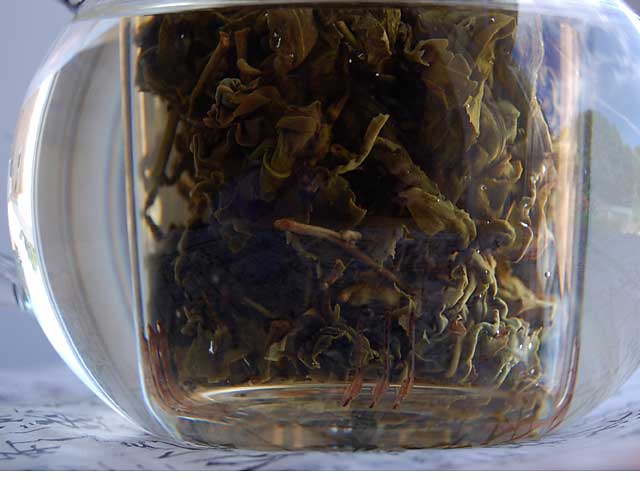
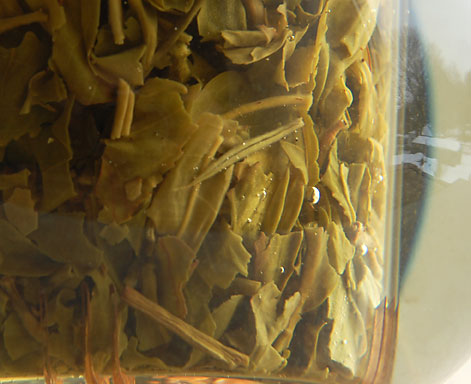
Dry, the dark green leaf is long and twisted with light green bits but a 3 minute steeping unfurled the leaves, revealing many intact leaves that are a beautiful, light olive green. With most green teas, this one included, I use 180 degree F water for steeping.

The aroma is lightly vegetal with a hint of Darjeeling astringency.

The vegetal quality carries on into the flavor but only lightly so, with notes of tart green grapes and sweet pear which I enjoyed very much.

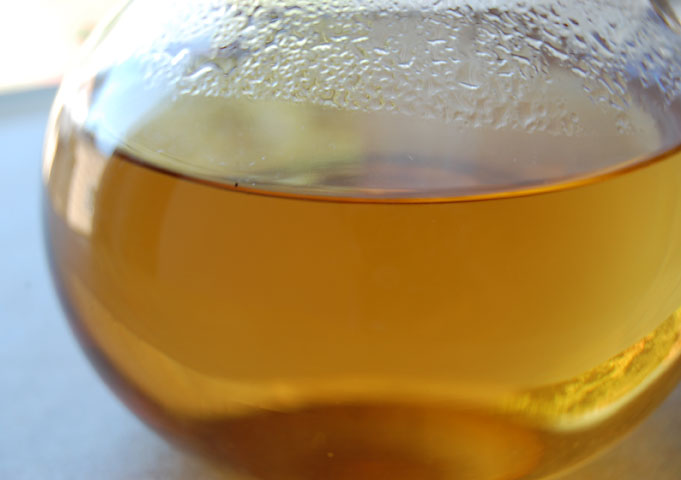
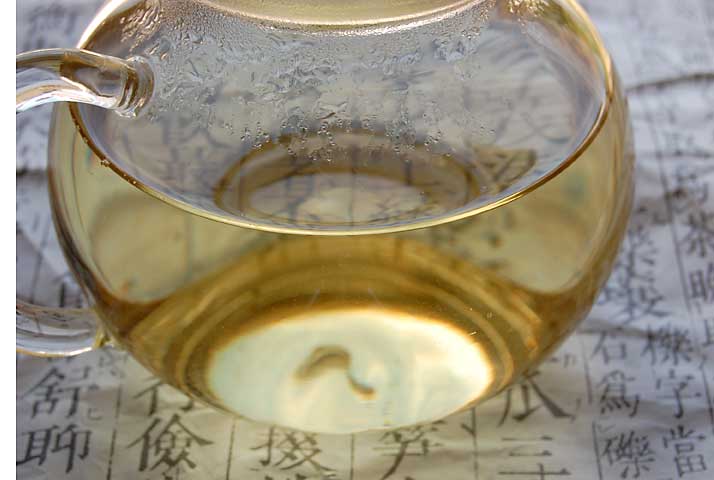
I find it interesting that such intensely green leaves can produce a liquor that is so golden yellow.

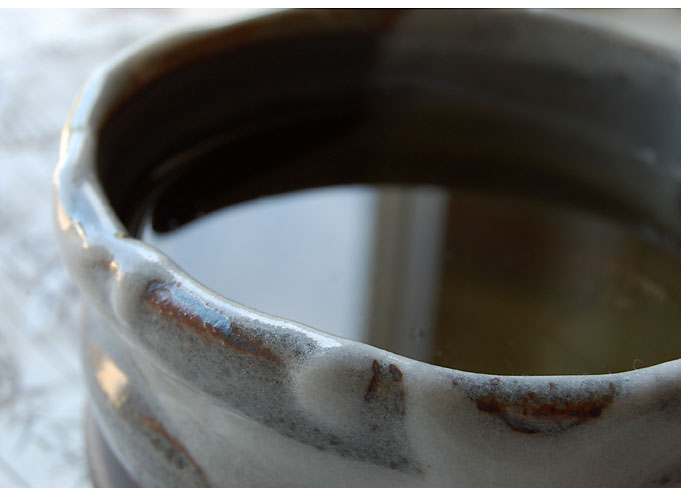
I’ve chosen my spiral teabowl as the light color of the liquor allows me to see the wonderful spiral shape inside the bowl.

Do you have a favorite teabowl or mug? What does it look like? One of the things that influences my choice of mug or bowl is the color of the tea liquor.

I had an odd experience this week. Normally, when I include a link to a former post in my present post, WordPress sends me a “pingback”. Of course, I know about this already because I was the one to place the link in my post. But this week I received one I didn’t recognize. I discovered that another website called rakkatei was posting my latest post in its entirety as if they had written it! I found this quite disturbing, especially when I couldn’t locate any contact information on the site. I did some research and was able to find a company name and promptly sent them a letter requesting that they immediately remove my content from their website. So, if you’re seeing this post on that website right now, please know that it does not belong to them. I am the author, Karen at Art and Tea. Has this ever happened to anyone?

Have a great weekend, dear tea friends, and Happy Valentine’s Day!

“Where there is great love there are always miracles.”

~Willa Cather

Saturday Morning Tea

I’ve become fascinated with roofs lately. Yes, you heard me correctly – roofs. In particular, the big chunks of ice and icicles hanging from their edges.

This has been such a rough winter in New England with a foot of snow arriving every week it seems and so many people are dealing with collapsed roofs and leakages from ice dams. On the news, they recommend shoveling the snow off your roof. However, when you live in a 3-story house such as I do, that task seems monumental. I’ve been lucky and have had only a minimum amount of leaking from one of my windows.

Ok, on to my tea…

Introducing Moonlight white tea. For me, the name conjures up images of a huge, full moon illuminating a tropical sea, a path of glitter from shore to horizon. Hey, I think that all of this snow is inspiring daydreams of a warm place. A much warmer place…

The leaf of this white tea from China is enormous and beautifully variegated, ranging in color from dark olive to silvery green.

I steeped the leaves in 180 degree F water for 3 minutes which produced a lovely pale yellow liquor.

The aroma is soft and floral, the floral notes carrying on into the flavor. Notes of honey and apricot whisper in the delicate taste. This would be a wonderful treat for white tea lovers to try.

Speaking of a treat, I treated myself to a pair of new teamugs this week. Made by Bodum, they’re double-walled, insulated borosilicate glass mugs.

I was amazed at how light they are! I just love anything glass and now I can see my tea while I’m drinking it.

Like my glass teapot, I’ll treat my new mugs with extra TLC and handwash them. So far, I think they’re great. I see from the brochure that came with my mugs that there’s a whole line of these glasses in all sorts of shapes and sizes. Hmmm, perhaps a pair of tall glasses this summer for iced tea…

Does anyone have any experience with these glasses?

Rain is in our forecast for later today so it’s a good day for staying inside and playing in my studio. Now that I’ve finished my Towers and Turrets necklace (see last post), I’m ready to start on a brand new project!

“Ah!  There’s nothing like staying home for real comfort.”

~Jane Austen

Saturday Morning Tea

This morning we travel from Japan, where we’ve been tea-wise for the last month, to Sri Lanka. In contrast to the vegetal greens I’ve been enjoying, this morning I chose a dark, rich black tea with beautiful silver tips from New Vithanakande.

Its FBOPF leaf style, designated for this long, wiry, twisted leaf, is unique for a Ceylon tea. You know the tea that comes in teabags from the grocery store, the kind that we might have drunk when we were sick as kids? Well, that leaf style is called “fannings”, a very finely-particled leaf that fits into those bags easily and steeps very quickly. Astoundingly, this leaf has that same designation which is what the last “F” stands for. It’s because this skinny leaf can fit through the smallest sieves during the leaf sorting process. Amazing, huh?

The good news is that, unlike last week, this leaf fits nicely into my glass infuser and doesn’t fall through the narrow slits at all. The leaf swells during steeping but doesn’t unfurl from its tightly rolled shape.

Glorious color!

The wet leaf looks like a bunch of twigs but it’s actually twisted tea leaves. The aroma is bright with a sweet molasses note.

This tea is grown in the Ratnapura district, located in southern Sri Lanka. I’ve read that this district is the home of gem mining as well as a crossroads where hill country and plains come together. This tea is processed at a factory supporting 6,000 small landholders and their families. You can read more about it here. In this respect, the tea is similar to a Japanese tea in that it is named after the place that processes the tea not the tea garden.

The rich, dark amber liquor has the brightness of a Ceylon tea along with notes of caramel and molasses, a rich, sweet taste. I put a drop of milk in my second cup to smooth out the brightness.

One of my favorite color combinations – a blend of orange and dusky purple, like dark clouds against an autumn sunset.

A light gray blanket of clouds hangs from the sky, lighting the last of the dark copper leaves clinging to the tree branches. Despite the gloominess of the day, my thoughts are on next spring as I hope to plant some daffodil and tulip bulbs into the earth today.

My hours at work have lengthened as the light of the days grows shorter. This has resulted in much less time in my studio which I’m sure you’ve noticed as I haven’t posted any artwork in awhile. Sometimes when I stop and think about it, a wave of sadness washes over me and I yearn for a stretch of time where I had nothing to do except to play in my studio. But it is what it is and I take comfort in creating some holiday gifts from my pointy sticks in the evenings, hot cup of tea by my side.

Today is my granddaughter Ella’s second birthday and I am looking forward to traveling out to New Mexico very soon to see her and also my new grandson, Landon, who is due to arrive in this world this week. I take so much joy in these blessed family events!

Have a wonderful weekend, dear tea friends.

“But if you have nothing at all to create, then perhaps you create yourself.” ~Carl Jung

Saturday Morning Tea

On this gorgeous late summer’s day, I end my series on Oolong teas with another Tieguanyin style Oolong, this one from the island of Taiwan (Formosa). It is called Tie-Guan-Yin Vintage style.

Not quite as dark as last week’s Buddha’s Palm, this tea is the closest in color and flavor to the first Oolong I reviewed 3 weeks ago called Golden Guan Yin. The dry leaf has been curled during processing, opening up during steeping to reveal the large leaves.

As you recall from my discussion last week on TGY Oolong processing, one of the last steps – the drying/roasting – is critical to the final taste of the tea. This particular tea has been roasted for a longer period of time with a lower temperature. This results in a pronounced toasty flavor note which I find quite pleasing.

I steeped the leaves for 3 1/2 minutes in 190 degree F water. As Oolong teas are not as oxidized as black teas, it’s always a good idea to cool the water from boiling before steeping your tea leaves.

The beautiful light amber colored tea glows in my glass teapot, inviting me to pour my first cup.

The aroma also smells like warm toast and notes of honeyed chestnut and whispers of fruit caress my tongue.

I’ve really enjoyed learning about Oolong teas in more depth and hope you have, too. Soon, our Assam teas should be arriving and I’d love to explore them in more depth as well. Perhaps in October. If there is any category of tea that you’re interested in, please let me know. This has been fun!

Just don’t give up trying to do what you really want to do.  Where there is love and inspiration, I don’t think you can go wrong.” ~Ella Fitzgerald

Saturday Morning Tea

In continuing my series on Oolong teas, this morning’s tea, called Bao Jun, comes from the island of Taiwan, located just across the Formosa Strait from Fujian Province in China, home of the Chinese Oolongs.  235 miles long by 90 miles wide, Portugese traders called this island, covered in misty forested mountains, Ilha Formosa.

For many centuries, the island’s original inhabitants, of Polynesian descent, had cultivated and processed tea picked from wild-growing tea trees found high in the mountains. In the 1600s, the Dutch brought over Chinese citizens from Fujian to work as laborers. Some of these immigrants brought tea bush cuttings with them and established tea gardens in various mountain areas, teaching the natives their own methods of tea cultivation. Thus was born a unique history which merged native with immigrant tea knowledge.

Look how these 3 leaves are still connected to the stem. Gorgeous!

This beautiful, hand-made artisan tea, comes from a small family farm located in the Shan Ling Xi area in the mountains of Nantou County, located in central Taiwan. I wrote about another tea grown there and more about this farm here.

I steeped the leaves for 4 minutes in 190 degree F water. You can see how the curled leaves are beginning to unfurl, however, they are not fully unfurled until after the 3rd or 4th infusion. This makes them ideal for multiple steepings.

The aroma carries wisps of a light floral scent.

Its pale gold liquor has a honeyed flavor with notes of flowers and fruit. A magnificent tea!

This past week, our weather has turned cooler and less humid and, yes, there is a very faint hint of the changing season to come. A friend of mine told me that August always makes her sad as she feels the cool winds of change coming our way. Still, our weekend temps are forecasted in the 80s and I will soak up this rich, sunshine-y warmth as long as I can by taking a long, meditative walk on the bike path near my home.

How are you enjoying your August?

“People usually consider walking on water or in thin air a miracle. But I think the real miracle is not to walk either on water or in thin air, but to walk on earth. Every day we are engaged in a miracle which we don’t even recognize: a blue sky, white clouds, green leaves, the black, curious eyes of a child — our own two eyes. All is a miracle.” ~Thich Nhat Hanh