The Birth of a Freeform Peyote Bracelet – Part 4

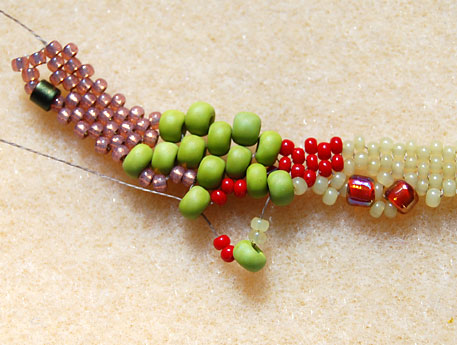
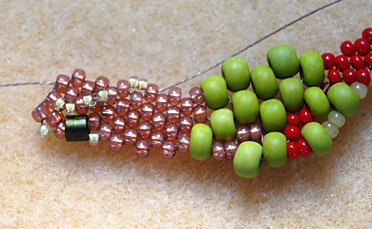
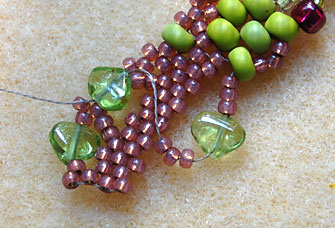
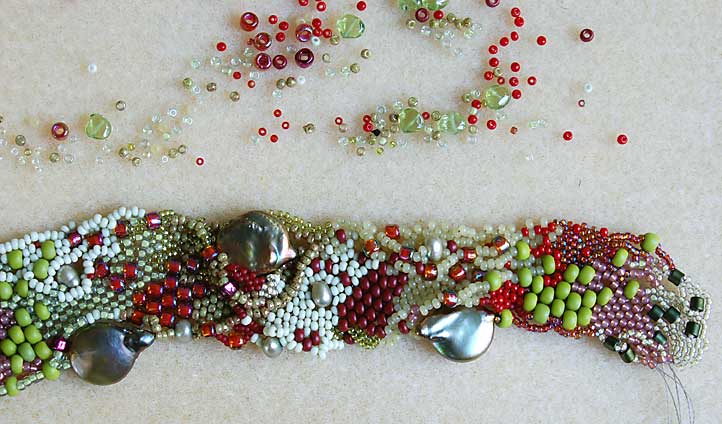
My bracelet is progressing, slowly but surely. Originally, I was going to add one coin shaped pearl but I loved their shape and color so much that I decided to add 3 of them. You can see how it doesn’t grow in an even way. Just like life where we will focus our attention to certain parts, my bracelet is growing more on one side than the other. As I go with the flow of the beads, I will feel a pull to work on one particular part and help that grow. Then I will notice the gaps in the other parts of the bracelet and move over to those places to seek balance.

As the bracelet grows, I am still working in peyote stitch here and there but find myself adding whole loops of beads to create bridges to other parts of the bracelet. As in life, flexibility is key as you listen to your inner voice to see what the next step should be.
I’ve been read a fascinating book called “The Kaizen Way: One Small Step can Change your Life” by Dr. Robert Maurer. Kaizen is a Japanese technique using small, steady steps to achieve lasting success with a goal. You can read more about it and Dr. Maurer here.

There is a part of our brain, located in the midbrain and called the amygdala, that is crucial to our survival because it controls the fight-or-flight response. This response is a natural alarm that alerts certain parts of our body for action in the face of immediate danger. When the alert happens, other parts of our body are slowed or shut down to allow all of our energy and resources to get us out of the danger. One nonessential (at the time) function that shuts down is our rational and creative thought processes. Even though most of us aren’t in situations where a dangerous animal is charging at us, this response is appropriate and vital in our lives today in emergency situations such as someone breaking into our house or reacting to a driver who has run a red light and threatens to hit our car. Where it can create a problem, however, is when we are faced with a new situation that is not part of our usual, safe day-to-day routine, such as the challenge of finding a new job or quitting a habit such as smoking or overeating. This situation can trigger fear and the fight-or-flight response can be triggered from our fear which will then shut down the thinking part of our brain. Big goals can trigger fear also. So, taking very small steps towards a big goal or new situation can bypass those fears. With each small step, new neural pathways are laid down in our brain and we build new habits, working towards our goals and a new situation in a comfortable way for us.

So, what does this Japanese technique have to do with creating a freeform bracelet, you ask? As I’ve read different comments from my readers about their experience with freeform peyote, I’ve heard that this kind of project might feel overwhelming, especially when it is such a free flowing creation. There really isn’t an exacting set of instructions regarding what to do. So, I suggest to fool that fear response and accomplish this creative task with teeny, tiny steps. Set aside 5 minutes a day to add a couple of beads at a time. Put a little sign next to your growing creation that says something like, “whatever I create is beautiful”. There is no right way or wrong way. Whatever you create is a beautiful expression of you, one tiny bead at a time.

The Birth of a Freeform Peyote Bracelet – Part 3

I’ve done some more work on my freeform bracelet and it’s slowly but surely getting wider. Because of the different size beads I’m using, it’s starting to lean to one side on the left end. This will work to my advantage, however, because I want to add a coin shaped freshwater pearl and was looking for the perfect place to put it.

It fits perfectly in this little spot right here. Once I add it, I’ll just bead around it with a loop of beads. This loop will eventually be incorporated into the rest of the bracelet as will the large pearl. In this way, you may add anything you’d like to your piece.

I’ve been adding pearls here and there. I also love to add “bridges”, a loop of beads that cross over from one side to the other. This gives the surface of the piece wonderful texture. You can choose to leave the loop as is or add some more beads to it on your next pass around.

At this stage, I will add the larger beads/objects and then assess which parts of the bracelet need to be built up more. You can leave the edges wavy and uneven or try and even them up before you finish the piece. Also keep in mind that if you add to the ends, it will increase the length of your bracelet, of course. I usually start with a 6 inch length so I can add to the ends without worrying about it getting too big. Another thing to keep in mind is what type of clasp you’d like to add. This will add length to the bracelet as well.

If anyone is being inspired to create their own piece, please let me know. I’d love to see photos!

The Birth of a Freeform Peyote Bracelet – Part 2

Here is what I’ve accomplished today. You can see how I am starting to place the beads in such a way so that the colors are drifting into each other. This will soften that striped look. Because I’m using various size beads, the bracelet starts to get a bit wavy but I can adjust that as I go along by where I place the beads and how many I place.

Sometime I place 2 same size beads at once to fill in a space.

To add a larger size 6 bead, I sandwich it between smaller size 11 beads and make a little bridge by skipping more than the usual one bead.

Or, instead of staying on one side of the bracelet, I can move to the other side by placing size 15 beads (the lighter ones) across the top.

I love to add pearls because they give a lustrous, organic look. Another little bridge. Play with the placement and see which beads work best. Follow your inner voice.

Sometimes bridges can go across to the other side. Those green chips are peridot. I found them at a bead show I went to last spring. The clarity is amazing.

A closeup of one side.

And the other side.

If you want a thinner bracelet, all that’s left to do is to add beads in such a way to even it out and then add a bead/button and loop clasp. The clasp is beaded in a freeform way so that it fits right in with the rest of the bracelet. Because I’m having such a wonderful time with this, I’ve decided to continue beading and make this bracelet wider. Stay tuned for more progress…

The Birth of a Freeform Peyote Bracelet – Part 1

When I woke up yesterday morning, I discovered that the power was off. That was strange because we hadn’t had any storms overnight nor was it terribly windy. I called the power company to be told that they were working on the wires up the street and the power would be restored by 10am. Ok, I guess I could wait for my cup of tea until then. I waited patiently, writing 3 pages of Morning Pages and doing a little reading in my current book, Happy for No Reason. 10am came and went and I called the power company again only to get their automated power outage line. Apparently, I wasn’t the only one who had called in. Without lights, there was no working in my studio so I brought some beadwork out on the deck where there was plentiful sunshine. The power came back on about 7:30 last night when I was out having dinner with a friend who I hadn’t seen in 3 years.

So, what did I do yesterday, you ask? Out there on my sunny deck, another freeform peyote bracelet was born.

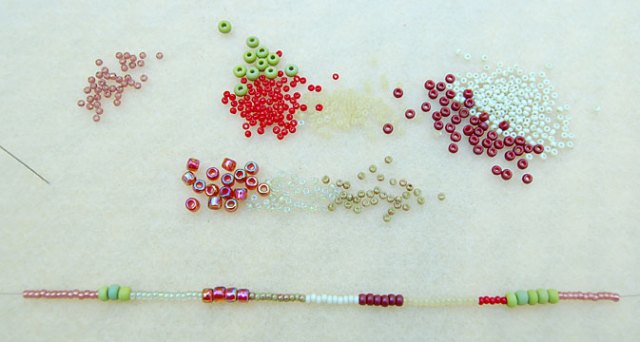
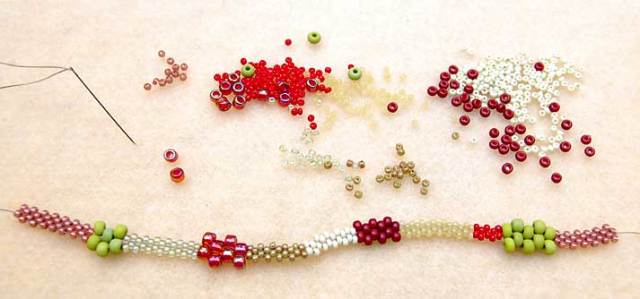
I chose 9 different beads in various sizes – 11s, 8s and 6s – and strung about 10-15 beads of each color for a total of 6 inches. I used 2 of the beads twice in my strand for a total of 11 sections. I always string an even number of beads on a neutral color Silamide thread. Silamide is a twisted 2-ply prewaxed thread that has been used by dressmakers for years. Here’s some great information about it. I’ve been using this thread for years now and I really like it. I used to always use Nymo but it tangled too much on me even when I waxed it. I think that the best thread to use is whatever you feel comfortable with and works well for you. Before I added all of my beads, I added one bead, leaving a 6 inch tail, and looped the thread around to go through that bead again. This creates what is called a “stop” bead which prevents the beads from falling off your thread.

In peyote stitch, I added the second row of beads, stopping to tighten every 3 beads or so. You can see how the sections are more accentuated now.

I then added a third row.

From now on I will start adding beads so that the bracelet doesn’t look so striped. I do this by drifting the colors into each other. In my next installment, I’ll show how I do this.

I absolutely love this way of beading. You don’t have to follow a pattern, only a technique and even then, you will be improvising on the technique here and there. Every freeform piece you create is totally unique and expresses your voice, what you were experiencing, thinking of and feeling in the moment. What colors shall I use? Shall I put this color next to that color? What size beads? The more sizes you use, the more textural and wavy your piece will become. It’s a wonderful way to experiment with different beads. There isn’t a right way or wrong way to do it. Just get in the flow and add one or two beads at a time and see where the beads lead you.

A freeform peyote bracelet – the color palette

I’m going to create another freeform peyote bracelet and have picked out my color palette. Some of these beads were used in my faux jade fringy bracelet. I have been very drawn to this muted red/green palette for awhile now.

I thought it would be fun to document my creative process here, step by step. I’ve had this idea in my head for months now and am excited that my life has now slowed down enough to be able to finally do this. Of course, I am still working on my beaded journal page and beaded cabochons, too. Having several projects going at once keeps me motivated and fresh in my process. With each project, I always get to a certain point where it needs to be put down for awhile so the next step can be worked out internally. That’s when I turn to one of my other projects.

Stay tuned for “The Birth of a Freeform Peyote Bracelet”.