Saturday Morning Tea

keemunmaofengimpdry032109

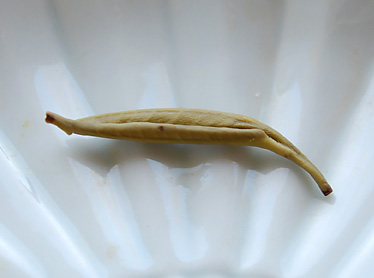
A shell cradling some tea leaves. Both once living, now both transformed. One is part of my nature collection and one will be further transformed into a delicious hot beverage to drink. Both give me great pleasure.

Change. It is woven into the fabric of our lives and is a constant by which we can guide our lives. Some do not like change. Or, I should say, too much change all at once. I’m raising my hand on that one. However, it is the change in our lives that brings us to new and wonderful places.

Because the last year of my life has been filled with so much tremendous change, I’ve been thinking about that a lot lately. I’m sure that there a lot of folks experiencing the same in their lives. I find that when I embrace the change that it flows so much easier. Embracing it means that we have to move beyond our fears and that is sometimes a hard thing to do.

So, this morning I sip my tea and think about these things.

keemunmaofengimpwet032109

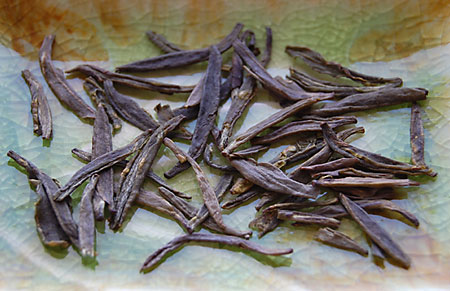
My work colleague (thanks Dan!) gifted me with a sample of a brand new Keemun called Mao Feng Imperial. I’ve reviewed Keemun tea before and you can read more about it here. The leaf style is called Mao Feng which means “Fur Peak” or “Hairy Mountain”, referring to the downy white hairs on the leaf when it is plucked and also to the location where it is grown and harvested. During its processing, the full leaf is rolled into long, thin strands, characteristic of this style of tea.

keemunmaofengimpsteep032109

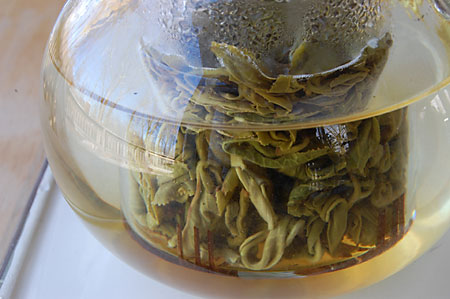
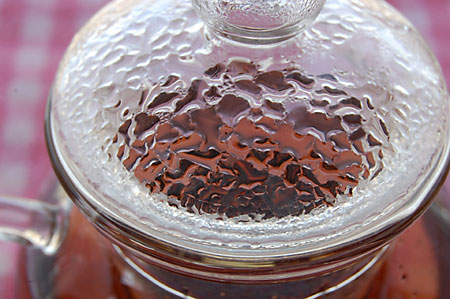
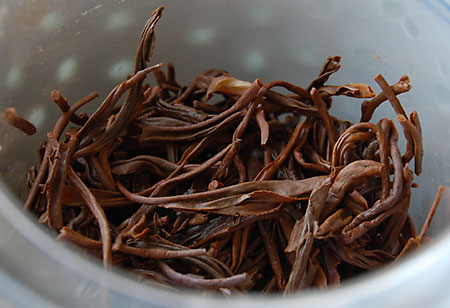
I steeped the leaves for 5 minutes in 212 degree F water. The tea liquor is a beautiful deep russet color with a sweet, dark aroma. The steeping leaves reveal a reflection of the deep blue spring sky today.
keemunmaofengimpwet2032109

You can see how the leaf uncurls slightly after steeping.

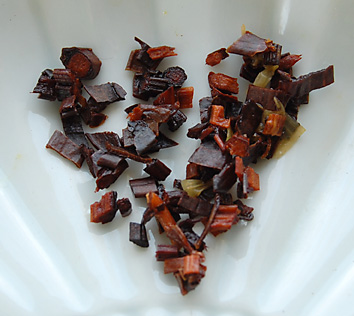
The flavor is silky smooth with a lot of complexity, meaning many layers of flavor. I taste wine, fruit, smoke, chocolate, earth. Keemun is called the “burgundy” of teas. Sometimes when a customer is looking for a new black tea to try, I ask them if they enjoy a full-bodied red wine. If so, I think that they would love a Keemun.

keemunmaofengimpbowl032109

I am going to spend this first full spring weekend out in nature and enjoying the company of some dear friends, embracing the change of the season.

Open your arms to change, but don’t let go of your values.

~H.H. the Dalia Lama
Saturday Morning Tea

tippygunpowederdry031409

Looking out on a brilliant blue sky, I carefully measure my tea leaves into my glass teapot. This morning’s tea is one that I haven’t reviewed before, China Gunpowder green tea. I have never been fond of gunpowder tea because I find that it has a tobacco-ey smoke flavor note. As a reformed smoker, I shy away from anything that reminds me of those days, especially smells and tastes.

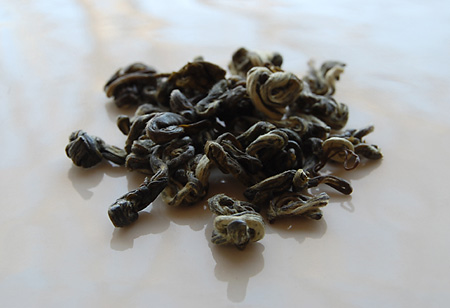
I find this tea, called Tippy Gunpowder Imperial, to be an exception in that there is none of that smoky quality to it. The leaves have been withered, heated and then rolled and shaped into the distinctive gunpowder “pellets”. These tea leaves have a looser shape, however, reminding me of the Yunnan Spiral Buds I reviewed 3 weeks ago.

tippygunpowderwet031409

Steeping the leaves for 3 minutes in 180 degree F water reveals the fine plucking and tips. Wow, that is the intact end of the stem. Beautiful! You can see the tip, the new growth, in the middle between the 2 larger leaves.

tippygunpowedersteep031409

I found this great tea processing flow chart on Wikipedia. I’m a visual learner so it helps for me to visually see the steps taken to create the different kinds of tea.

tippygunpowderteapot031409

The processing of green tea leaves into gunpowder style tea dates back to the Chinese Tang Dynasty (618–907). It was originally done to expose the leaf to less physical damage and to retain more flavor and aroma. The name comes from the resemblance of the rolled leaf to gunpowder pellets.

tippygunpowderteabowl031409

As I sip my tea from one of my favorite pottery bowls, I am greeted by a fresh, clean aroma which reminds me of the fresh air smell after a spring shower has passed. The flavor is also fresh and vegetal but not overly so, with a distinct astringent finish that lingers in my mouth for awhile. This tea has a robustness about it that I find very appealing.

It’s time to go make another pot of tea and go play in my studio! Enjoy the unfolding beauty of your world this weekend.

The breeze at dawn has secrets to tell you.

Don’t go back to sleep.

You must ask for what you really want.

Don’t go back to sleep.

People are going back and forth across the doorsill

where the two worlds touch.

The door is round and open.

Don’t go back to sleep.

~Rumi

Saturday Morning Tea

honeybushvandry030709

This past week was my first week back to full-time work. I keep telling myself that this is a good thing, giving me the ability to work towards my dream of owning my own home. Still, there has been some sadness associated with things I’ve had to let go of. Time for my art, especially.

As I prepared for my morning tea today I realized that I haven’t had many reviews about herbal tea. Or infusions, I should say, because herbals are not really tea. I apologize to any caffeine sensitive readers who are interested in exploring herbal options. I will strive to be more balanced in my tea choices and if there’s anything – tea or herbal – that you want to hear more about, please do let me know.

honeybushvanwet030709

This morning I am enjoying a cup of Honeybush Vanilla, a delightful herbal with Bourbon vanilla pieces and dried marigold petals. Mountain Honeybush, Cyclopia intermedia, is a bush that grows wild on the slopes of the Kouga mountains in South Africa. The leaves of this bush are harvested and processed much like the tea plant, camellia sinensis. It gets its name from the scent of its flowers.

Can you imagine wandering through a field of blooming honeybush and experiencing that sweet scent filling the air?

honeybushvansteep030709

This herbal is very smooth so you can steep the leaves for awhile without worrying about it turning bitter like oversteeped tea. I boiled my water and let it cool a short while before steeping the honeybush for 8-10 minutes.

The aroma is of sweet vanilla without being cloying or overpowering. The beautiful pink amber infusion tastes smooth and sweet with fruit and flower underlying the vanilla taste.

honeybushvanteacup030709

I have filled this beautiful china cup, a gift from a dear friend who knows how much I love new tea “equipage”.

Every week I usually stop by the library to pick up books that I have put on my online queue. However, this week drew me back to my own bookshelf to a book I had picked up about 3 years ago at the bookstore. I remember reading it at that time and enjoying it but this time I can feel each word penetrating my psyche on a deeper level.  Perhaps it is because of all of the changes I’ve experienced this past year and also the ones I am facing in the year to come. Called “The Courage to be Yourself” by Sue Patton Thoele, it is about finding an expanded vision of yourself and getting in touch with any self limiting fears that can get in the way of that expansion. Sue’s writing style is wonderfully down to earth and I feel like we’re sitting down in a cozy place having a cup of tea together while she shares the wisdom of her own personal journey.

She has 2 affirmations that she lives by.

I choose to live my life fully.

I will never give myself away again.

A truly wonderful book. Have a marvelous week.

Your joy is your sorrow unmasked

And the selfsame well from which your laughter rises was

oftentimes filled with your tears

And how else can it be?

The deeper that sorrow carves into your being,

The more joy you can contain.

~Kahil Gibran

Saturday Morning Tea

sparrowstonguedry022809

Wow, we made it through the month of February! Time is marching on and we are poised to enter the month when Spring officially starts. Hoo-ray!

There are already small signs of Spring’s imminent arrival.

It’s light out when I rise at 6am every morning.

Where there was once a hushed silence there is now birdsong here and there.

When I go outside, the air feels softer, milder.

Yesterday I saw the tip of a hyacinth gently nudging its way up through the earth.

People are smiling more…

This morning’s tea is a China green called Sparrow’s Tongue Lung Ching. Grown in Zhejiang province, its name comes from its resemblance to bird beaks.

sparrowstonguewet2022809

This little beak is closed for the moment. The leaf is a fine plucking of the first 2 leaves and a bud at the tip of each tea bush stem, the new tender growth. It is minimally processed so the leaf retains its original appearance. It looks freshly plucked, a beautiful spring green.

sparrowstonguewet1022809

Lung Ching tea is a popular green tea from China. You can read more about it in one of my previous posts here.

sparrowstonguesteep022809

I steeped the leaves for 3 minutes in 180 degree F water. The aroma is very clean, fresh and light. The tea liquor is a pale muted yellow with a smooth vegetal taste. There’s something about this tea that is very calming.

sparrowstongueteabowl022809

Can you see the whisper of steam rising from my teabowl? I love its speckled glazing. It reminds me of the speckling on a birds egg.

As I gently sip my tea, I listen to a CD called “Silk and Bamboo”, an ensemble by harpist Patricia Spero and flautist Tim Wheater. Here is the description from the CD cover:

“Silk and Bamboo brings together the meditative sounds of the traditional silk strings of the Chinese Harp or Cheng and the wonderful sounds of bamboo and wooden flutes.”

The achingly beautiful sounds of the harp and flute weaving their magic together is lovely to listen to while sipping this gentle green tea.

A moment of serenity after a busy week…

Saturday Morning Tea

yellowteadry111508

On this rainy, misty morning, I am sipping the rarest variety of all teas, a yellow tea. Called Jun Shan Yin Zhen, its name translates to “Silver Needles of Jun Shan Mountain”. Jun Shan is actually an island located in Dong Ting lake in China’s Hunan province. The climate and soil on this small island, along with the special processing of the tea, create a unique aroma and flavor.

guywan111508For steeping the yellow tea leaves, I chose my gaiwan, a lidded teabowl popular for enjoying the delicate aroma and taste of white, green and yellow teas. After steeping, the leaves are left in the bowl and the lid is used for sweeping them out of the way for ease of sipping.

yellowteasteeping111508I like the wide opening of this little bowl so I can watch the leaves as they infuse. I used 165 degree F water and steeped for 3 minutes. The aroma is delicate and soft with wisps of fruitiness. The taste is sweet and smooth with a hint of fruit.

The flavor is closer to a white tea than a green tea because there isn’t any vegetal quality to it.

yellowteawet111508The leaves are plucked in the early spring. To stop oxidation, they are quickly fried in small batches and then wrapped in a very thin old yellow paper while still moist. They dry naturally for several hours and then this process is repeated several times. This way of processing the tea leaves was first developed during the Tang dynasty, over 1300 years ago. Because this tea is created by such a tedious hand process, only small lots are made. I am honored to experience such a rare treat, created so artistically. The liquor lives up to its name with its delicate golden color.

yellowteabowl111508This morning I was tagged by Autumn to list 8 random things about myself. Since I’ve done this a couple of times already, I direct you to these posts if you’d like to read random things about me, here and here.

Next Saturday I will be displaying and selling my jewelry at the 14th annual Arts and Crafts show at the Middlesex Community College in Bedford, MA, from 10am-4pm. If you happen to be in the area, I’d love for you to stop by and say hello. As I’ll be leaving for the show that day before the sun comes up, my tea review will be postponed to the following day, next Sunday.