Saturday Morning Tea

This morning I am enjoying a very unique Japanese green tea with 3 distinct components, a sencha green tea, a matcha green tea and puffed brown rice.

I introduce you to Matcha Gen-Mai Cha, the 4th tea in my Japanese tea series.

Even though Japan is now an industrialized nation with its bustling, crowded cities, underneath this is a culture based on Zen practices devoted to moments of simplicity and beauty as captured in the tea ceremony, or Chanoyu. Matcha, or powdered, tea is the tea that is traditionally used in this ceremony.

In this tea, the Matcha is dusted over the sencha leaf and the puffed brown rice. The addition of toasted, puffed brown rice to green tea is a popular beverage enjoyed in Japan. Gen-Mai Cha translates to brown rice tea.

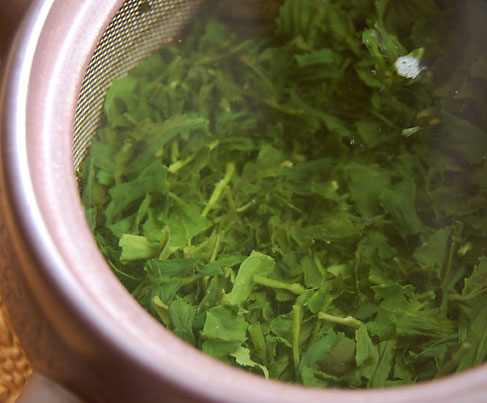
This tea leaf looks like cooked greens with rice krispies added to it.

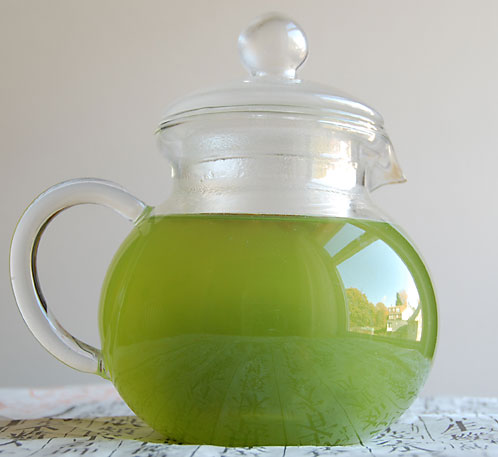
The liquor color is like none other I’ve ever seen in steeped tea. To be honest, it reminds me of the Gatorade drinks my kids used to drink after sports. The Matcha powder makes the tea more opaque.

With 80% of Japan’s 4 major islands being mountainous, efficiency is key in utilizing every piece of land available for tea cultivation. In contrast to China’s isolated mountain tea gardens, Japanese tea gardens are arranged in orderly, well manicured rows on gently rolling hillsides, close to rivers and streams to provide moisture for the tea bushes.
Except for very special, extremely expensive tea, most tea in Japan is harvested with shearing machines, either handheld by 2 workers on either side of the tea row or by a large volume machine which fits perfectly between rows set apart to accommodate the machine. The machines can yield 200-300 lbs. of tea per day as opposed to the 20-30 lbs. hand plucked.

The predominant aroma and flavor of this tea is of toasty rice. The vegetal quality of the tea comes through in wisps along with a lovely sweetness.

So warming. Mmmm…

This weekend my family is visiting from Michigan. It’s the perfect time of year to visit southern New England. The fall colors are at their peak – golds, russets, flaming orange and deep burgundy. I just love this colorful time of year!

Have a lovely weekend, dear tea friends.

“Call it a clan, call it a network, call it a tribe, call it a family.  Whatever you call it, whoever you are, you need one.”

~Jane Howard

Saturday Morning Tea

Produced in the spring from the first plucking of the tea bush, Gyokuro is Japan’s most treasured tea.

On this blustery fall morning, I watch the leaves dance and twirl outside my window as I sip from a cup of Gyokuro Kenjyo tea. Kenjyo translates to “present to noble man”.

What distinguishes a Gyokuro tea from other Japanese green teas is that as soon as the bushes start to flush with new growth, they are shaded. The first shading method, called tana, is when a black netting is thrown over trellises that have been built up around the rows of tea bushes. The second method, called jikagise, is when each bush is individually wrapped in cloth.

The bushes will grow in the shade for approximately 3 weeks.  The shading increases the chlorophyll production which in turn affects the balance of caffeine, flavanols and sugar in the leaf.  The absence of photosynthesis also increases the theanine component in the leaf.  Theanine is an amino acid that gives tea its vegetal taste.  With the increase of theanine, Gyokuro tea is quite vegetal.

I steeped my Gyokuro Kenjyo for 3 minutes in 170 degree F water. Look at that brilliant green leaf. It reminds me of cooked spinach.

The aroma is of spring asparagus, very vegetal.

As I take my first sip, a rich sweetness fills my mouth, not at all what I was expecting after smelling the aroma. The vegetal flavor is definitely there but the sweetness smooths all its pungent edges. So sweet!

Because there is only a small amount of tea styles grown in Japan, most tea is blended and sold without any tea farm or garden designation. The tea is sold as the brand of a tea shop or tea company.

Yearly competitions are held to seek the best Gyokuro producer. The hard work and intricate care that goes into producing this amazing tea makes it truly an art form.

“Making art is a rite of initiation.  People change their souls.”

~Julia Cameron, Writer

Saturday Morning Tea

After a damp, cool week, today dawned bright and clear and dry. A perfect weekend to be outside, soaking in the brilliant colors of autumn.

In the second week of my series on Japanese tea culture, today’s tea is a Japanese green tea called Fukamushi Cha, meaning “deep steamed tea”.

Almost all Japanese green tea is steamed for 30-45 seconds in the first step of processing. This halts oxidation of the leaf and sets the distinctive, brilliant green color of the Japanese green tea leaf as well as giving it its pronounced vegetal flavor.

Fukamushi Cha undergoes a deeper, or longer steaming time.

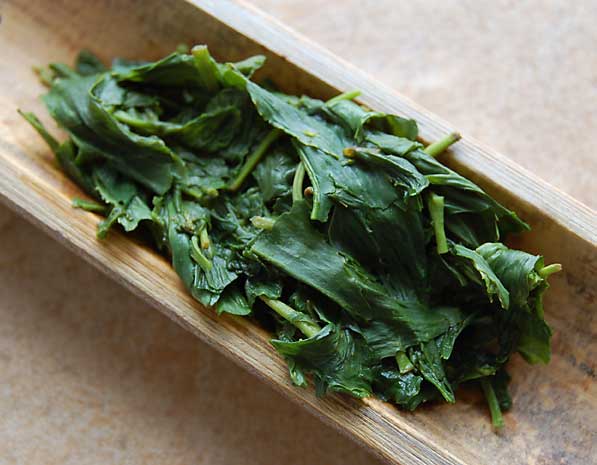
Just look at that gorgeous green leaf.

Tea drinking in Japan can be traced back to the 8th century when the Emperor Kammu dispatched several diplomatic missions to China to learn about and better understand their culture.

As in China, tea drinking was only practiced in Japan among monks, the nobility and the imperial court for many years.

It wasn’t until the 12th century when Myoan Esai, a Japanese Buddhist priest, encouraged all Japanese citizens to drink tea for their health, writing the first Japanese book on tea entitled Kissa Yojoki which translates to “Tea Drinking Good for the Health”.

I steeped my Fukamushi Cha for 3 minutes in a lower temperature water, 160 degrees F. The aroma is feather light and vegetal.

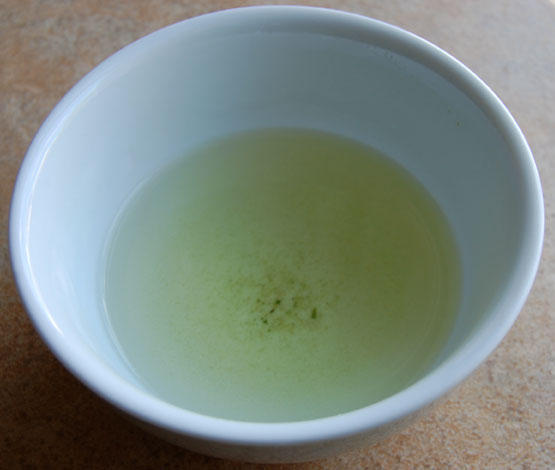
The pale spring-green tea liquor is very sweet with a light pungency which refreshes my palate. A pronounced vegetal flavor embraces the sweetness.

Over time, tea became elevated to a fine art in Japan, culminating with the development of the Japanese tea ceremony known as Chanoyu. I had the privilege of attending a tea ceremony 3 years ago and wrote about it here.

This weekend will be a fall cleaning, staying at home kind of weekend for me. Perhaps I’ll even find some time to spend in my studio!

Please join me next week when I will be sharing my review of a Japanese gyokuro tea.

“Make a delicious bowl of tea; lay the charcoal so that it heats the water; arrange the flowers as they are in the field; in summer suggest coolness, in winter, warmth; do everything ahead of time; prepare for rain; and give those with whom you find yourself every consideration.”

~Sen Rikyu, Zen tea master (1522-1591)

Saturday Morning Tea

Even though we are on the cusp of autumn and the temps are dropping rapidly here in New England, especially at night, I’m still in the mood for a light tea.

I introduce you to Huangshan Mao Feng Supreme, a beautiful, spring harvest Chinese green tea. Perhaps springtime in a cup can banish away the gloominess I feel on this dark, cloudy day.

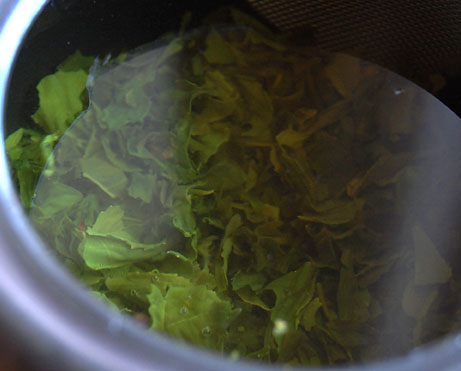
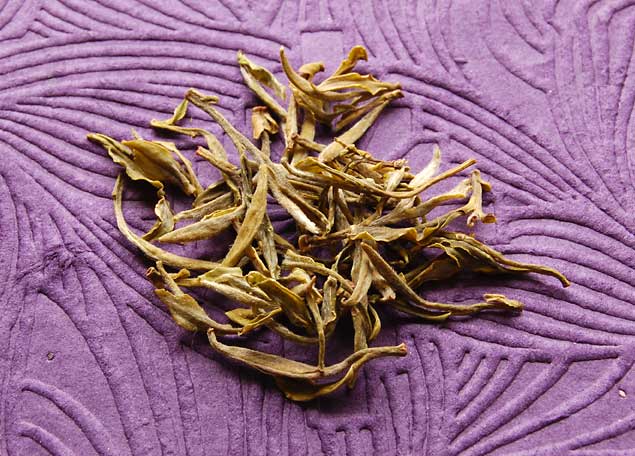
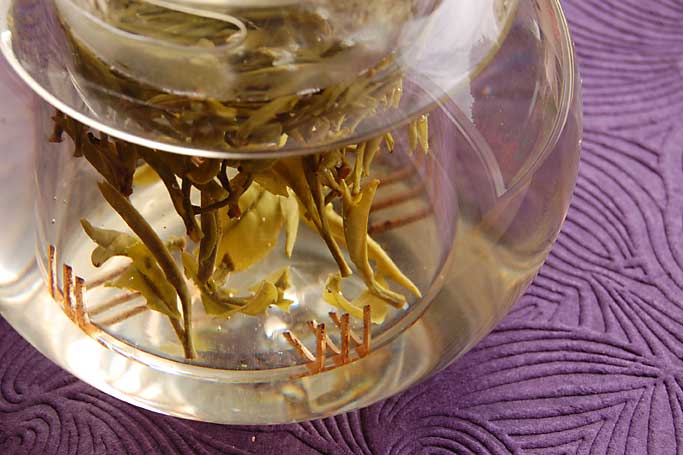
The leaf is from a very fine plucking and careful processing resulting in an amazingly intact leaf set. I loved watching the leaves dance in my glass teapot as they infused.

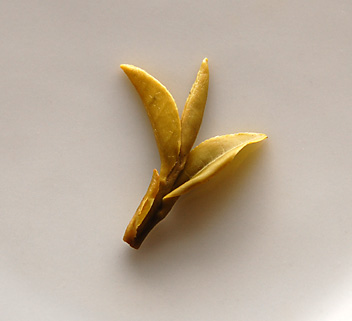
Just the tips, the very new growth, are plucked to create this special tea.

I have read that Huangshan is another name for Mount Huang, located in the Anhui province of China. It’s a place of  granite peaks, hot springs and beautiful sunsets and sunrises. An optical phenomenon known as Buddha’s Light occurs a couple times a month there with the sunrise. Sounds like an amazing place.

This tea is quite pale in color with a vegetal whisper in the aroma.

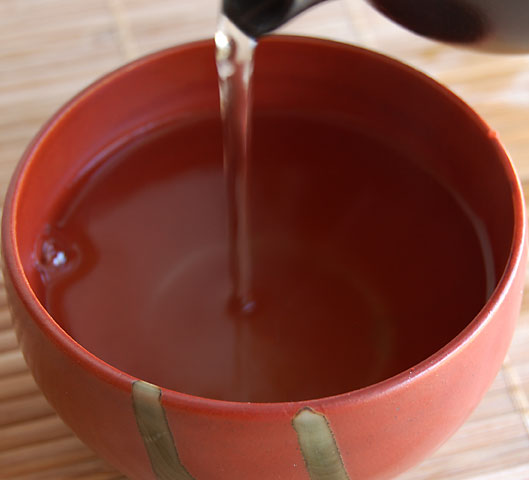
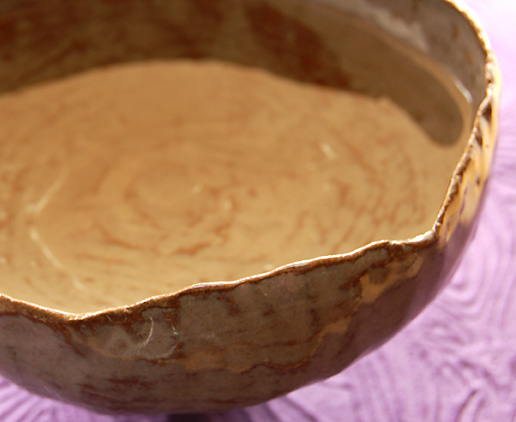
I chose this particular teabowl because the pale liquor allows me to see the beautiful texture inside the bowl. The flavor is light yet fills my mouth with its soft, fruity sweetness. Mmmm….

As I sip my tea, I watch the gray blanket of sky and contemplate the seasonal changes to come. My cup of springtime seems to hold back the thickening clouds as it releases the scent of new growth with every sip.

“Perhaps everything that frightens us is, in its deepest essence, something helpless that wants our love.” ~Rainer Maria Rilke

Saturday Morning Tea

I was up quite early today for a Saturday. The day dawned bright and clear and as I sipped my tea, I thought of that fateful day 9 years ago. Another beautiful, clear September morning that turned dark and sad as the events of the day unfolded.

I raise my teacup and dedicate my thoughts today in memory of all those lives lost that day…

I’m sipping a China green tea called Jade Cloud Mist. Harvested in the spring in An Hui province, the leaf is exquisite.

The leaf is a very fine plucking of the new growth found at the tips of the tea plant stems.

Simply gorgeous.

I steeped the leaves for 3 minutes in 180 degree F water. A pronounced vegetal aroma wafted up from my glass teapot as I poured my first cup.

Even though the tea liquor is a very pale sage green, the mouth feel is very full and buttery smooth with light notes of asparagus.

A sweetness lingers with every sip.

So pale, so light, yet so very flavorful. A real treat for those who cherish their green tea.

Today I am journeying down to the coast of Rhode Island for a gathering of artist friends. Fabulous food, wonderful conversation, creative energy…the perfect day…

“…to go into yourself and see how deep the place is from which your life flows…….perhaps you will discover that you are called to be an artist….” ~Rainer Maria Rilke