Studio Wednesday

Today I worked on and finished the beadwork on my faux jade charms fringy bracelet. I’ve ordered some brass and silver Chinese coin charms from Fire Mountain Gems and they should be arriving sometime this week. I want to make a clasp with one of the coins.

The fabric is a painted and stamped piece from an Art Day with friends in June. I really enjoyed transforming a white piece of muslin into colorful fabric.

Using Aleene’s Jewel-it, I glued some polymer clay pieces onto Pellon Peltex 70, an extra firm stabilizer I purchased at Joann Fabric’s. I’m hoping it’s not too stiff for the beadwork I’ll be adding around the pieces. I’ll also probably tone down the white color with some fabric paint. Has anyone ever used this for beadwork?

This first piece was created from a cane I made a long time ago at one of my guild meetings. My friend, Judy, showed us how to make this cane. I think it’s a variation of this scrap feather cane. I didn’t reduce the cane and stretched a slice over some scrap clay to make what looks to me like a cocoon. When I bead around it, I want to enhance its organic feel. It will probably turn into a pendant.

This polymer clay cabochon was created from the mokume gane stack I used to make these earrings. Another pendant, perhaps for a free-form necklace.

More pieces from that mokume gane stack. These will be made into earrings.

Saturday Morning Tea

The air is completely still this morning with hardly a whisper of a breeze. Temperatures are supposed to soar well into the 90s this weekend with the humidity level just as high. It’s a good day to be inside with the AC or next to a fan, relaxing with a good book and a cup of tea.

This morning’s tea is a unique white Assam from the Mothola estate. Usually when one thinks of an Assam tea, it is of a hearty, rich black tea. That is what most Assam teas are. This tea, however, is a unique production, entirely handcrafted which shows in the gorgeous full leaf covered in tiny white hairs.

The tea plant is called camellia sinensis, named by the father of modern taxonomy, Carl Linneaus, a Swedish botanist from the 1700s. There are several different variations of the tea plant. Assam teas, grown in the lowland district of Assam in northeastern India, are harvested from the Camellia Sinensis assamica variation. I have read that this particular variation has a higher caffeine level than the Camellia Sinensis sinensis or Chinese varietal. Perhaps this is why many folks enjoy Assams for breakfast . The name Sinensis actually means Chinese in Latin.

I know that it is such an artist cliche to say “I love color” but I truly, truly do, ever since I was very young. In fact, my favorite childhood book called “The Color Kittens” by Margaret Wise Brown, was all about colors and mixing them to create other colors. The words and images of this book filled my little person world well before I learned to read. From that time on, color spoke directly to my soul on a very deep level. I talk about that here. Anyway, I was captivated by the color of the liquor of this tea. A gorgeous dark honey, its aroma is sweet and malty. The flavor is also sweet and light but full of flavor that fills your mouth with a hint of nuttiness.

This is definitely one of my favorite teas!

Studio Wednesday

Every Wednesday I work at home in my studio. As I only have one day a week in my studio, one of my goals is to be more disciplined with my time so I can get the most amount of work done in the time I have. The first step towards this goal is to create a task list for myself on what I’d like to accomplish in the studio that day. I’ll make my task list up every Tuesday night. Another step in my goal process is to establish a weekly blog post entitled “Studio Wednesday” where I will share what I’ve been creating in my studio lately. A big thank you to my friend Amy who has been a big inspiration to me in setting this goal for myself.

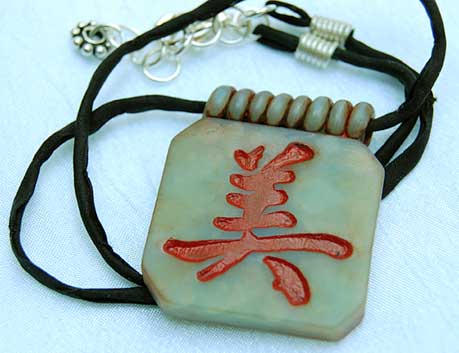
The photos are of some of the jewelry I created with the faux jade polymer clay I found in my studio when I was cleaning. The pendant above contains the Kanji character for “Beauty”. This was the word I chose for 2008.

Today I worked on my fringy bracelet and completed the first pass. On the second pass, I might add a couple more beads here and there but it will mainly be about reinforcing all of the heavier beads in the bracelet.

I also discovered that the sterling silver wires that I had super glued in the mokume gane polymer clay earring components weren’t staying put. When I opened the loop to add the earwires on some of them, the wire started to move. So, after some internet research to find out what type of glue would work better, I went up to Lowe’s and found an epoxy that works well on plastic which is basically what polymer clay is, namely polyvinyl chloride or PVC. Fine particles of PVC are suspended in a liquid plasticizer to create polymer clay. The epoxy has 2 separate tubes that are set side by side with a plunger that dispenses equal amounts of material for mixing. It is the mixing of these 2 materials that creates the strong bond. You can read more about how it works here. It will be fully cured in 24 hours so, hopefully, this will work to keep the wire in place in the polymer clay.

My Weekend Project

A couple of weeks ago, I was organizing my polymer clay stuff in my studio when I found a bag of faux jade I had mixed up years ago at one of my guild meetings. So, I got out my rubber stamps and paint and had some fun making beads and charms for jewelry. I was playing around with different combinations when I decided to create a fringy bracelet with some of the bead charms I had made. I love fringy bracelets and have been making them for years. As I find myself moving into a more improv, freeform style with my jewelry, this type of bracelet fits perfectly with my interests and taste.

Going with the ancient look of the faux jade charms, I chose some matte/opaque disc shaped beads: African opal, coral, palmwood along with jade and turquoise heishe and rectangle fossilized coral beads. The fossilized beads are great. Some have starburst patterns and others look like they’re covered in ancient script in various color combinations of oranges, ambers and tan.

The design possibilities of these bracelets are endless. I have so much fun creating them that I’ve often thought of offering to make custom fringy bracelets with a person’s favorite charms, beads and ephemera.

My workstation won’t be this neat by the end of my project. As I beaded, I thought about a clasp. A Chinese coin toggle clasp would be perfect to finish this bracelet. If I can’t find one, I’ll make one then. Hmmm, I’ve been meaning to use that package of PMC…

Mokume Gane Earrings

I know, I know. I should be packing and getting ready for my trip. I decided to take a break and do something creative so I finished these earrings. Now I can bring them with me on my trip.

A couple of weeks ago I created a polymer clay mokume gane stack and started playing around with different shapes for jewelry components. Today I glued in some wires, fashioned some earring hooks from 20-gauge S.S. wire and these earrings were born.

I’m experimenting with weaving seed beads around polymer clay components. I especially like the freeform designs of mokume gane to go with freeform beadwork. My most successful color combinations have been when I’ve incorporated light, medium and dark colors. It’s fun looking around the house for various tools and objects to impress into the clay stack. Just mix your colors, create individual sheets, layer them to make a stack and then texture with your found objects. Using a tissue blade, slice from the top of the stack to reveal the patterns. I love watching the patterns emerge. You can make a “fabric” by laying the slices on a coordinating color sheet of clay. I like to take that sheet and run it through the pasta machine to stretch out the patterns so they swirl and dance around.

Ok, back to packing!