Saturday Morning Tea

Huang Jin Gui Oolong Dry Leaf 11-23-13

Good morning, dear tea friends! Life has taken a busy turn lately, and it’s been challenging to find the time for my tea posts. I apologize for my absence last week! Ok, on to tea….

This morning’s cuppa is a Chinese Oolong from Anxi County in Fujian province. It’s called Huang Jin Gui Oolong. Huang Jin Gui translates to “Golden Osmanthus”, which refers to this tea’s intense floral aroma and flavor, as well as its rich gold color in the cup.
Huang Jin Gui Oolong Steeping 11-23-13

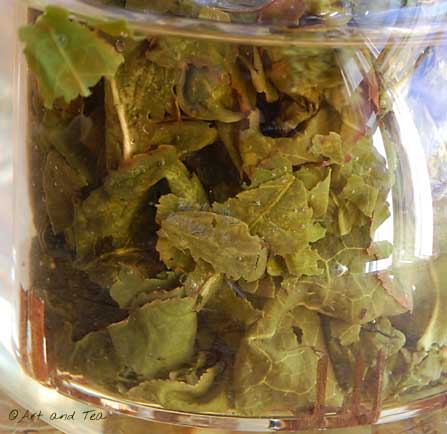
The leaves have been oxidized lightly (under 20%), like a Jade Oolong, and loosely rolled into roundish, crumply shapes.

I steeped for 4 and a half minutes, and the leaves unfurled and swelled open in the 190F water.

Huang Jin Gui Oolong Wet Leaf 11-23-13

Here is one of the accordion shaped leaves after steeping. Most of the leaves were huge and still intact.
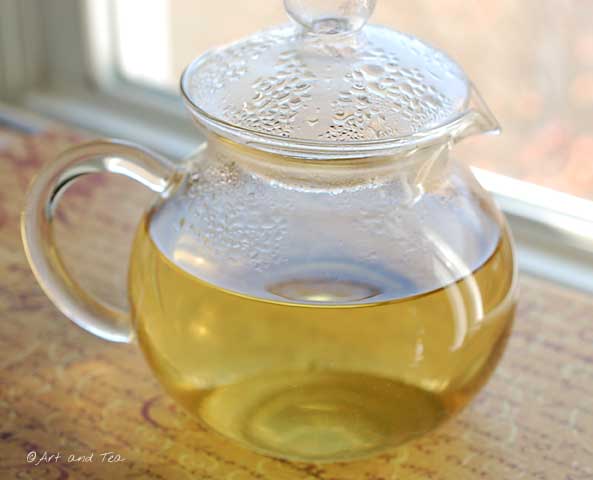
Huang Jin Gui Oolong Teapot 11-23-

The golden yellow tea liquor is quite fragrant, filling my kitchen with the scent of flowers. Mmmm….

Huang Jin Gui Oolong Tea Bowl 11-23-13

The smooth flavor is rich and buttery feeling on my tongue, with pronounced floral notes that linger well into the finish.

The last of the dried leaves are rattling like bones off the trees, and the wind blows colder as winter approaches near. This tea is perfect for lifting my spirits with the sweet scents of spring flowers.

Have a lovely week and a happy Thanksgiving!

“I am grateful for what I am and have. My thanksgiving is perpetual…O how I laugh when I think of my vague indefinite riches. No run on my bank can drain it, for my wealth is not possession but enjoyment.”

~Henry David Thoreau

Saturday Morning Tea

Noble Madam Dry Leaf 11-09-13

Good morning, dear tea friends! On this cool, brisk fall morning, I’m watching an unfolding taking place. The unfolding of tea leaves to reveal a lovely rose pink carnation. I love surprises, especially when flowers are involved! This artful display tea is called Noble Madam. Watch and enjoy!

Noble Madam Steep 1 11-09-13

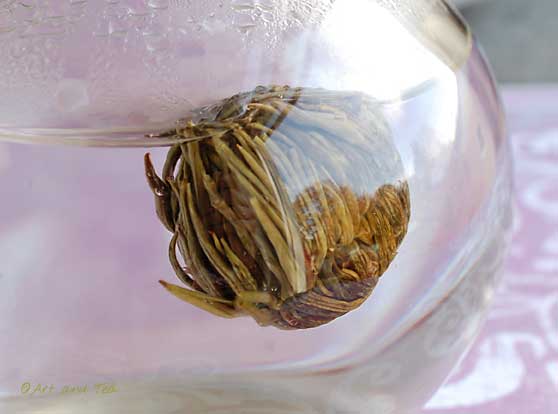
The green tea leaves are hand tied and compressed into a “pod” around the flower.

Noble Madam Steep 2 11-09-13

I’ve shared my delightful experiences with display teas here.

Noble Madam Steep 3 11-09-13

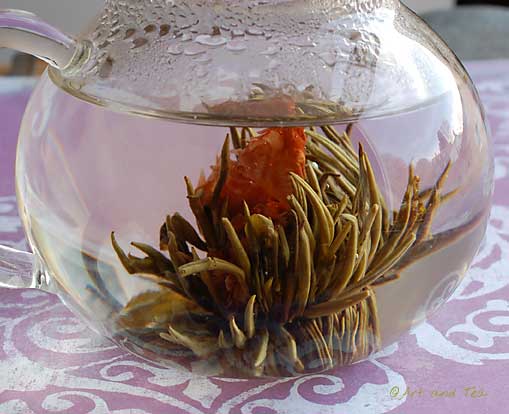
and here. As the 180F hot water soaks into the pod, the leaves open up oh so slowly…

Noble Madam Steep 4 11-09-13

Like a little sea creature gently reaching out…

Noble Madam Steep 5 11-09-13

and there is its heart.

Noble Madam Steep 6 11-09-13

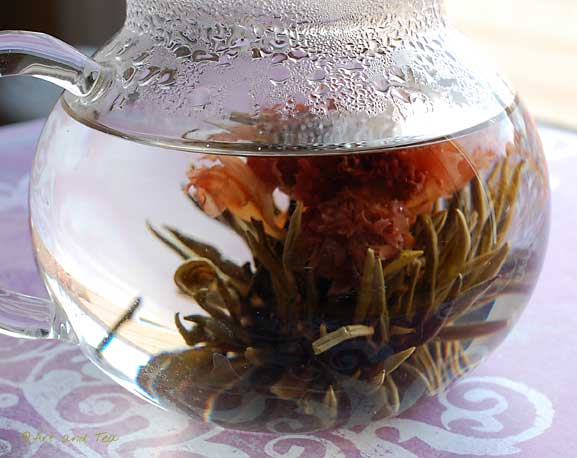
A beautiful rose pink carnation. Gorgeous!

Noble Madam Steep 7 11-09-13

I’ve read that hand tied teas have been created in China for hundreds of year, however, it’s only been in the last 30 years or so that the showier teas, such as this one, have been made.

Noble Madam Wet Leaf 11-09-13

This photo shows how they bundle the leaves and tie them.

Noble Madam Teapot 11-09-13

The carnation flower lends a rose tinge to the light colored tea liquor.

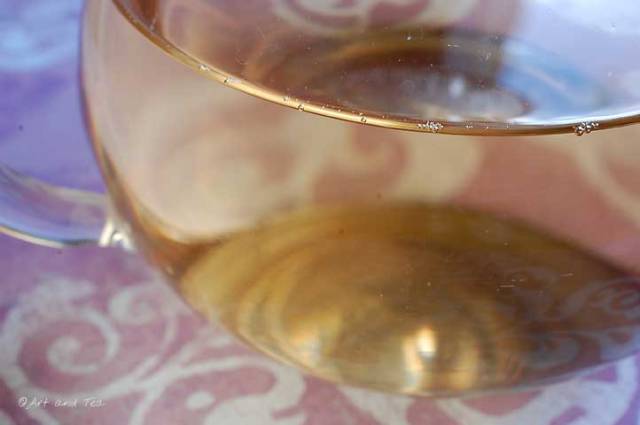
Noble Madam Teabowl 11-09-13

The flavor is light and vegetal with delicate floral notes. I think this would make a lovely gift, along with a glass teapot, to show off its steeping display.

My company has just received a big shipment of glass teapots – 5 different styles – and we’ll be introducing them shortly, just in time for holiday gift giving. Glass teapots are my favorite!

Have a wonderful week and enjoy your tea!

“And the day came when the risk to remain tight in a bud was more painful than the risk it took to blossom.”

~Anais Nin

Saturday Morning Tea

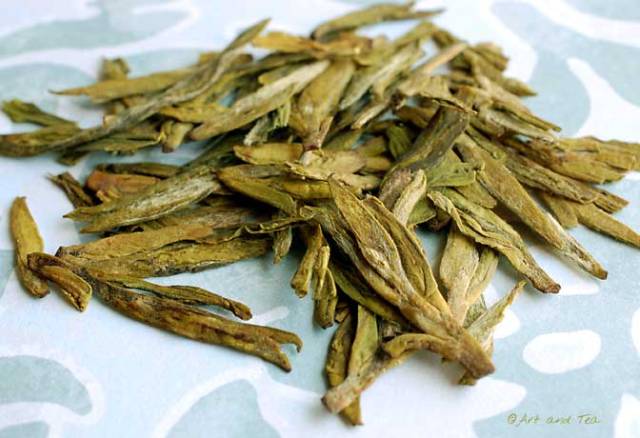
Long Jing Te Ji Dry Leaf 10-26-13

Good morning, dear tea friends! This morning’s tea is a well-known China green tea called Lung Jing, or Lung Ching, this particular lot called Lung Jing Te Ji. Te Ji means “superior grade.”

Long Jing Te Ji Steep 10-26-13

Lung Jing (Lung Ching, Long Jing) tea has a distinctive flat shape due to its unique processing. This flat shape is intentionally caused by the motion of the charcoal pan when the leaf is heated/fired to stop oxidation. Its name means “Dragon’s Well”, referring to the place where it has been traditionally grown. Legend has it that a Taoist priest in the 3rd century advised the local villagers to pray to the dragon of a local well to bring rain and end their drought. It worked and the well was named after that dragon. The Dragon’s Well monastery still stands in that spot to this day.

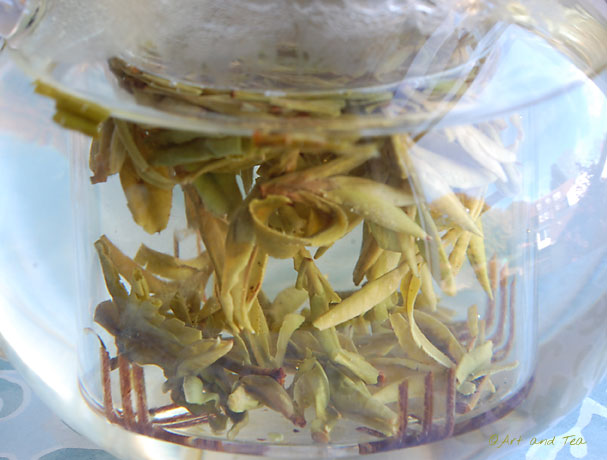
Long Jing Te Ji Wet Leaf 10-26-13

I steeped the leaf for 3 minutes in 180F water. After steeping, the leaf softened and revealed the beautiful, individual bud sets of this fine tea.

Long Jing Te Ji Teapot 10-26-13

The pale yellow-jade tea liquor has a nutty aroma with a light vegetal undertone. The flavor is clean and refreshing with notes of chestnut and sweet baby corn. The smoothness yields to a whisper of tang in the finish.

I could drink this lovely green tea all day.

Long Jing Te Ji Teabowl 10-26-13

I pulled out my Volmod Ceramics tea bowl to hold and honor this most excellent tea. I purchased it on a trip to Saugatuck, MI with my parents a couple of summers ago. So, not only do I get to enjoy a delicious tea this morning but in holding my tea bowl in my hands, I remembered some warm and wonderful memories.

Have a great week!

“Nothing is ever really lost to us as long as we remember it.”

~L.M. Montgomery

Saturday Morning Tea

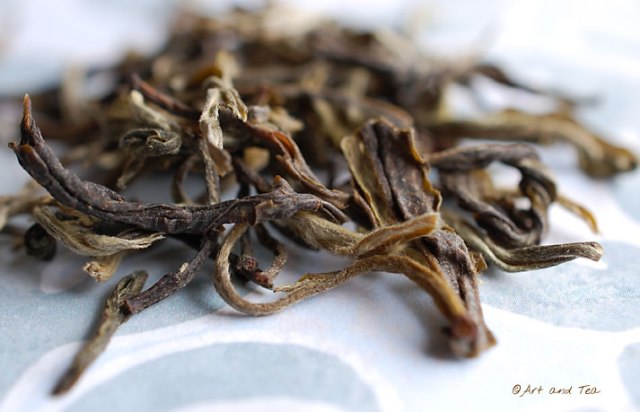
White Mao Feng Dry Leaf 10-12-13Good morning, dear tea friends! As I sip my tea and glance out my window, I spy a flock of pigeons wheeling around against a sky of pale gray clouds. The high dome of cloud cover filters and softens the light so the changing fall colors on the trees really pop in fiery tones of red, orange and yellow. I’m not sure where that pigeon flock live. I see them now and again congregating on my neighbor’s high pitched roof.

This morning’s tea is from the Hunan province of China, a white tea called Organic China Mao Feng White tea. My first experience with a Mao Feng (translates to Hairy Mountain, hairy referring to the downy white hairs on the leaf) leaf was with a green tea and then with a black tea. Traditionally, Mao Feng, which refers to the large leaf’s processing and shape, was always processed as a green tea but is now being produced in black and white tea as well.

White Mao Feng Steep 10-12-13 I steeped the leaf for 4 minutes in 180F water. Because of the enormous size, I used approximately 2-3 teaspoons per cup in my glass teapot. It’s challenging to measure out tea leaf this big with a spoon so I pinch it and estimate. A tea scale would come in very handy with this tea. It’s on my wish list!

White Mao Feng Wet Leaf 10-12-13This particular leaf is a great example of how it’s twisted during processing. The length of the leaf, its twisted shape and the downy white hairs all contribute to its unique Mao Feng designation.

White Mao Feng Teapot 10-12-13

The tea liquor is a light golden color with a wonderful fruity aroma. I detected honeydew melon notes with my first sip and, as I sipped some more, the flavor progressed with some delicate peachy notes. The pronounced fruity flavor lingers long into the finish.

White Mao Feng Teabowl 10-12-13

The tea is light enough to show the interesting cracks in one of my favorite handmade bowls.

With the cool, cloudy weather outside, it’s the perfect afternoon to curl up with a good story and a big pot of tea. Have a great week!

“You can never get a cup of tea large enough or a book long enough to suit me.”

~C.S. Lewis

Saturday Morning Tea

Keemun Xiang Luo Dry Leaf 09-07-13

Good morning, dear tea friends! Change is in the air. The winds have shifted, welcoming in September with dry, cool air. As I sit and sip my tea, I watch the summer curtains dance and flutter around my windows.

I’ve chosen a dark, rich tea this morning, a China black tea called Keemun Xiang Luo, which translates to “fragrant snail”. The leaves are rolled and curled during processing, similar to the green tea called Pi Lo Chun, to resemble spiral snail shapes.

Keemun Xiang Luo Steep 09-07-13

I steeped the dark, glossy leaf for 5 minutes in boiling point (212F) water.

Keemun tea is named after a county, Qimen, in Anhui province. There are several stories about its origins but the most common is one of a governmental official in the late 1800s who learned about black tea production in Fujian province and then decided to return to his native county, Qimen, to produce black tea there. He met with success and his new black tea was imported to England where it was enjoyed as a breakfast tea.

Keemun Xiang Luo Wet Leaf 09-07-13

As you can see, some of the leaf opened their accordion pleats during steeping and some stayed rolled. I detected a maltiness in the aroma as the leaves steeped, which dissipated after the tea cooled to reveal a hint of red wine and a toasty note.

Keemun Xiang Luo Teapot 09-07-13

The tea liquor gleams like dark honey in my glass teapot. The flavor is thick and rich with notes of dark cocoa, which linger in my mouth.

Keemun Xiang Luo Teabowl 09-07-13

This would be a great tea to take along to an outside fall activity, like a long walk through the woods or a football game. It’s very warming.

I’d like to wish my very dear Mom a happy birthday today. Happy Birthday, Mom!

Have a wonderful week and enjoy your tea!

“And the beauty of a woman, with passing years only grows!”

~Audrey Hepburn