Saturday Morning Tea on Friday

taipinghoukuidryleaf.jpg

I’m in Michigan visiting family this weekend so my tea post is a day early. I’m using my Dad’s laptop and I absolutely love it.  Note to self: purchase a laptop this year!

This morning I am sipping a cup of Tai Ping Hou Kui, a China green tea, and gazing out at the 4 inches of snow that fell over night.  Even though the sun is shining brightly on the sparkling snowfall, winter is not over here in the Detroit metro area.  Back home in Massachusetts, I think the forecast was for more springlike weather, rain and temps in the 40s.

taipinghoukuiwetleaf.jpgtaipinghoukuiliquor.jpg

The long hand-crafted leaf is amazingly intact. After steeping the leaves for 3 minutes with 180 degree F water, I found a leaf set with 4 leaves attached. The aroma is fresh and mildly vegetal and the liquor feels surprisingly thick and full in my mouth even though the taste is mild and sweet.  This tea was first produced at the beginning of the 20th century by a venerable Tea Master.  Its name translates to Great Green Monkey King and it is produced in An Hui province.  The criss-cross pattern on the leaves is stamped from the cloth used to press and flatten the leaf.  The fine crafting and care in its processing is apparent in its beautiful appearance and taste.

Yesterday, my Mom (who is an avid needlepointer and knitter) and I visited a fiber arts shop in Macomb, MI, called Crafty Lady Trio.  We purchased some scrumptious wool and silk yarn, Mom to knit a scarf and I to try my hand at a felted bowl pattern I found in the book One Skein by Leigh Radford. I have visions of colorful felted bowls filled with beads adorning my new studio!  I’ll post photos of the yarn, along with some rubber stamps I purchased for my next mosaicon, when I return from my trip.   

The Thirteenth Tale

thirteenthtale.jpg

I am listening to a new audiobook called The Thirteenth Tale by Diana Setterfield. This wonderful ghost story, filled with surprising twists, is about 2 women, a reclusive famous writer, Vida Winter (read by Lynn Redgrave), and a young bookish woman she asks to write her biography, Margaret Lea (read by Ruthie Henshall).

I have only just begun to listen to this mesmerizing tale but I am already hooked by the story as it unfolds in the rich British accents of these talented dramatic women.

Storytime

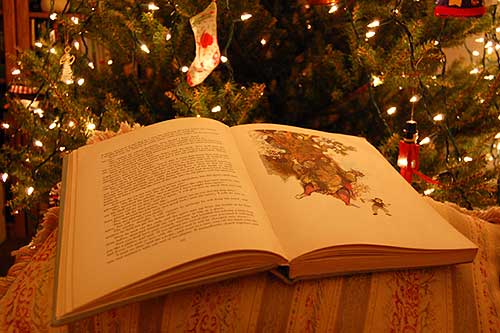
grimmsfairytalebook.jpg

Several months ago, my Mom lent me her copy of “A Thousand Splendid Suns” audiobook and I rediscovered a passion that nourishes my soul. Listening to a book on CD brings me back to the pleasure of being read to as a child. It fills my imagination with all of its descriptive language spoken aloud. It has changed my work commute which has always been a stressful drive in traffic. Now I am not bothered at all by the many vehicles surrounding me as I am transported by words to another world.

Here is a list of the books I have listened to since then.

A Thousand Splendid Suns by Khaled Hosseini – A riveting tale about 2 women’s lives over the course of 3 decades in Afghan society during Soviet occupation, civil war and then the Taliban. Mariam is 15 when her mother commits suicide and she is given in marriage to 40-year-old Rasheed, a cruel man who abuses her throughout the many years of their marriage, especially after she cannot have any children. Laila is 14 when her parents are killed by stray bombs and Rasheed takes her in and marries her. The 2 women come together in that household and slowly develop a deep bond that carries them through the worst of times. I smiled and laughed, cried and sobbed as I listened to the story of their lives unfold.

The Tenth Circle by Jodi Picoult – A very intense story about a 14-year-old girl, Trixie Stone, whose life comes apart after her boyfriend breaks up with her and then rapes her at a party. Her mother, Laura, a college professor who teaches a course on Dante’s Inferno, and her father, Daniel, an artist who draws fantasy comic book heroes, cope to keep their family together as their world unravels around them. Their traumatic experience eventually leads them to Daniel’s boyhood home, a remote Alaskan village. Picoult has an amazing ability to bring out such depth in her characters, showing all of their faults in colorful detail. A lot of twists and unexpected turns in this story.

Thirteen Moons by Charles Frazier – The story of a man’s life from age 12 until he is very old. Will Cooper is bonded to an “antique gentleman” when he is 12 and he sets off for the general store where he will be working. Narrated in the first person as Will looks back upon his life, his journey is described in beautiful, poetic language. The story is set in the Southern Appalachian mountains in the 1800s and the landscape is described so beautifully that you can picture every tree, every creek, every ridge, every mountain. Will is adopted by Bear, a Cherokee chief, and he then grows up to become a lawyer and then a state senator, defending his people and their rights to their land as Jackson and his government move the Native people out west. Will’s deep love for the young girl, Claire, is woven into the tapestry of his many years. The actor Will Patton does an amazing job with the accent and his narration.

Women Who Run with the Wolves by Clarissa Pinkola Estes – By the telling of myth and story, Dr. Estes explores the instinctual nature of the wild woman archetype. Her soothing, melodic voice invites you on a journey to discover your own power, creativity and passion. I read this book in the early 90s and that sparked an exploration into Goddess myths and archetypes. It inspired me to embrace my creative nature as an artist. Listening to her stories again brought that wonderful journey back to me and deeper into the spiral of my psyche.

A Christmas Carol by Charles Dickens – Brilliantly read by actor Patrick Stewart, this classic tale of Ebeneezer Scrooge is sure to delight, especially at this time of year.

Slow Time

candlesunset.jpg

I’ve recently started working with a book called “Slow Time” by Waverly Fitzgerald. I had first become acquainted with Waverly’s work when I used to subscribe to SageWoman, a magazine devoted to Goddess lore and Earth based spirituality. I was fascinated by her thoughts about the cycle of the seasons and her words resonated on a very deep level within my soul.

The book is set up in a 12-week format and it is filled with exercises and questions that help you explore your relationship with time. Speaking of time, I have been busy getting ready for my annual jewelry show tomorrow so I haven’t exactly been following it by a weekly schedule. I am reading and absorbing and exploring in my own “slow time”.

The subtitle to the book is “Recovering the Natural Rhythm of Life”.

As I was reading Richard Bode’s “Beachcombing at Miramar” last night, these words jumped out at me.

“I believe there is a clock within me, a living clock, and it keeps pace with the beat of the world. I hear the slow ticktock of the planet when I stand in a salt marsh or walk the sands of Miramar, and I lose it the instant I slip behind a steering wheel. The moment I exceed the speed at which I was born to move, I lose the tempo of the natural world and become like a singer who has lost the rhythm of his song.”

This passage stayed with me long after I had read it. As we move through our days faster and faster, here, there and everywhere, work, school, errands, etc., are we losing our natural rhythms? The speed we were born to move? I wonder about these things.

More photo experiments

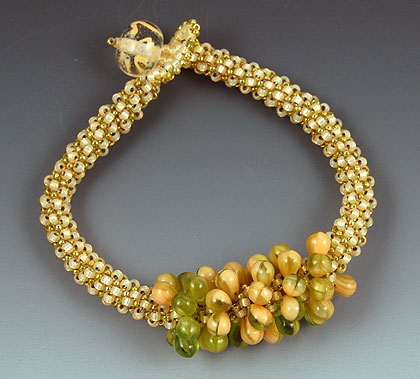
woodlandfairybracelet.jpg

With my photo experiments so far, I have used natural light and flourescent daylight bulbs, colored paper and a black velvet bust. The photos taken in the natural light of my window were too dark. The photos taken on the black velvet bust were too flat looking. The photos taken on the colored paper looked too busy to me. The jewelry was getting lost in the color of the paper. Some props I used competed with the jewelry. Then I borrowed some gradient paper and did some experimenting. It is the best so far, I think. Clean and professional looking, it does not compete with the jewelry at all. In fact, it seems to make the colors of the jewelry stand out so it enhances the piece.

My “Woodland Fairy” bracelet was inspired by a stitch technique in the marvelous book, “Mastering Beadwork” by Carol Huber Cypher. Carol calls the technique “peyote-carry-one” and it is similar to a Dutch spiral in that you add an extra bead which is then not woven into on the next round. It gives more fluidity and drape than regular tubular peyote which can be pretty stiff. It also enables you to add a bead with small holes since you don’t stitch into it on the next round. I decided to use the drop beads I used in my “Woodland Fairy” necklace but I didn’t want to carry them through the whole bracelet. I think it gives the look of a textured bead in front.

What do you think?