Saturday Morning Tea

Good morning, dear tea friends! Last weekend, my desktop computer finally died, after 15 years. Unfortunately, it’s the computer I write my blog from so now I need to figure out what to do. Until I can sort that out, I’m going to rerun some holiday posts from years past. I hope to have a new tea post for you very soon. Enjoy and Happy Holidays to all!

To start the holiday weekend festivities, this morning’s tea is a decadent treat – an India black tea (my guess is Assam) with cardamom pods and cocoa and cinnamon pieces – called Melange de Chamonix. Named after the luxurious resort in the French Alps, this is indeed a luxuriant morning treat. Yum.

I think my reindeer friends approve.

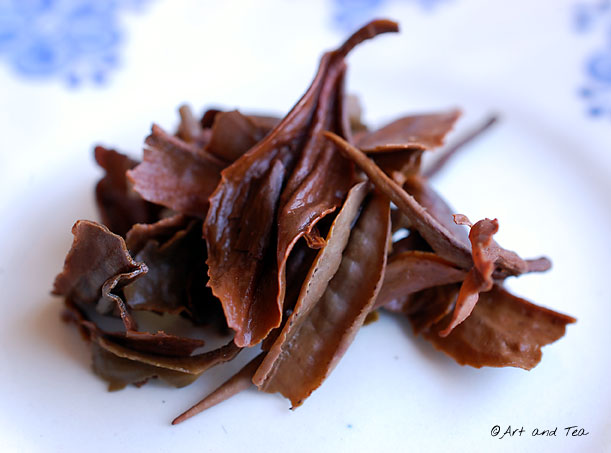
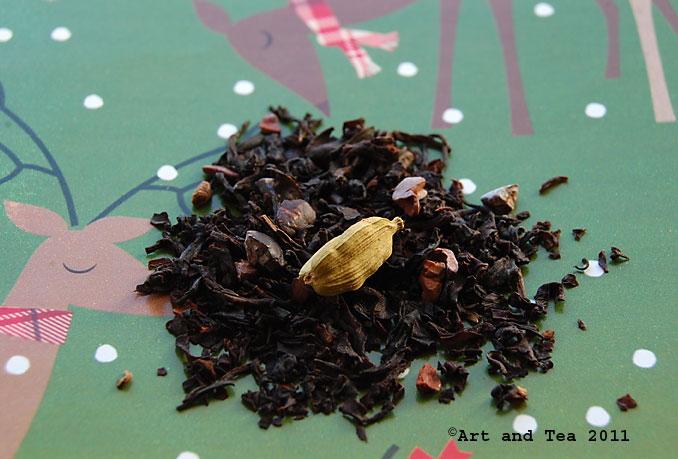
The dry leaves have an aroma of spicy chocolate liquor. With the addition of cardamom and cinnamon, I thought this tea would be more like a Chai Spice tea but the cocoa pieces predominant in the aroma and flavor so it is its own wonderfully unique blend.

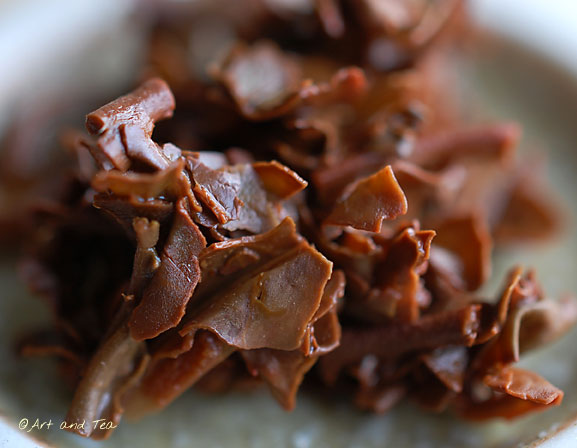
Look at all of those lovely cardamom pods. I love the taste of cardamom.

I steeped the tea for 5-6 minutes for a rich, cocoa flavor with warm, spicy nuances. After sipping the tea plain for awhile, I poured half a cup and then added sweetener (mine is agave syrup) and a good dollop of whole milk. The flavor is strong enough to come through the additions and I found that the milk gave the tea a creaminess which I really enjoyed. I’ll say it again. Yum.

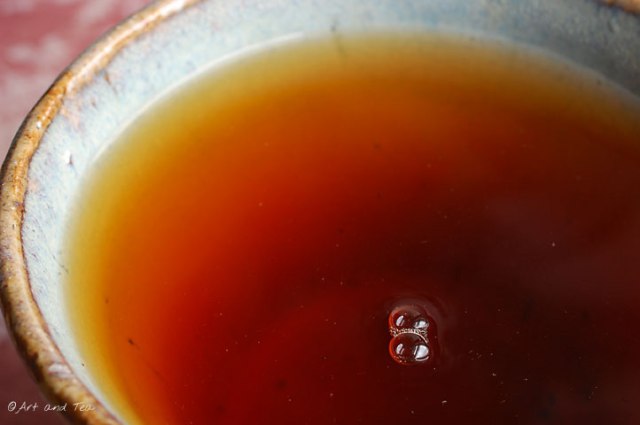
Comet seems to enjoy the aroma of the deep amber-colored tea liquor.

As much as I love tea with nothing added to it, this lovely tea sure has “spiced up” my morning!

I am going to Michigan for the holidays so there will be no Saturday Morning Tea post next Saturday. I will return in 2 weeks with some new tea to share with you in the brand new year.

Happy Holidays to all of you, dear friends. May your days be filled with light and love and many delicious cups of tea!

“I will honour Christmas in my heart, and try to keep it all the year. I will live in the Past, the Present, and the Future. The Spirits of all Three shall strive within me. I will not shut out the lessons that they teach. Oh, tell me I may sponge away the writing on this stone!”

~Ebeneezer Scrooge, A Christmas Carol by Charles Dickens
Saturday Morning Tea

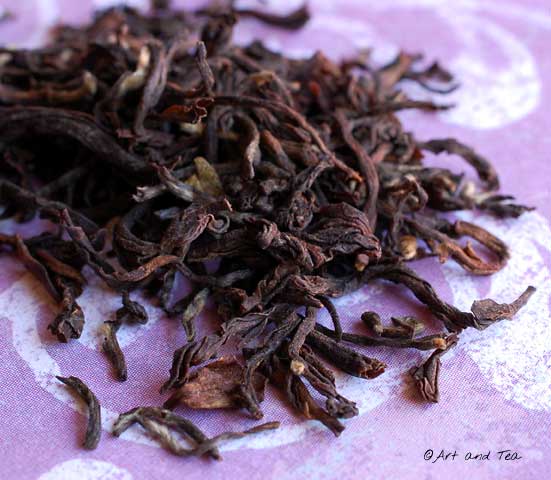
Jungpana Estate 2nd Flush Darjeeling Dry 09-28-13

Good morning, dear tea friends! With almost a week past the autumnal equinox, the shadow of darkness falls earlier in the evenings. That said, when the sun is shining, the days are glorious and the trees look dipped in fire. I love this autumn time of year.

Speaking of glorious, my morning tea is a high-end second flush Darjeeling from the Jungpana Estate. The price per packet might take your breath away, however, the price per teacup is only .76 and compared with a latte price from the local Starbucks, it’s quite a bargain for such an amazing cup.

JungpanaEstate 2nd Flush Darjeeling Steep 09-28-13

Referred to as “an island in the mountains”, the Jungpana Estate is located in a rugged terrain surrounded by pine forests in northeastern India. There is a sad legend on how the area received its name. From their website:

Legend has it that many years ago a British hunter was roaming the Himalayas with his faithful gurkha Jung Bahadur by his side when they were attacked by a leopard.

In trying to save his master Jung Bahadur was severely mauled before his master dispensed with the beast. Jung Bahadur was weak and thirsty and asked his master for ‘pana’, or, water. He was carried to a nearby stream and given water to drink but died in his master’s arms soon thereafter.

Eversince that moment, the area has been known as JUNGPANA, or, where Jung Bahadur had his last drink of water. The tea estate planted later, carries the name till today.
Jungpana Estate 2nd Flush Darjeeling Wet 09-28-13
The leaves consist of new tip growth and leaf, some intact, some broken. I steeped them for 3 minutes using boiling point (212F) water. As I lifted the infuser after steeping, I noted the fragrant aroma of peach nectar rising from my glass teapot.
JungpanaEstate 2nd Flush Darjeeling Teapot 09-28-1
The amber-colored tea liquor is rich and fruity with pronounced notes of peach and muscatel. As the tea cooled, some toasty nuances came out along with a gentle astringency in the finish.
Jungpana Estate 2nd Flush Teacup 09-28-1
Tomorrow I’m going on a fabulous fall adventure – apple picking with family and friends. Mmmm, I can already smell that apple pie baking…
Have a wonderful week filled with many cups of delicious tea!
“Delicious autumn! My very soul is wedded to it, and if I were a bird I would fly about the earth seeking the successive autumns.”
~George Eliot

Saturday Morning Tea

Halmari Estate Assam Dry Leaf 09-21-13

Good morning, dear tea friends! A blanket of clouds covered the sky as I poured my first cup of morning tea but now as I sit down to write, I see peeks of blue here and there. Tomorrow marks the Autumnal Equinox here in my corner of the world, the Northern Hemisphere, however, I’ve felt the winds of seasonal change for several weeks now. Going with that change, I’m enjoying an Assam tea today, a tea I enjoy most as the cooler weather comes. This one is a broken leaf selection  from the Halmari Estate. Look at all that beautiful golden tip interspersed among the leaves!

Halmari Estate Assam Steep 09-21-13

It seems like the color orange pops out and surrounds us in the fall – pumpkins, butternut squash, autumn sunsets, chrysanthemums, even the light has a crisp golden-y orange hue. This tea fits right into the the colors of fall, with its wonderful russet glow. I steeped the leaves for 4 minutes in boiling point (212F) water.

Located on the plains of upper Assam in northeastern India, the Halmari Estate was started in the 1940s and is owned by the Daga family. You can see some cool pictures of their factory, where the tea processing takes place, here. That’s where it all happens, leaf to cup.

Halmari Estate Assam Wet Leaf 09-21-13

Most of the leaf particles are broken, however, I found some little tips, which had turned the same color as the rest of the leaf, during steeping.

The aroma has light malty hints with a whisper of red wine.

Halmari Estate Assam Teapot 09-21-13

The burnt orange colored tea liquor reflects the changing colors of the leaves on the trees. The flavor is silky smooth, one of my favorite qualities to find in an Assam tea. The notes are dark honey sweet with hints of spice that linger in the finish. If you enjoy milk in your Assam tea, I recommend steeping this one longer than 4 minutes.

Halmari Estate Assam Teamug 09-21-13

The clouds are now moving swiftly, dark grey with tufts of white higher up. The glimpses of blue sky are growing as the moving clouds part. It’s a fine day for a long walk on the bike path, methinks…

I’ve been lately enjoying the audiobook version of The Fellowship of the Ring during my work commute. I leave you with one of my favorite poems from the book.

Have a wonderful week and enjoy your tea!

All that is gold does not glitter,
Not all those who wander are lost;
The old that is strong does not wither,
Deep roots are not reached by the frost.
From the ashes a fire shall be woken,
A light from the shadows shall spring;
Renewed shall be blade that was broken,
The crownless again shall be king

-J.R.R. Tolkien, The Lord of the Rings

Saturday Morning Tea

Keemun Xiang Luo Dry Leaf 09-07-13

Good morning, dear tea friends! Change is in the air. The winds have shifted, welcoming in September with dry, cool air. As I sit and sip my tea, I watch the summer curtains dance and flutter around my windows.

I’ve chosen a dark, rich tea this morning, a China black tea called Keemun Xiang Luo, which translates to “fragrant snail”. The leaves are rolled and curled during processing, similar to the green tea called Pi Lo Chun, to resemble spiral snail shapes.

Keemun Xiang Luo Steep 09-07-13

I steeped the dark, glossy leaf for 5 minutes in boiling point (212F) water.

Keemun tea is named after a county, Qimen, in Anhui province. There are several stories about its origins but the most common is one of a governmental official in the late 1800s who learned about black tea production in Fujian province and then decided to return to his native county, Qimen, to produce black tea there. He met with success and his new black tea was imported to England where it was enjoyed as a breakfast tea.

Keemun Xiang Luo Wet Leaf 09-07-13

As you can see, some of the leaf opened their accordion pleats during steeping and some stayed rolled. I detected a maltiness in the aroma as the leaves steeped, which dissipated after the tea cooled to reveal a hint of red wine and a toasty note.

Keemun Xiang Luo Teapot 09-07-13

The tea liquor gleams like dark honey in my glass teapot. The flavor is thick and rich with notes of dark cocoa, which linger in my mouth.

Keemun Xiang Luo Teabowl 09-07-13

This would be a great tea to take along to an outside fall activity, like a long walk through the woods or a football game. It’s very warming.

I’d like to wish my very dear Mom a happy birthday today. Happy Birthday, Mom!

Have a wonderful week and enjoy your tea!

“And the beauty of a woman, with passing years only grows!”

~Audrey Hepburn

Saturday Morning Tea

Kaimosi Estate Kenya Tea Dry 8-17-13

Good morning, dear tea friends! I’m finishing up my explorations of African black tea with another visit to Kenya. In my cup on this warm summer morning is Kaimosi Estate GFBOP, a broken leaf tea with flecks of tip sprinkled amongst the dark leaf.

Kaimosi Estate Kenya tea Steep 8-17-13

The Kaimosi tea farm, along with 3 other farms, is owned by Williamson Tea. At an altitude of just under 6,000 feet, this 3.2 square mile farm is located in the North Nandi district of Kenya. They started planting tea there in the 1940s and most of the tea harvested today comes from the original plantings.

Kaimosi Estate Kenya Wet Leaf 8-17-13

I steeped the leaves for 4 minutes in boiling point (212F) water.

This tea was plucked in the early morning hours while the dew was still fresh on the leaf. It takes ten days to pluck the whole of the tea farm. Because they sit so close to the Equator where the sun is quite hot, the leaves need to be transported to the factory quickly, where they are dried, withered, rolled and oxidized all within a 30-hour period from picking to cup.

Kaimosi Estate Kenya in Teapot 8-17-13

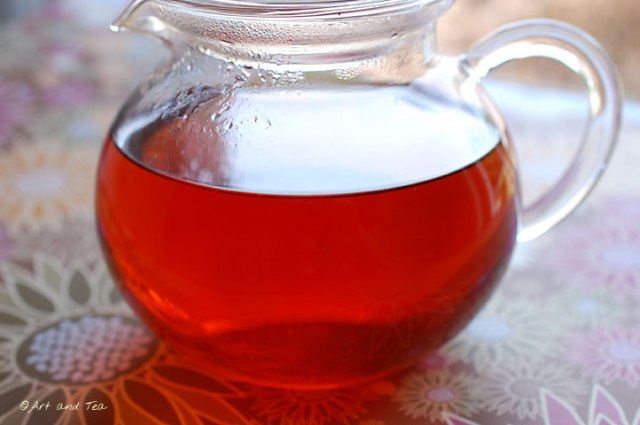
The other day, I responded to an e-mail from a customer asking for a red tea. I have found that most of the black teas I photograph are varying shades of amber. Even though this tea is also a dark amber color, it comes pretty close to being red that I’ve seen.

It simply glows in my teapot like a rich jewel.

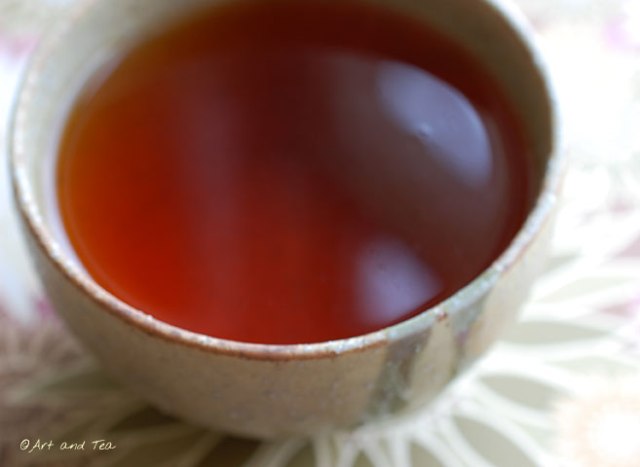
Kaimosi Estate Kenya in Teabowl 8-17-13

The aroma is warm and inviting with a whisper of citrus. The robust flavor reminds me of a smooth Assam, with light malty hints and and nuances of warming spices. At a 4-minute steep, this tea was quite smooth. I believe it could take a longer steep time, 5 or 6 minutes, especially if you’re adding milk and sweetener.

I’m looking forward to going to a painting class with a dear friend tonight. Mixing colors and painting connect with a deep passion I’ve had since I was very young and played with watercolors. It’s one of those activities that makes time stand still and the regular day-to-day world recedes for a little while. A lot of fun!

As always, thanks for stopping by and sharing a cup of tea with me!

“There are painters who transform the sun to a yellow spot, but there are others who with the help of their art and their intelligence, transform a yellow spot into sun”

~Pablo Picasso