New polymer clay earrings

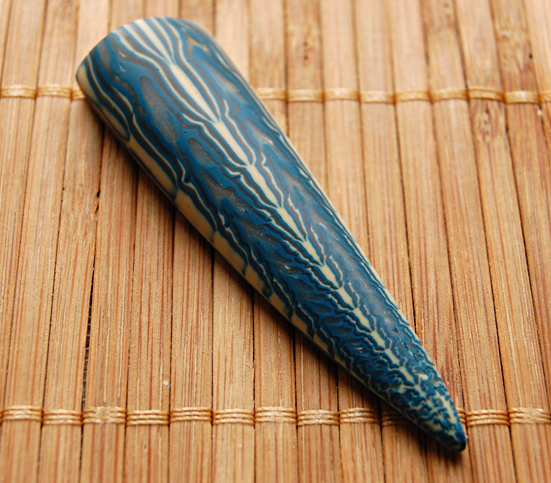
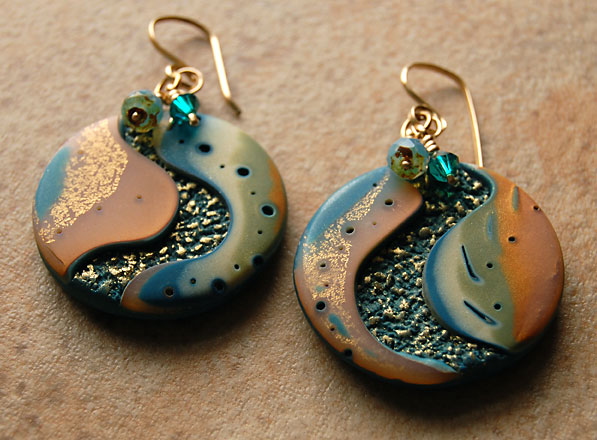
With both sets of my polymer clay earring components created in Julie Picarello’s workshop – the round discs and the long “lizard tails” – I drilled a small center hole approximately 1/8″ from the top of each piece. That is where the similarity in the embellishment process ends.

Using gold-filled wire threaded through the drilled hole, I made a wrapped “hanger” for each of the round discs and then attached a handmade gold-filled ear wire. I then created some crystal bead dangles using the same gold-filled wire and attached them to each ear wire with a small jumpring.

Using Silamide thread (my favorite for beading) and size 15 seed beads, I used the drilled hole to secure a ring of beads around the top of each “tail”. From that base ring, I worked peyote stitch first up around the top of the piece and then on the bottom of the ring, decreasing when needed to form fit the beads around the “tail”. I added a small pearl for embellishment and then a loop at the top so that the pieces could hang comfortably from ear wires.

Next up…..the pendants…

What I created in Julie Picarello’s workshop

To inspire my color palette that day, I purposefully wore my Come Spring vest to the first day of Julie’s workshop. You can read my post about knitting that vest here.

When presented with a choice of metal foil to add to my mokume stack, I chose gold because these cool colors have an underlying warm tone to them.

I created 2 pendants and 2 pairs of earring components from my stack. Instead of adding metal embellishments to the components to create jewelry as Julie does, I want to put my own artistic mark on my creations with some seed beadwork.

The “river’ running through the middle of my pendant will have flowing seed beads. You can see from my photo that I’ve started to drill small holes in the “river” so I can couch the strands of flowing beads. As I was working out this idea, I got another one about a beach scene done with half polyclay and half seed bead embroidery!

Coming up soon…how I turned these components into jewelry…

Julie Picarello Workshop

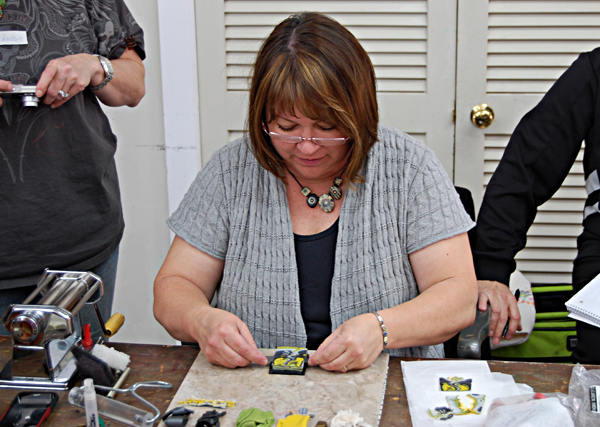
This post is long overdue! In March,  I had the wonderful opportunity to take a workshop with the talented polymer clay artist, Julie Picarello. Here is one of her fabulous creations destined to adorn some lucky person.

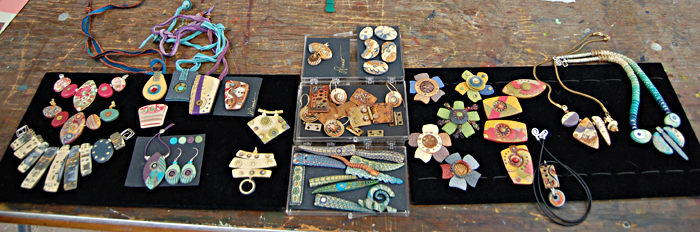
More of her amazing work to inspire and delight!

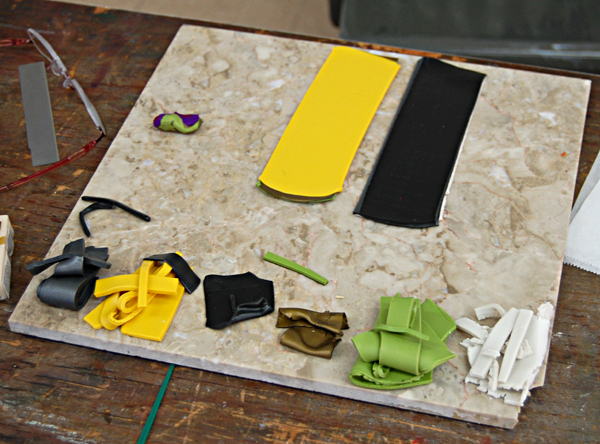
Julie has explored and perfected her own faux mokume gane technique using layers of colored clay, metal leaf and all sorts of nifty texture tools. From this layered and textured clay, she creates colorful, unique jewelry pieces.

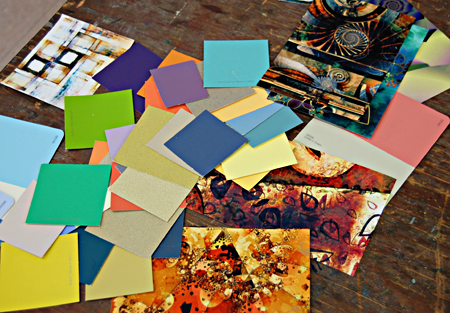
Color inspiration can come from many sources.

A yummy color palette.

The first thing that struck me about Julie upon first meeting her is her warm smile and twinkling eyes. In a new place and new experience, she made me feel very welcome and right at home. She is kind, generous and very patient, perfect qualities for a teacher to possess, allowing your students to relax and open up to the creative process.

Besides learning a new approach to one of my favorite polymer clay techniques, this fun workshop also taught me to open up to new color inspiration and that you can find fabulous texture tools just about anywhere.

Soon I’ll share with you what I created at the workshop!

From bead soups to a free-form bracelet

A winter walk in the woods under a full moon.

As I wrote these words today I thought how appropriate to post this on the day of the full moon even though winter has now blossomed into spring.

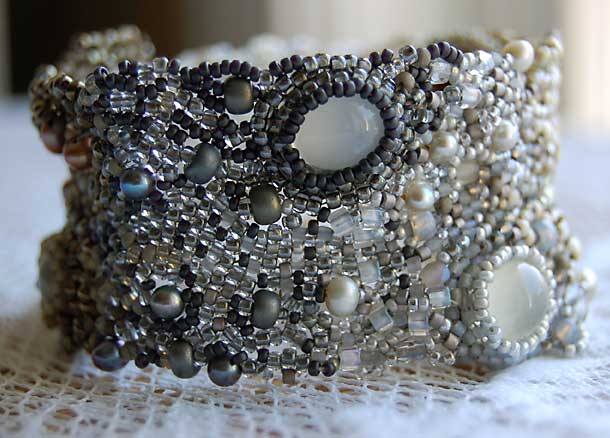
My first bead soups have come together with needle and thread to create a story.  Unlike my other free-form bracelets with woven patches of color, this bracelet gradates from lights to darks with beaded cabochons woven into its fabric.

I love trying out new techniques and expressing them in my own voice.

3 moonstone beads finish my bracelet in a button and loop clasp.

“In every walk with nature one receives far more than he seeks.”

~John Muir

Saturday Morning Tea

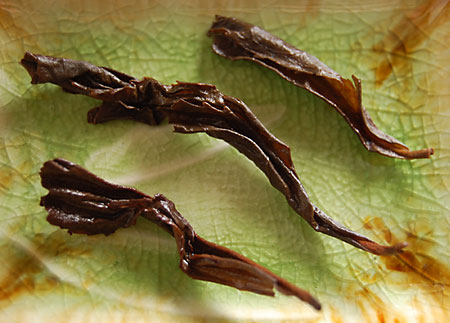
I must admit that I chose this morning’s tea just for the name alone – Water Fairy Oolong, also known as Shui Xian. Grown in the Fujian province of China, the huge, dark chocolate brown leaves are hand-rolled to resemble a frog’s leg.

Of course, there’s a story about how this tea got its ethereal name. I love tea stories so gather round, my friends, teacups in hand…

About 900 years ago, a Song dynasty emperor was traveling with his entourage to southern China to inspect a tea garden. It was a hot summer’s day and everyone soon became very thirsty. They searched high and low for water but could find none. One of the scouts spotted a bush with bright green leaves and his extreme thirst led him to place one of the brightly colored leaves in his mouth. The leaf was very juicy and he found that it quenched his thirst as he chewed it. Soon, everyone was chewing the leaves of this magical plant. Of course, it was the tea plant that produced Shui Xian tea. So, the emperor named the tea “Water Fairy” for its magical thirst quenching powers.

The leaves do look thirst quenching, don’t they?

I steeped them for 4 minutes in 190 degree F water. Even though the leaves look very dark, they are still not oxidized as much as a black tea is so it’s best to use a water temp below boiling point.

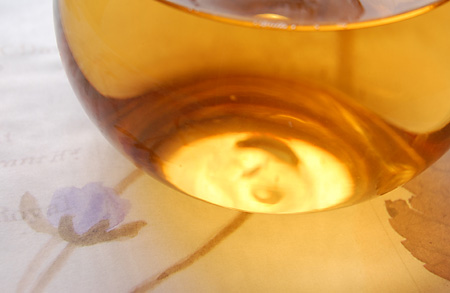
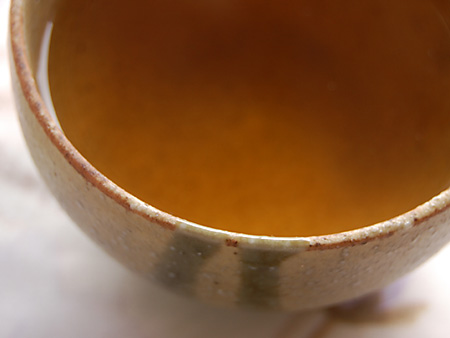
This tea is well known for its “narcissus” fragrance. The light amber liquor is silky smooth on my tongue with a lingering honey sweetness felt in the back of my mouth for a long time after sipping. Notes of chestnut and delicate peach round out the flavor.

Today is a day to relax at home and work on some art projects – making a polymer button for my finished Winter Woods vest and starting my winter palette free-form bracelet.

What tea are you enjoying today?

Whatever special nests we make – leaves and moss like the marmots and birds, or tents or piled stones – we all dwell in a house of one room – the world with the firmament for its roof – and are sailing the celestial spaces without leaving any track. ~John Muir