Saturday Morning Tea

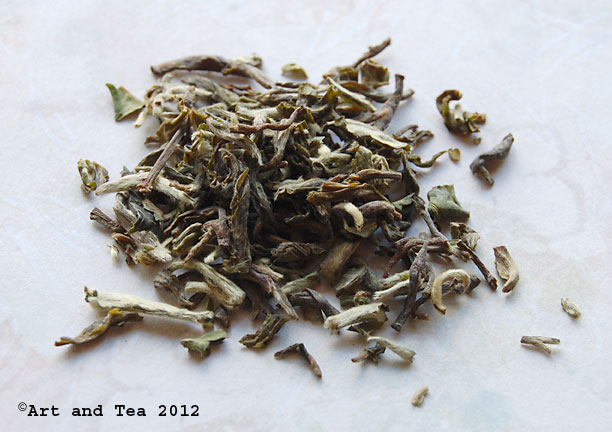
Hello again, my dear tea friends! I’m happy to be back to share another cup of tea with all of you. This morning I’m enjoying another first flush Darjeeling, this selection from the Glenburn estate. So far, 5 first flushes have arrived and I have to say that this one is my favorite so far. The leaf is from the first plucking of the season and, as you can see from my photo, it’s filled with the silvery white tips of the tea bush. So new, so tender.
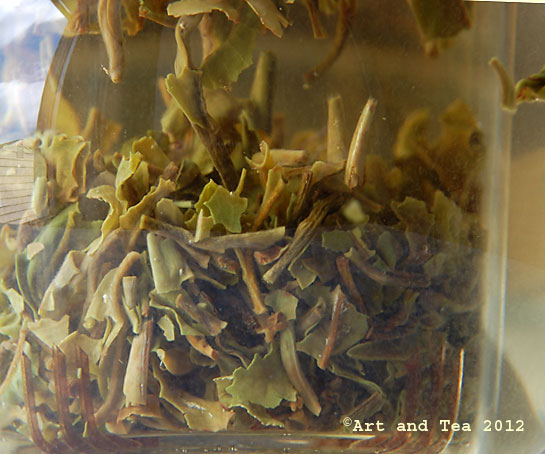
The leaf shows off its gorgeous green color as it steeps. I steeped for 3 minutes in just under boiling point water, around 200 degrees F. Remember that this is not a green tea but has been oxidized and processed as a black tea.
My online tea friend, Steph, had the opportunity to visit the Glenburn tea estate during a trip to India last year. She shares her wonderful adventure on her blog, Steph’s Cup of Tea, here. To visit a tea estate in Darjeeling would definitely be a dream come true for me. Someday…

Ok, back to the tea. The tea liquor steeped up to such a pale, delicate golden color. A sweet aroma of flowers wafted up from my glass teapot as I gently removed the infuser basket.

While I do love notes of tropical fruit and banana in a first flush tea, my first love has always been the floral notes. This tea is a perfect example of that – in the aroma and pronounced in the flavor. The liquor is so smooth that you could probably experiment with pushing the steeping time a little bit. If you do, please let me know what you think.

Have a wonderful week filled with many delicious cups of tea!

“One of the secrets of a happy life is continuous small treats.”

~Iris Murdoch, Writer

More Ribbon Bracelets

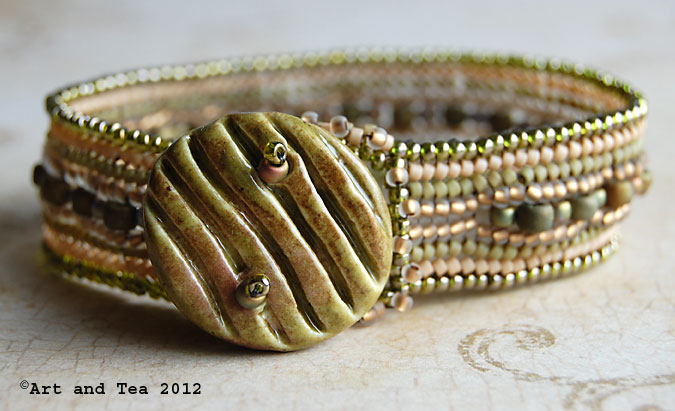
I just love beading these bracelets. They’re a great way to play with color palettes inspired by the different buttons I use for the clasps. I first wrote about my love affair with these herringbone stitch bracelets here.

These wonderful porcelain buttons were created by Maryann Carroll of Artisan Beads Plus. The delicate, muted colors remind me of the awakening spring world outside.

Here’s another view. Maryann describes her bead/component process as follows:

– Individually hand-crafted
– Dried and then smoothed with a sponge
– Bisque fired to about 1850 degrees F (1000 C)
– Glazed with about 3 coats of glaze
– Fired again to about to 2200 degrees F (1240 C)

Amazing, beautiful work.

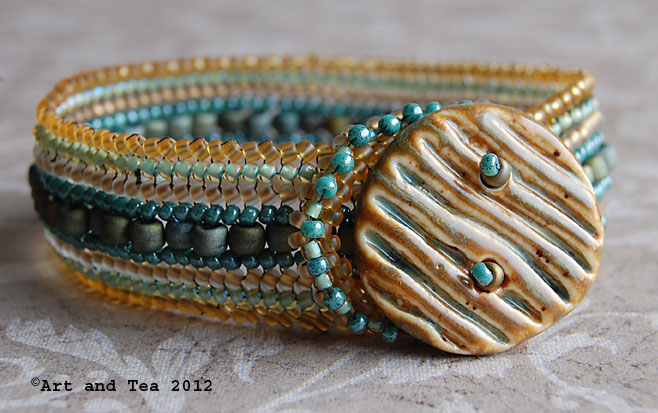
This color palette reminds me of sea and sand. I just love the texture on these buttons.

Herringbone stitch gets its name from the way the beads sit next to each other in a v-shaped pattern. The beads in my bracelets are woven in 2 at a time except for the single row of larger beads running down the middle of the bracelet. This stitch creates a bead fabric that feels silky and sinuous against the skin. Almost like a second skin. The button and loop clasp make for a super easy on and off that my “getting older” fingers are grateful for.

For this bracelet, I chose a vibrant color palette to match this beautiful vintage style button I purchased years ago at a Whole Bead show in Providence, RI.

For the center row of larger beads, I chose triangle shaped seed beads that interlock together perfectly. The majority of beads in these bracelets are a size 11.

Interestingly enough, I shared my ribbon bracelets last year right before a spring trip out to Michigan and here I am leaving tomorrow for a trip out there. I’ll be sure to visit my favorite bead store in Frankenmuth, Bead Haven, as well as a stop by Munro Crafts in Berkley. Stay tuned for treasure sharing!

As always, thanks for stopping by and have a most wonderful week.

Saturday Morning Tea

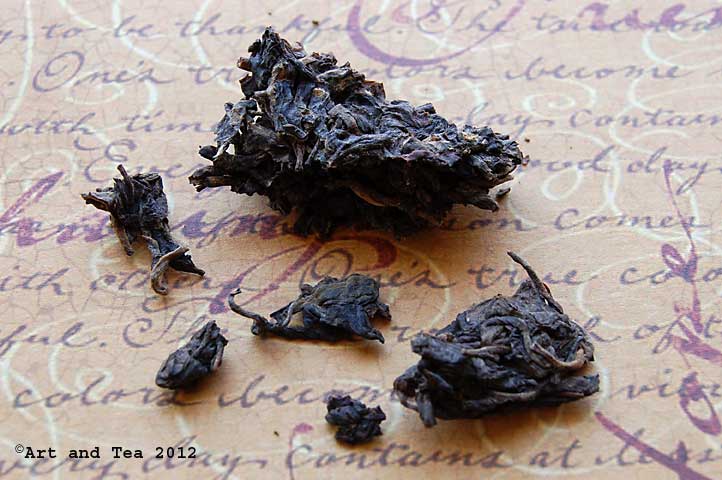
Good morning, dear tea friends! About a month ago, I reviewed a Pu-erh tea which had been compressed into a small square. You can see the photos of it here. I also talked about the two different kinds of Pu-erh tea, raw (Sheng) and cooked (Shou). The mini-square Pu-erh is the cooked kind and the tea in my cup this morning, called Ancient Forest Pu-erh Cake, is the raw kind. During its processing, this tea was compressed into “cakes” and each cake was wrapped to look like this:

Pretty cool, huh? Anyway, I find this particular raw type of Pu-erh tea fascinating in that it started out as a green tea, processed back in 1999. 13 years ago! One would think that a tea hanging out for that long would get stale and flavorless. Not so. The tea leaves aren’t heated up in the normal green tea processing way; they are allowed to dry in the sun, like white tea.

So, please correct me if I’m wrong, my understanding of raw Pu-erh is that it is stored in a special way allowing it to darken (oxidize) through its exposure to the natural elements. That’s why Pu-erh afficionados talk about storage and the aging process. The longer it’s “aged”, the darker it gets?

Because it is raw yet aged for 13 years, I steeped the leaves for 5 minutes in water under the boiling point, probably around 200 degrees F. So, hotter than what I normally use for green tea steeping.

This would be an excellent tea for experimenting with different steep times and water temperature. We did that at work and didn’t find a lot of difference between a 3 and 5 minute steep except for a bit smoother tea at 3 minutes.

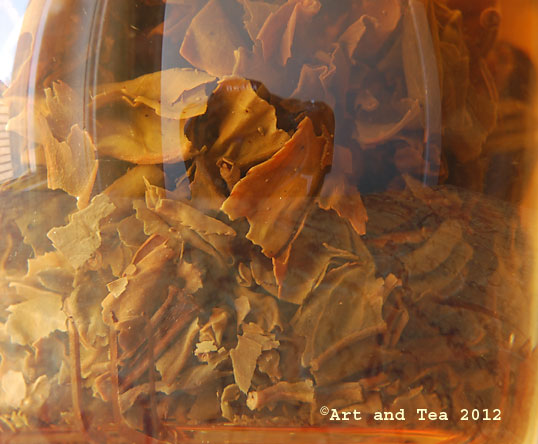
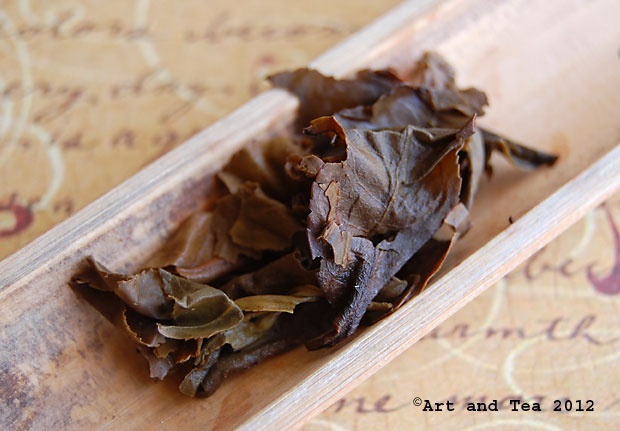
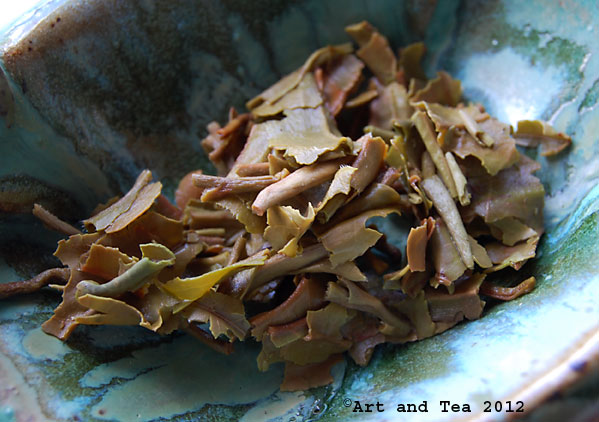
Traditionally, Pu-erh teas are created from leaves harvested in the ancient tea forests of Yunnan province in China. You can see from the photo above that when the leaves unfurl from their compressed state, they’re pretty large.

The aroma is earthy and sweet with a faint hint of artichokes.

Compared to other Pu-erh teas I’ve tried, the flavor of the amber-colored liquor is quite mild and sweet, very smooth with a lingering earthy note in the finish. As I sip, that distinctive earthy flavor conjures up images of walking through a deep, dark ancient forest.

Much like wine lovers collect wines, some Pu-erh lovers collect these raw type, compressed Pu-erh teas and age them, waiting for just the right moment to break off a piece and steep a cup. If you have any experience with this, I’d love to hear your story.

Next weekend I’ll be out in Michigan visiting with my family so there won’t be any Saturday Morning Tea post. I’ll look forward to returning in 2 weeks to share another cuppa with you.

To all who celebrate, have a wonderful Easter and Passover!

Saturday Morning Tea

Good morning, dear tea friends! It’s that time of year again when not only are the first flush Darjeelings being harvested in India but the Pre-Chingming teas are being harvested in China. In my cup this morning is a Pre-Chingming Lung Ching which I am happy to introduce to you.

Chingming, or Qingming, is a festival in China, usually celebrated on the 15th day from the Spring Equinox, or April 5th. It is a day for going outside to enjoy the return of greenery and tend to the graves of departed loved ones. So, Pre-Chingming refers to the tea being plucked before this festival time. This particular tea was harvested in China within the last few weeks.

Lung Ching tea, a very popular and well known tea from China, has a distinctive flat shape to the leaf after processing. This flat shape is intentionally caused by the motion of the pan when the leaf is heated to stop oxidation. Its name means “Dragon’s Well”, referring to the place where it has been traditionally grown. Legend has it that a Taoist priest in the 3rd century advised the local villagers to pray to the dragon of a local well to bring rain and end their drought. It worked and the well was named after that dragon. The Dragon’s Well monastery still stands in that spot to this day.

The color of the leaf while steeping is such an amazing spring green, don’t you think? I steeped the leaves for 3 minutes in 180 degree F water.

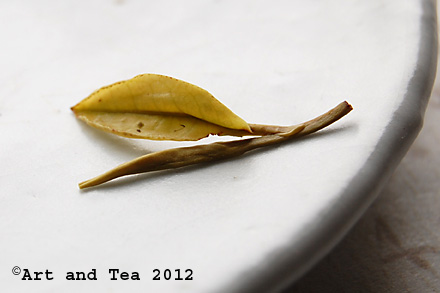
Seeing such an intact leaf is a gift. I imagine a field of women deftly plucking the delicate leaf and tossing it into the baskets strapped to their backs. They methodically make their way through the rows in the crisp spring air.

The tea liquor is so pale, like straw, with a whisper of green tinge. It’s as delicate as a white tea with a complexity of flavor showing its high quality and care in processing. The aroma is slightly nutty with a note of fresh early corn.

So very pale and delicate yet so very flavorful with notes of sweet nectar, melon, a hint of grapefruit and that delicious note of sweet corn. A very special tea indeed.

I’m so excited that my son is on leave for the next week and has come home to be embraced by his family once again.

Enjoy your week and your tea!

Dragon Bangle

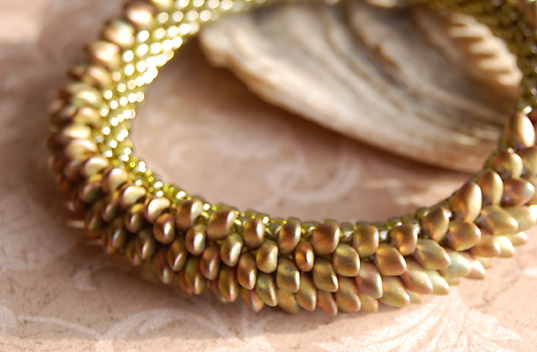
In anticipation of the second season of my beloved Game of Thrones series starting this Sunday, I thought I’d share with you a bangle of “dragon scales” I wove last year.

Years ago, when I was just learning all of the different beadweaving techniques, I was a faithful reader of bead magazines. I think that they’re a wonderful resource for learning and inspiration.  After awhile though I found myself drawn to create my own designs so I stopped buying the magazines and started following my own voice. A good thing, too, because at that point, the magazines were taking over my studio floor!

That said, about a year ago, I was browsing around our local bookstore, cup of Chai tea in hand, when I spied the latest issue of Super Beadwork magazine. The cover featured this bangle created by Nancy Jones of Tiny Dog Seed Beads in Houston, TX. She was using a kind of bead that I had never seen before – a 4x7mm long magatama bead. To me, each individual bead looks like a tiny shoe but when woven side by side like this, they look just like dragon scales. Or what I imagine dragon scales would look like. I was quite entranced with the design so I purchased the magazine and went to work creating my own bangle.

I used a matte metallic color, antique bronze AB, for the “scales” and the inside beads are a size 8 seed bead called “Green Tea”, one of my favorite colors and the name oh so appropriate for me. I purchased the beads at my LBS but I saw several online sources for them when I googled.

The bangle is created using brick stitch for the length and peyote stitch to zip up the strip into a tube shape. If you’re familiar with these bead stitches, it works up quite easily. The problem I ran into was in the sizing. I made it way too big for my wrist. The challenge with a bangle like this is to make it big enough to fit over your hand yet not be too big for your wrist. I achieved the first challenge yet failed on the second. Oh well, now that the bangle is done, I wonder how I can make it smaller without it being a big production. Any ideas?

The link I found for this issue indicated that they were all sold out of it but I bet if you contacted Nancy Jones directly, you might be able to purchase the pattern from her.

As always, thanks for visiting and happy beadweaving!