Saturday Morning Tea

Good morning, dear tea friends! I was going to review a Formosa Oolong Extra Fancy this morning, however, it has turned into a very busy morning with some unexpected happenings. So, what I’d like to do instead is to share a review I posted a couple of years ago of another lot of this very same tea. Then, next week I’ll review the present lot and we can compare them. Enjoy and have a great week!

This morning’s tea is a decadent treat.

At approximately $2.25 per cup, it is also an expensive treat! It’s name is quite fitting. Meet Extra Fancy Oolong from Taiwan (Formosa). Extra Fancy indeed.

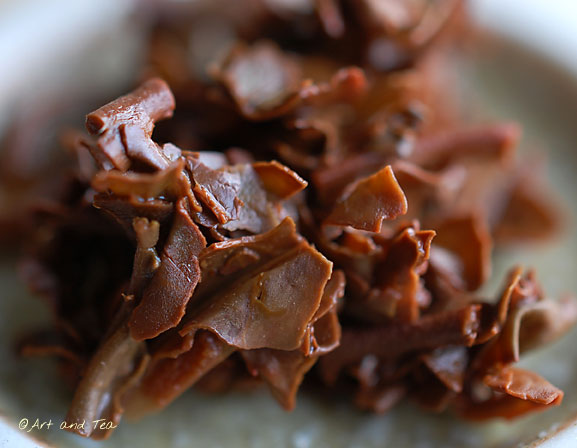
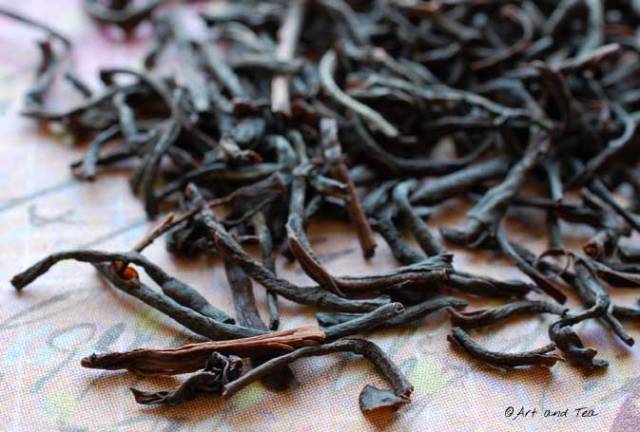
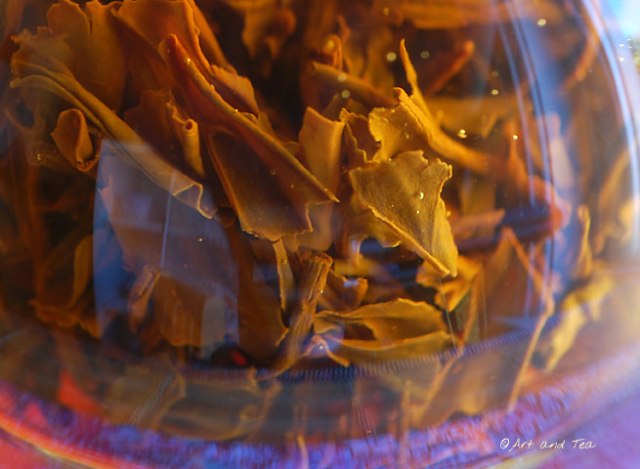
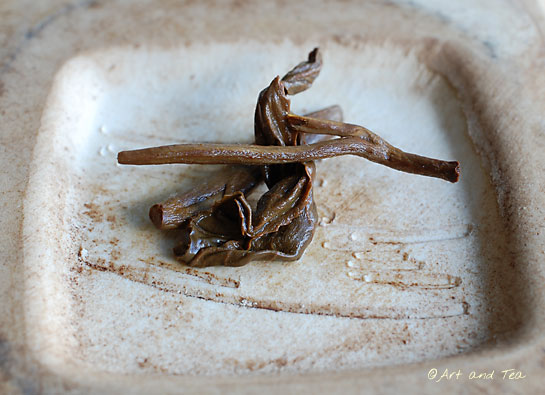
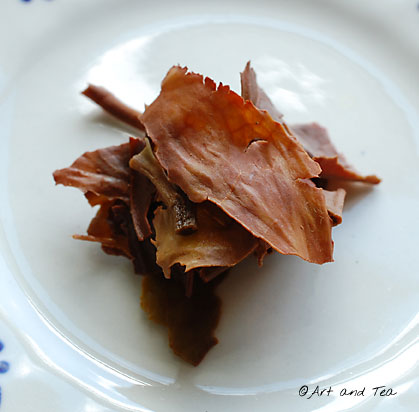
It is described as a “style of Oolong often referred to as ‘Champagne Oolong’, and exemplifies the art of fine tea manufacture”. We can see how carefully this tea was processed by the full leaf sets still intact.

This tea has been entirely hand processed. From the careful picking of the first two leaves and bud on the tea plant to the drying and shaking of the leaf every hour to bruise and encourage oxidation to the pan roasting that halts the oxidation, the Tea Master who created this tea has synchronized all of these steps perfectly as an art form.

Because Oolong tea is not fully oxidized as is black tea, I steeped the leaves in cooler than boiling point water – about 190 degrees F for 5 minutes.

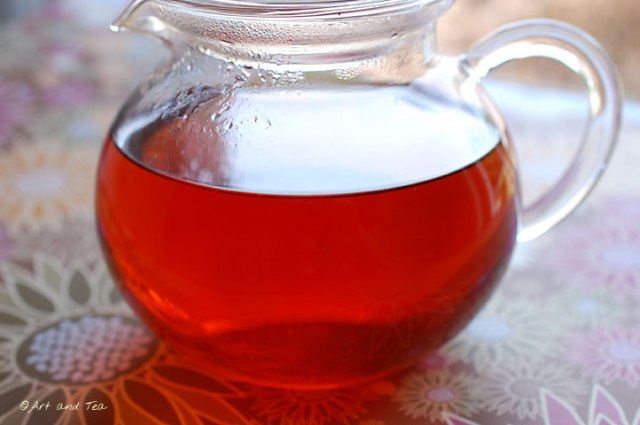
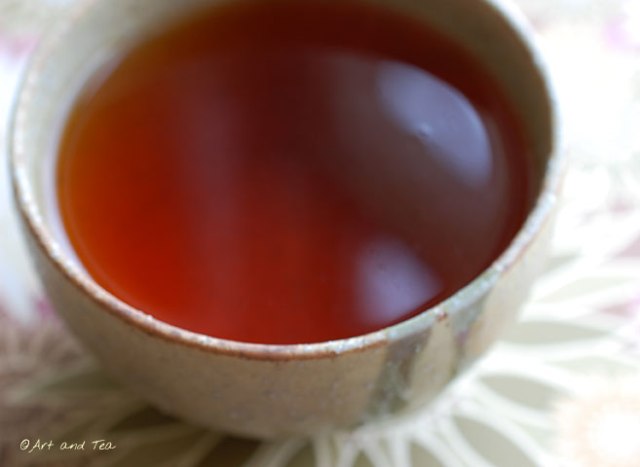
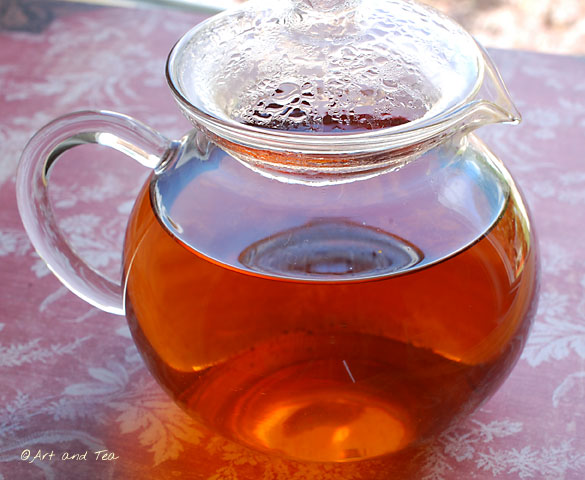
The deep sherry-colored tea liquor smells like ambrosia, giving off an aroma of fresh peaches. I can’t wait to take my first sip which fills my mouth with notes of ripe fruit, rich and syrupy. Oh, what a treat!

I know it’s a tradition to have a glass of champagne at midnight on New Year’s Eve. Why not enjoy a cup of “champagne” tea instead?

What a wonderful way to welcome in a brand new year!

Until next time, dear tea friends…

To listen to the songs of birds, I skipped the evening meditation,
enjoyed a patch of grass by the edge of an ancient mountain stream.
Pleasure recollected depends on a beautiful phrase;
the appreciative mind meets with a close friend.
Spring water cries out in a rocky valley;
pine trees echo when wind is coming.
I drank a cup of tea and watched the flowing and stillness.
Quietly and naturally I seemed to forget the return of time.

Cho-ui
1786-1866

Saturday Morning Tea

Kaimosi Estate Kenya Tea Dry 8-17-13

Good morning, dear tea friends! I’m finishing up my explorations of African black tea with another visit to Kenya. In my cup on this warm summer morning is Kaimosi Estate GFBOP, a broken leaf tea with flecks of tip sprinkled amongst the dark leaf.

Kaimosi Estate Kenya tea Steep 8-17-13

The Kaimosi tea farm, along with 3 other farms, is owned by Williamson Tea. At an altitude of just under 6,000 feet, this 3.2 square mile farm is located in the North Nandi district of Kenya. They started planting tea there in the 1940s and most of the tea harvested today comes from the original plantings.

Kaimosi Estate Kenya Wet Leaf 8-17-13

I steeped the leaves for 4 minutes in boiling point (212F) water.

This tea was plucked in the early morning hours while the dew was still fresh on the leaf. It takes ten days to pluck the whole of the tea farm. Because they sit so close to the Equator where the sun is quite hot, the leaves need to be transported to the factory quickly, where they are dried, withered, rolled and oxidized all within a 30-hour period from picking to cup.

Kaimosi Estate Kenya in Teapot 8-17-13

The other day, I responded to an e-mail from a customer asking for a red tea. I have found that most of the black teas I photograph are varying shades of amber. Even though this tea is also a dark amber color, it comes pretty close to being red that I’ve seen.

It simply glows in my teapot like a rich jewel.

Kaimosi Estate Kenya in Teabowl 8-17-13

The aroma is warm and inviting with a whisper of citrus. The robust flavor reminds me of a smooth Assam, with light malty hints and and nuances of warming spices. At a 4-minute steep, this tea was quite smooth. I believe it could take a longer steep time, 5 or 6 minutes, especially if you’re adding milk and sweetener.

I’m looking forward to going to a painting class with a dear friend tonight. Mixing colors and painting connect with a deep passion I’ve had since I was very young and played with watercolors. It’s one of those activities that makes time stand still and the regular day-to-day world recedes for a little while. A lot of fun!

As always, thanks for stopping by and sharing a cup of tea with me!

“There are painters who transform the sun to a yellow spot, but there are others who with the help of their art and their intelligence, transform a yellow spot into sun”

~Pablo Picasso

Saturday Morning Tea

Rwanda OP Dry Leaf 8-10-13

Good morning, dear tea friends! I continue my journey through the tea producing countries in Africa with a visit to Rwanda. In my cup this morning is an OP (Orange Pekoe) black tea selection.

Tea growing in Rwanda started in 1952 and has grown steadily ever since. The tea is planted at two different elevations – on hillsides at an altitude of 6,000-8,000 feet and in well drained marshes at an altitude of 5,000-6,000 feet. I have read that there are 11 tea estates in the country and each estate is located right by a tea processing factory as the tea must start its processing within a few hours of plucking.

Rwanda OP Tea Steeping 8-10-13

I steeped the large rolled leaf for 5 minutes in boiling point (212F) water. You can see the leaf starting to unfurl as it steeps.

Rwanda OP Wet Leaf 8-10-13

Back in April, the Rwanda Ministry of Agriculture unveiled plans to increase tea production in their country. You can read more about that here. It sounds like they have some challenges to make that happen, like infrastructure access and resistance of some farms to grow tea.

Rwanda OP in Teapot 8-10-13

The glowing amber tea liquor has a toasty fragrance, which I find comforting. The flavor is strong yet smooth with light nuances of cocoa thickness and toastiness. I think this tea could be steeped longer than 5 minutes as I only detected a mild tang in the flavor. I’m going to try 6 minutes next time I brew a cup.

Rwanda OP in Teamug 8-10-13

I think this tea is a fabulous value and would make a great everyday tea. At a longer steep time, it would stand up well to milk and sweetener, too.

It’s a beautiful summer day with high wispy clouds sailing across a deep azure sky.  I think I’ll pull on my walking shoes and go for a hike on the bike path along the lake. Have a wonderful weekend!

“All truly great thoughts are conceived by walking.”

~Friedrich Nietzsche

Saturday Morning Tea

Marinyn Est Kenya Dry Leaf 080313

Good morning, dear tea friends! I’m continuing my exploration of African black teas this morning with a visit to Kenya, the Marinyn Estate, to be exact. This tea has some nice tip mixed in with the leaf, as you can see in my photo above. The tip is the newest growth on the tea plant and is covered by tiny white hairs.

Tea has been grown in Kenya for 110 years, however, it wasn’t until 1924 when the crop was commercialized, leading this country to be the third largest tea producer in the world today, behind China and India. The land has the ideal climate for tea growing – long sunny days with well distributed rainfall and rich red volcanic soil.

Marinyn Est Kenya Steep 080313

I steeped the leaf for 4 minutes in boiling point water.

Marinyn Est Kenya Wet Leaf 080313

I found a tiny leaf tip as well as a larger leaf that had been rolled. As the leaf steeped these rolled leaves unfurled to reveal a set of accordion pleats. The leaf is rolled during the tea processing to release its volatile oils for flavor.

Marinyn Est Kenya in Teapot 080313

The tea liquor is a rich, medium-amber color with a mellow aroma and a hint of tang. The flavor is smooth and well-balanced with light sweet malty notes. I enjoyed the tea plain in my cup but I think that it would stand up well to a light addition of milk and sweetener.

Marinyn Est Kenya in Teamug 080313

This is one of my favorite teamugs, given to me by my daughter, Aimee. I love the way the glaze drips down the side of the mug like rain upon a window. Beautiful color!

The skies are starting to cloud up, a great day for taking photos outside in my garden. The perennial hibiscus are blooming in gorgeous colors of mulberry and pale pink. What do you have planned this weekend?

Thanks for stopping by and sharing a cuppa with me.  Have a wonderful week!

“There is something in the nature of tea that leads us into a world of quiet contemplation of life.”

~Lin Yutang, The Importance of Living

Saturday Morning Tea

LupondeEstDry072713

Good morning, dear tea friends! I’ve been told that this season has not been a very good one for Indian teas, Darjeelings and Assams alike. So, I decided that I would expand my horizons and start exploring the African teas, which I’ve been told are excellent this year, at reasonable prices. I’d like to introduce you to a black tea from the country of Tanzania – Luponde Estate GFOP Organic.

LupondeEstSteep072713

I quote from the Luponde website:

“The Luponde Tea Estate is one of the oldest organic tea estates in the world and the climate is perfect for growing tender leaves and flowers which are handpicked, bringing you the highest quality single estate teas. The estate is situated in the stunning Livingstonia Mountains in Southern Tanzania and at an altitude of 7,000 feet. Tea was first planted on the estate in 1954 and today covers 2,212 hectares. There are 730 hectares of planted tea, of which 401 are organic and there are currently 20 hectares of herbal plants. The estate produces on average 2 million kilograms of black tea a year and the majority of this is tea bag grade. The Luponde estate is the only steady source of income for the people who live in this area and in peak season 80 kilograms of wet leaf will be picked per day by one person.”

You may read more about this tea estate here.

LupondeEstWet072713

I steeped the leaf for 4 minutes in boiling point (212F) water. The aroma of the brewing leaves was of a lemony freshness, portending its crisp flavor.

LupondeEstTeapot072713

Look at that gorgeous deep amber color! Magnificent.

The smooth flavor is well balanced with notes of lemon and cedar.  If you like a more pronounced briskness, steep the leaves for 5 minutes. Fair warning though. We recently did that at work and one of my colleagues remarked that it tasted like he was licking a cedar block. Oh my.

This tea would make a wonderful iced tea. Its flavor reminds me of a high quality Ceylon black tea.

LupondeEstTeacup072713

On this beautiful summer day, I’ve captured a puffy white cloud in my teacup.

Have a wonderful week!

“So fine was the morning except for a streak of wind here and there that the sea and sky looked all one fabric, as if sails were stuck high up in the sky, or the clouds had dropped down into the sea.”

~Virginia Woolf, To The Lighthouse