Saturday Morning Tea

The rain clouds have finally parted here in New England but not without some severe flooding in certain areas. My thoughts and prayers go out to all those affected by the storm. I hope that the warm temps and bright sunshine help clear all of this water away and folks can return to their homes and businesses.

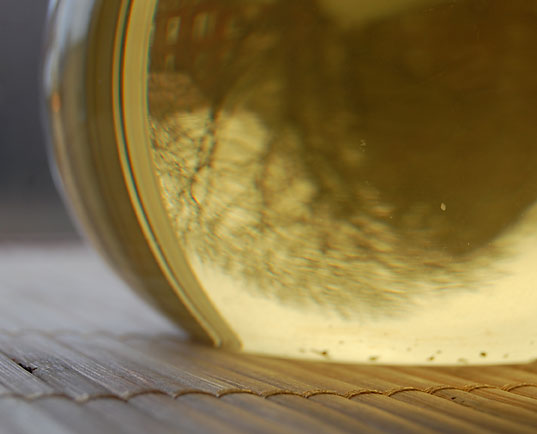
This morning’s tea is a Ceylon black tea from the Deniyaya estate, located in the Ruhuna district in southern Sri Lanka. I’ve written about another tea grown in this district here.

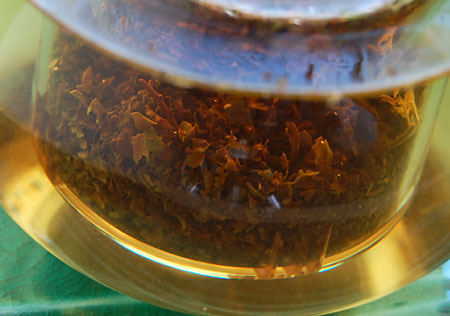
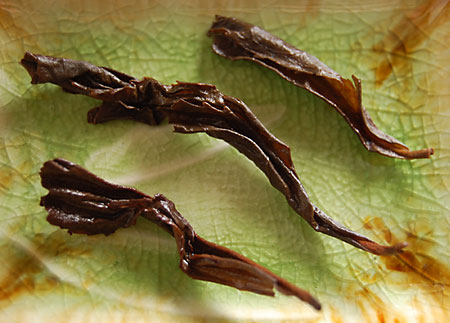
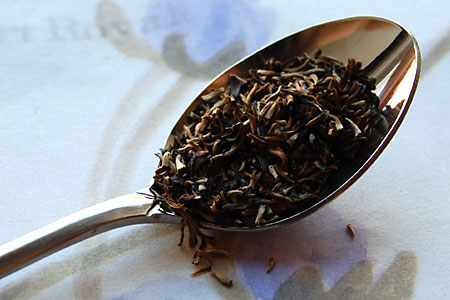
The plucking is predominantly composed of very fine tip, giving the dry leaf a “salt and pepper” look.  The fine, needle-like structure of the leaf reminds me of South African Rooibos.
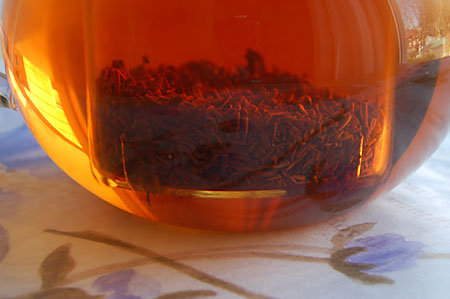
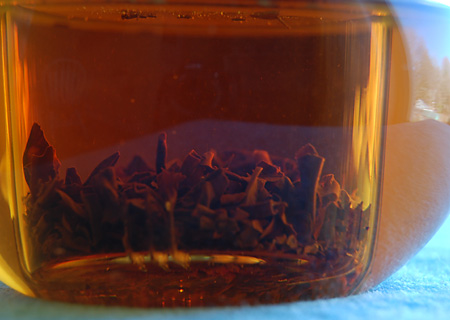
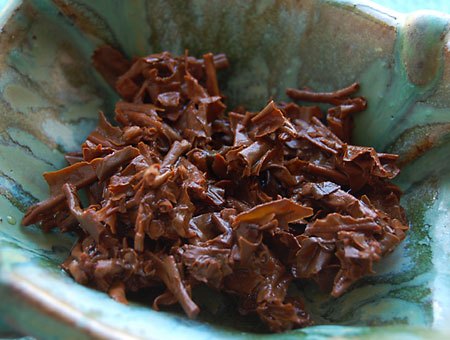
Because of its fine structure, I steeped the leaf for 3 minutes in boiling point (212F) water. It didn’t take up much room in my teapot’s infuser at all.

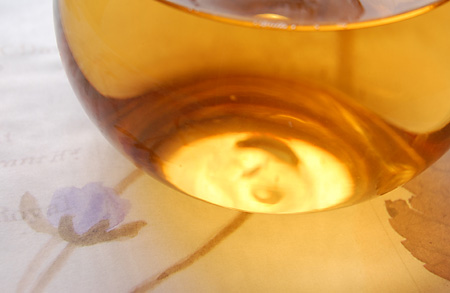
As I poured my first cup, I notice a pronounced, rich molasses aroma wafting up from the dark amber liquor.

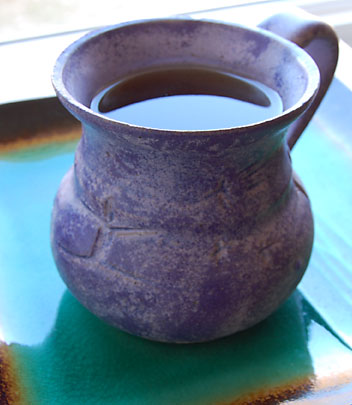
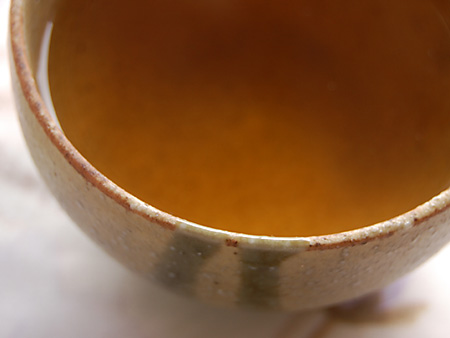
I’m enjoying my tea in a new teabowl purchased from Salty Dog Pottery at a recent art show I attended. As I browsed around the show, I was immediately drawn to the soft colors and symbolism on this piece. The shiny glazing is created with salt!
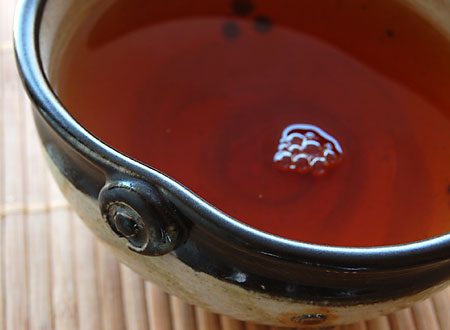
I love the layered complexity of this tea. I taste cocoa, whispers of vanilla, hints of fruitiness and a smoothness that carries into the finish.

Today I am spending the afternoon with my precious 17-month old granddaughter who is here visiting from New Mexico. The day has graced us with warmth and sunshine so we are going to enjoy a trip to the playground and a long walk on the bike trail at a nearby pond. Oh yes, and a trip to the toy store for a Dora the Explorer doll! Ella loves Dora and calls her “Do-ba”, “Do-ba”.

What are you enjoying today?

You are the bows from which your children, as living arrows, are sent forth. ~Kahlil Gibran

Saturday Morning Tea

Happy first day of Spring, my friends! Outside my window, birds flit across the bright blue sky, welcoming the season with their lovely songs.

For my morning cuppa, I chose a black tea from Assam in northeastern India. It’s from the Harishpur estate.  The Assam tea growing region is the only area in the world, besides southern China, that has native tea plants.

I chose this particular tea because of some correspondence I had with a customer this past week. He had purchased this tea and found it had an unpleasant burnt aftertaste. So, we decided to do some testing by steeping the leaves at 3, 4 and 5 minutes, respectively. I repeated this test at home this morning.

Usually, I will steep a whole leaf Assam, as this is, for 4-5 minutes, reserving a 3 minute steep for the broken leaf teas. What I found out this morning from my testing is how very individual teas really are and it’s important to experiment with steeping times for each tea.

The 3 minute steep was rich yet quite smooth with some malty and fruity notes. No need for milk or sweetener, the tea tasted wonderful plain. I didn’t detect any aftertaste.

The 4 minute steep, while retaining some of the flavor notes of the 3 min. steep, was starting to exhibit a sharp astringency which I’ve always described as a taste I can feel in my teeth.

The 5 minute steep was incredibly astringent and left a sharp, yes, almost burnt taste in my mouth for awhile. Even when I put a little milk in it, it was still in my opinion, oversteeped.

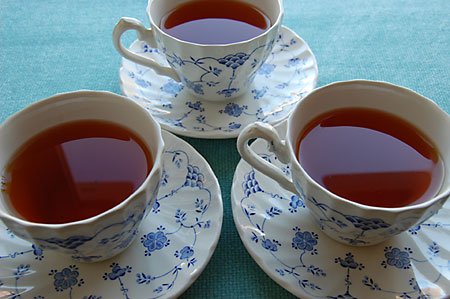
As you can see, the tea liquor is the same color – a deep amber – no matter how long the steeping time.

One of the things I love about my job (and there are many things!) is that I have the opportunity to converse with tea lovers from all over the country. Each moment is a learning experience and my tea journey is constantly expanding with new knowledge and ways of seeing the world.

I encourage you to be open and experiment with your teas and would love to hear of your experiences!

“How gently the winds blow!  Scarce can these tranquil air currents be called winds.  They seem the very breath of Nature, whispering peace to every living thing.” ~John Muir

Saturday Morning Tea

Oh my, where did the morning go to?

I started out the day by indulging in a sleep in, getting 3 hours extra sleep than normal. Very decadent, I know. It’s the perfect day for it though – gray and dreary with heavy rain and wind. A day you want to stay under the covers a little longer.

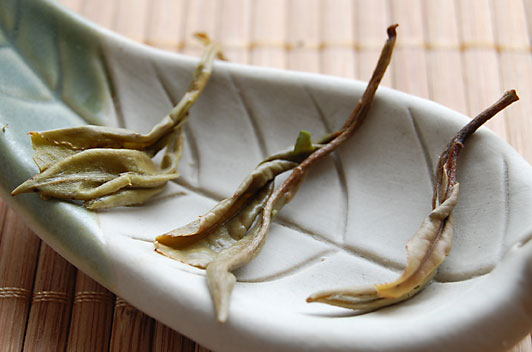
I felt like something lighter this morning so I brewed a pot of Pai Mu Tan, an organic white tea from China. The least processed of all the teas, you can still see the downy white hairs on the leaf. Also known as Bai Mu Tan tea which literally translates to “white peony”.

I have read that the plucking rules for this tea are very strict. It is only allowed to be picked between mid-March and mid-April and only when it is dry out. No rain, no dew, no frost on the ground.

The epitome of spring in a cup of tea.

As you can see, it is a fine plucking, meaning the top two leaves and the bud. The tender leaves remind me of what is starting to peek out of the soil here in New England. Soon the crocuses will begin the blooming parade of color.

I steeped the leaves for 3 minutes in 180 degree F water. The pale gold liquor is delicate and sweet with a bloom of fruity notes in the flavor.

I am often surprised when people say that white tea has no flavor. Yes, the taste is delicate but I find it full of complexity and flavor. The expectations are not the same as those for a black or Oolong tea.

Amazing how they all come from the same plant though. It’s like people. All of us are born with the same parts, we breathe, we eat, we have blood flowing through our bodies. What happens after that, our experiences and how we respond to them contributes to what makes us different.

I love the color of this teabowl. The white tea is so pale that it shows the beautiful green color of my bowl.

What tea is in your cup this weekend?

“Nature is ever at work building and pulling down, creating and destroying, keeping everything whirling and flowing, allowing no rest but in rhythmical motion, chasing everything in endless song out of one beautiful form into another.” ~John Muir

Saturday Morning Tea

Here in New England, this is the kind of day we wait for all winter long – brilliant sun, azure skies, no clouds and temps forecasted near 50. A glorious day for walking!

This morning I am delving back into the herbal world to share an interesting tisane that I’ve been enjoying as my evening cuppa lately.

Ocimum tenioflorum, commonly called Holy Basil and known in India as Tulsi,  meaning “the incomparable one” in Sanskrit.

There are 2 types of Holy Basil, one with light green leaves and one with dark. I have prepared the darker variety, also called purple leaf probably because the leaves have a purplish tinge to them.

Many Hindu families have Tulsi growing in pots outside the entrance to their home. The Tulsi plant is venerated as a goddess and every year a ritual is performed marrying her to the god Vishnu. This ceremonial marriage is called Tulsi Vivah and it signifies the end of the monsoon season and the beginning of the Hindu wedding season.

Tulsi has been used for thousands of years in Ayurvedic remedies. Studies have shown its benefits in quite a few conditions ranging from regulating blood glucose to pain relief to reducing cholesterol levels. I’ve also read that its great for easing stress.

I steeped the leaves for 8 minutes in boiled water. The amber liquor has a distinctive clove, anise/licorice aroma which carries over into its taste.

Sweet and spicy pepper notes mingle with a hint of cinnamon and fruit. I bet this would be lovely iced.

I’m looking forward to a warmer time when iced drinks will be regularly enjoyed.

The fresh air is beckoning….enjoy your weekend!

“When we emerge into the bright landscapes of the sun everything looked brighter, and we felt our faith in Nature’s beauty strengthened, and saw more clearly that beauty is universal and immortal, above, beneath, on land, in heat and cold, light and darkness.” ~John Muir

Saturday Morning Tea

I must admit that I chose this morning’s tea just for the name alone – Water Fairy Oolong, also known as Shui Xian. Grown in the Fujian province of China, the huge, dark chocolate brown leaves are hand-rolled to resemble a frog’s leg.

Of course, there’s a story about how this tea got its ethereal name. I love tea stories so gather round, my friends, teacups in hand…

About 900 years ago, a Song dynasty emperor was traveling with his entourage to southern China to inspect a tea garden. It was a hot summer’s day and everyone soon became very thirsty. They searched high and low for water but could find none. One of the scouts spotted a bush with bright green leaves and his extreme thirst led him to place one of the brightly colored leaves in his mouth. The leaf was very juicy and he found that it quenched his thirst as he chewed it. Soon, everyone was chewing the leaves of this magical plant. Of course, it was the tea plant that produced Shui Xian tea. So, the emperor named the tea “Water Fairy” for its magical thirst quenching powers.

The leaves do look thirst quenching, don’t they?

I steeped them for 4 minutes in 190 degree F water. Even though the leaves look very dark, they are still not oxidized as much as a black tea is so it’s best to use a water temp below boiling point.

This tea is well known for its “narcissus” fragrance. The light amber liquor is silky smooth on my tongue with a lingering honey sweetness felt in the back of my mouth for a long time after sipping. Notes of chestnut and delicate peach round out the flavor.

Today is a day to relax at home and work on some art projects – making a polymer button for my finished Winter Woods vest and starting my winter palette free-form bracelet.

What tea are you enjoying today?

Whatever special nests we make – leaves and moss like the marmots and birds, or tents or piled stones – we all dwell in a house of one room – the world with the firmament for its roof – and are sailing the celestial spaces without leaving any track. ~John Muir