Saturday Morning Tea

There is nothing like returning to a place that remains unchanged

to find the ways in which you yourself have altered.

-Nelson Mandela

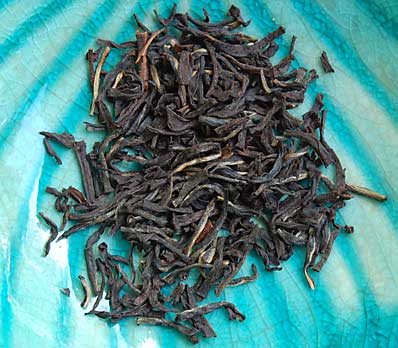
Have you ever been in a situation where all of a sudden something happens, you are given a new piece of information and then it’s like something clicks into place inside of you and you’re looking at your world with whole new eyes? Well, it’s been that kind of eye opening week for me that has rocked the very foundation of my psyche. The universe is showing me a whole new direction these days. Maybe that is part of turning 50. So, after my week, this morning I decided on a nice strong cup of tea, a Ceylon black from Homadola estate.

This tea is produced in the Ruhuna district of Sri Lanka, an area located in the southwestern tip of the island, with an elevation between sea level and 2,000 feet. Most Ceylons black teas are produced in a higher elevation which gives them a lighter, brisk flavor. Most people are familiar with Ceylon tea in a teabag.

This low growing district produces very strong, dark teas that are usually accented with silver tips. Their flavor reminds me more of a China black than a Ceylon tea. The aroma is very rich and sweet with a slight hint of cocoa. The leaves are large broken pieces, some uncurling after steeping. I brewed this tea in boiling water for 4 minutes. The liquor is very rich and dark with earthy, cocoa notes. It stands up very well to milk or cream.

This tea reminds us to be strong, fill our lives with richness and be grounded in our connection to the earth.
Saturday Morning Tea

Tropical Storm Hanna is reaching out her grasp to the New England coastline this weekend. We felt the touch of her outer edge early this morning when a steady rain began to fall. Even though the local weather forecasters have predicted a lull this afternoon, we will be tightly in her grip by tonight with torrential downpours and gusty winds. It’s a good day to brew up a pot of tea and clean my studio.

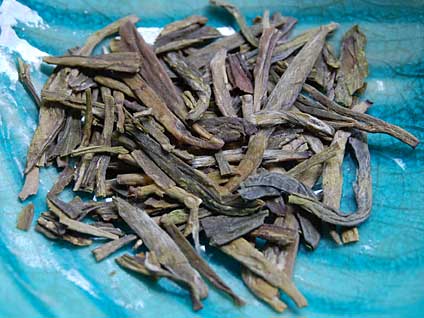
My teapot is filled with a China green called Lung Ching, named after a small village in Zhejiang province, meaning “Dragon’s Well”. Legend has it that a Taoist priest in the 3rd century advised the local villagers to pray to the dragon of a local well to bring rain and end their drought. It worked and the well was named after that dragon. The Dragon’s Well monastery still stands in that spot to this day.

The leaves are carefully plucked by hand and then pan fried in large woks to stop oxidation. Special care taken during processing preserves the whole leaf intact and the motion of the pan frying gives it a unique flat shape. The liquor is a pale yellow with a light greenish tinge and a fresh clean aroma.

The taste is also fresh and clean with a flavor note which reminds me of that first bite of a newly harvested ear of corn.

Time to clean my studio and “batten down the hatches”!

Saturday Morning Tea

When I got up this morning, I discovered that it had rained overnight. The sky now looks like a big gray blanket, overhanging a very wet world outside. The air is very still and a few birds call to one another in the treetops. As we enter the Labor Day weekend, the official end of summer, I can feel a change in the air. Lazy, hazy is being replaced by a cooler more “get down to business” type of energy as school starts again. When I was young, I always loved the start of school because it meant a shiny new pencilcase and a bright box of Crayola crayons with the sharpener on the back. Oh, how I loved to draw and color!

In honor of this ripe, harvest time of year, this morning I am sipping a cup of second flush Darjeeling from the Makaibari estate. The Darjeeling tea growing district is located in northeastern India. When I think of second flushes, words like ripe, grape, heavy and lush pop into my mind. As I gaze out my window, I see our garden, a riot of color, a sea of golden yellow, ruby red and rich magenta.

2nd flush Darjeelings are harvested in the summertime after the tea bush has “flushed” again after the spring picking. With a rich, amber colored liquor, the taste represents the more mature taste of the leaf as opposed to the greener, brighter taste of a first flush. For tea drinkers who enjoy their tea British style with milk, most 2nd flushes offer a stronger taste that one can taste through the milk. I always recommend to try the tea plain first so you can discover what it really tastes like.

A rich fruity aroma greets me as I take my first sip. What is called a muscatel flavor note predominates the taste. Some Darjeelings are described as “muscatel”, a flavor note which speaks of the Muscat grape, said to be the oldest domesticated grape variety.

With this tea, I also detect a slight nutty note with a crisp finish that lingers in the back of my throat. The pungent character of this tea would go very well with rich food, especially a rich dessert like a dark chocolate torte or something incredibly decadent like that. Mmmmm…

Saturday Morning Tea

It is a gorgeous late summer morning here in New England with brilliant sunshine and low humidity. A soft breeze ruffles the treetops as I sit out on my back deck and listen to them sigh. A good morning for sitting out in nature and being still.

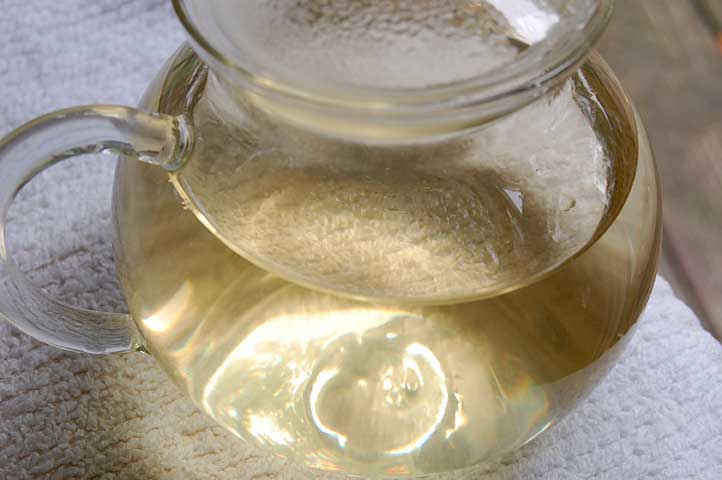
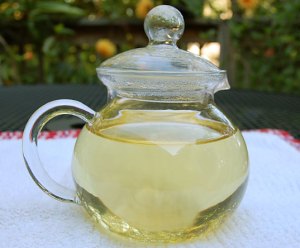
Several weeks ago I reviewed a tea called Heavy Baked Tie-Guan-Yin Oolong and I discovered that I had never reviewed a Jade Oolong, a tea upon which that particular tea is based. Well, this morning I brewed some up in my favorite glass teapot.

Oolongs are allowed to oxidize at varying times thus creating some that are more towards green tea and some that are much darker than that. A Jade Oolong is only oxidized for a short amount of time, about 18%. As you can see, this creates a tea that is very pale yellow.

A luscious flowery aroma greets me as I pour my first cup.

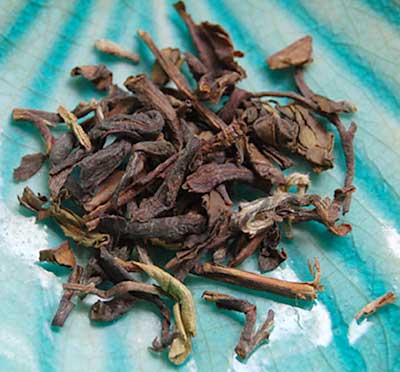
During processing, the leaves are rolled into curly shapes that gently release during the steeping. Sweet and rich, the liquor is buttery soft with a pleasing lilac note. I steeped the leaves in 180 degree water for 3 minutes.

If you want to try multiple steepings, shorten your steeping times.

My youngest son leaves for Basic Training with the Air Force in 2 days. He’s been trying to go early all summer but it didn’t happen. It seems his military training began earlier with this first exercise in patience. I’m so proud of him. Today we are having a big family dinner to send him off with good wishes and love. Between that and a little soreness in my right wrist, my freeform bracelet will also have to wait patiently for my return.

Saturday Morning Tea

The last few days have been filled with tons of lightning, rumbling thunder and more torrential downpours. This certainly has been the summer of storms here in New England. I’m hoping that all of this tumultuous weather will herald in a crisp, clear fall season with plenty of sunshine.The plants are just loving this weather, especially the tropical hibiscus and plumeria on our back deck. They feel like they’re home in the rainforest, I think. One of the hibiscus plants is almost 6 feet tall!

On this cool, misty morning, I felt like something dark and smoky. This morning’s cup is a China black Lapsang Souchong named Gao Ji. To be perfectly frank, I’m not a lover of a very smoky tea like a Lapsang but I want to expand my tastes and give it another try. This particular tea is a lot milder than the characteristic smokiness. I searched for the meaning of Gao Ji and found it in a Pinyin dictionary. The translation to English is “high ranking” or “high grade”.

Lapsang Souchong tea, grown in the Wuyi region of the Fujian province of China, is known for its distinctly very smoky aroma and taste. During its processing, the leaves are dried over wood fires which impart that smoky quality to the leaf. In essence, the leaves are “smoked’ in their drying. The story goes that many years ago the tea processing had to be sped up as armies marched through that region so the villagers dried the tea leaves over open pinewood fires.

A new type of tea was born.

Chinese black or “congou” tea is also referred to as red tea. The liquor on this tea really supports that terminology. The aroma is lightly smoky with a hint of chocolate. The liquor is mild, sweet and lightly winey/smoky, reminding me of a very high quality Keemun. It is smooth with only a passing tang in the finish.

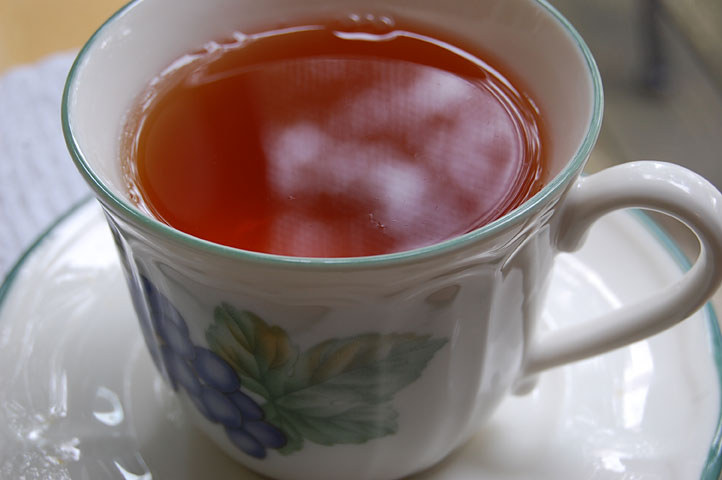
The tea appears much darker in my pottery cup. Whenever it rained, a friend of mine always said that it was a great day for a Keemun. In that spirit, I think that this is a great tea for cooler weather. As we enter the second half of August, we are still over a month away from the official first day of fall but I can feel its whisper in the air already.