Hello friends. As I am leaving very shortly to go see the Dalai Lama speak, I am postponing my Saturday Morning Tea post until tomorrow morning.
Thanks for understanding. See you tomorrow!
Hello friends. As I am leaving very shortly to go see the Dalai Lama speak, I am postponing my Saturday Morning Tea post until tomorrow morning.
Thanks for understanding. See you tomorrow!
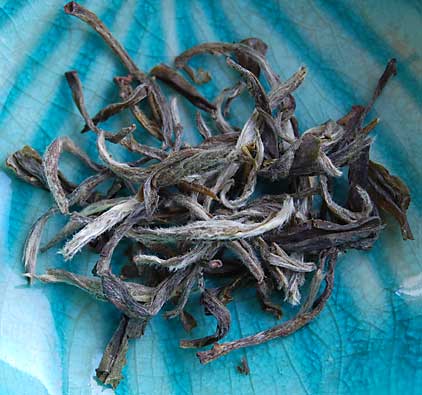
I’m up early on this cool late November morning, contemplating all of the abundance and treasure that fills my life. The hamster wheel of thoughts in my mind can often bring me back to what is lacking or missing in my life, all that I have lost. We all do that from time to time, right? If only I…I should have…why didn’t I? I try so hard not to get caught up in this negative spiral of thoughts. I have found that the best solution in the face of that downturn is to stop myself, take a deep breath and focus on what is actually here, what I do have. So, in the spirit of all that is present in my life, I am sipping a China white tea called Fuding White Treasure. This tea is grown in the Fuding hills of Fujian province.
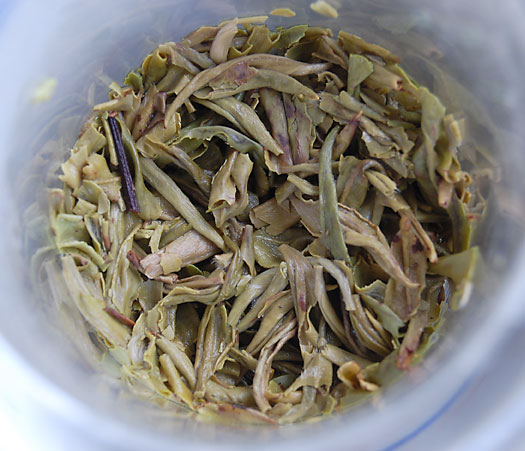 White teas are harvested from a Camellia sinensis var. sinensis (tea plant) varietal that will grow bigger leaves with more downy white hairs on the new growth. It is these fine hairs that give the leaves its whitish look and its name. The silvery white down is accentuated on the dry leaf which then turns a beautiful light green during a 3 minute steeping in 180 degree F water.
 The green look of the wet leaf foreshadows its vegetal aroma and taste, much like that of a very fine green tea. To me, the difference lies in the soft delicacy of this tea, a gentle treasure. I find this tea much lighter in taste than a green tea. It also has a whisper of sweetness that lingers in the smooth finish.
 White tea is hand picked in the springtime, most ideally in cool, dry weather. After picking, the leaves are withered (dried out) in the sun. During adverse weather conditions, the leaves are brought inside to be withered under carefully controlled conditions. The temperature and humidity will contribute greatly to the final taste of the tea so the tea master monitors all of these conditions very closely. After withering, the leaves are roasted or baked to further remove moisture from the leaves and halt oxidation (turning dark). White tea is the least processed of all of the tea categories so the leaf is the closest to its original state which gives it its delicate flavor.
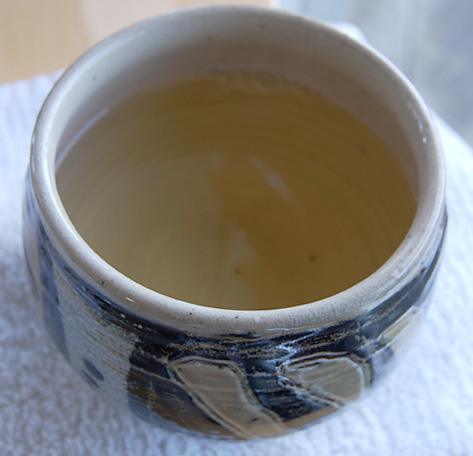 I wrap my hands around my warm teabowl and give thanks for this treasure that is now warming my hands. I love doing that in cold weather, a lovely little ritual that helps me stop what I’m doing and be present in the moment. I focus on the delicious warmth of my teabowl and how wonderful it feels on my cold hands.
What do you do that helps you become present in the moment?

This has been a truly amazing week.
Last Tuesday, history was made with the election of Barack Obama as the first African American man to be president. And, on a more personal note, I became a grandmother for the first time on Thursday night with the birth of my granddaughter, Gabriella, to my son, Brendan, and his wife, Brianna. All is well with Mom and baby and I’ll be happy to share pictures very soon.
I feel hope and new beginnings.
Even the temperature outside is gentle and hopeful, hovering around 60 degrees last night when we left the hospital.
This morning I’ve brewed up a steaming cup of a Golden Tip Yunnan black tea, recently arrived. It was a real challenge finding high quality Yunnan black teas back in 2007 but that seems to have resolved in 2008, and there are some wonderful teas coming in.
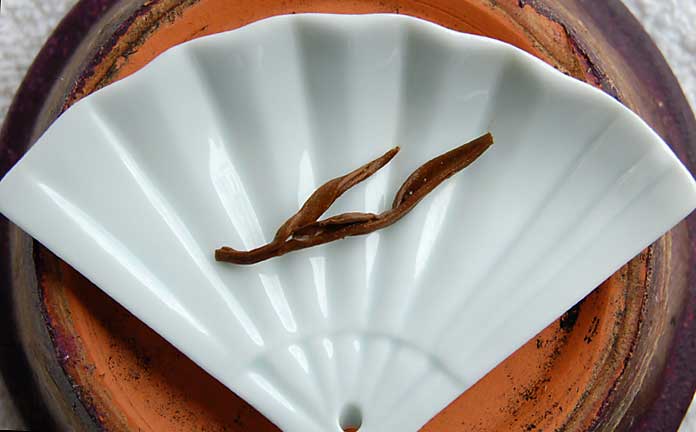 The long dry leaves are soft golden leaf tips with fine white hairs. Many leaves come in leaf sets like the one in my photo. Even though the dry leaf can resemble white tea because of the fine downy hair, this tea is fully processed as a black tea. The sage-y white look of a white tea leaf becomes a brownish golden color in a black tea due to the oxidation of the leaf.
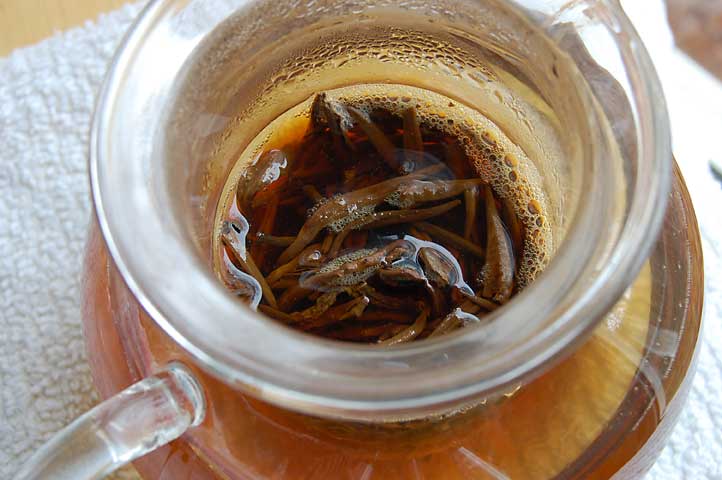 I steeped the leaves in my little glass teapot for 5 minutes in boiling water. The liquor is a deep rust brown color with a sweet fragrance of fall leaf and earth. Each sip of tea fills my mouth with its full body and notes of peppery spice. It’s very smooth and can be enjoyed with a small amount of milk or cream added. With its natural molasses sweetness, there’s no need to add any sugar.
 Today will be a full day in my studio with my teacup by my side as I prepare for an arts and crafts show scheduled for November 22nd at Middlesex Community College in Bedford, MA. Of course, there will have to be breaks in my work so I can go over to the hospital and hold a sweet little angel named Ella.

“So I must rise at early dawn, as busy as can be, to get my daily labor done, and pluck the leafy tea.”
– Le Yih, Ballad of the Tea Pickers, Early Ch’ing Dynasty, 1644
This morning I am welcoming the month of November with a cup of Ruan Zhi Thai Oolong. Tea cultivation and production in the high mountains of Thailand was started and established in the 1980s by Chinese immigrants. What began as small economic activity has grown to a strong community of independent tea gardens.You can read more about the story of the arrival of tea in Thailand in this article.
 The tea is plucked from Taiwanese bushes that were brought over for Oolong tea production and the whole leaves are carefully rolled in the tradition of Taiwan tea crafting. Steeping for 3 minutes in 190 degree water, the leaf gently unfurls to reveal itself beautifully intact. As I lifted the lid of my teapot, I inhaled the delicate scent of lilacs and orchids. The tea liquor is golden yellow with exotic flavor notes of spicy flowers. It reminds me of a Formosa Jade Oolong. You can read my review of that tea here.

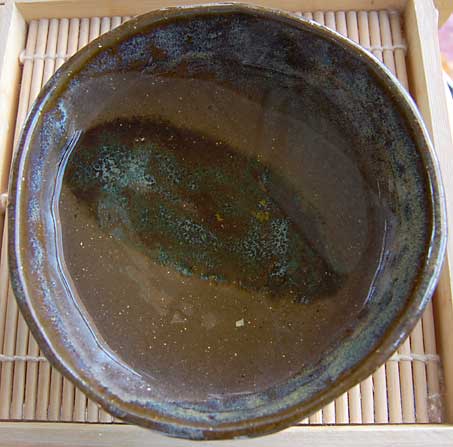 I was poking around in my cupboard this morning and found this simply designed teabowl that I completely forgot I had. I purchased it last year at the Kaji Aso studio in Boston when I attended the Japanese Tea ceremony. The clay is dark brown with white speckles and the glaze looks like it has been applied with a sponge in washes of white, yellow and brown. At the bottom of my bowl lies a shape that one moment looks like a fish and the next moment a leaf. I find myself drawn more and more to bowls and pots of simple Asian design with Wabi Sabi elements of perfection in imperfection.
For the first time in weeks, I have a weekend that is stretched before me with no plans at all. Possibilities…
Have you still got your space?
your soul, your own and necessary place
where your own voices may speak to you,
you alone, where you may dream.
Oh, hold onto it, don’t let it go.
-Doris Lessing

For the final phase of my bracelet, I created a rectangular paper template and placed it underneath my beadwork so I could see which areas needed to be built up. You can make a flowing organic shape that does not have straight edges, if you’d like. Use your imagination to draw any shape template to use as a guide.

Now it’s time to create my clasp. Because my bracelet is wide, I’ve decided to place 4 medium size pearls along the left edge to see how they would look.

I like the look so I go ahead and sew them on one at a time, being careful of the spacing as I bead.

Once they’re all placed on my bracelet, I reinforce them by running the thread back through each pearl. This is an important step to make sure they are securely fastened. You can even go through the beads a third time if the holes in your “buttons” allow it. Switching to a thinner needle can help in this process. Now it’s time to add loops to the other side.
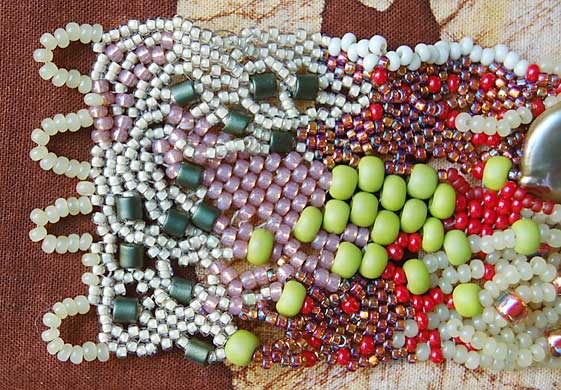
As I add my loops, I peyote stitch between them and check the spacing against the pearls on the other side.

I peyote stitch around the loops to strengthen them and also because I like the look.

My free-form bracelet is complete!
Time to choose a new color palette…
 Art and Tea