Jasmine Blossom Tea

openingjasmineblossom.jpg

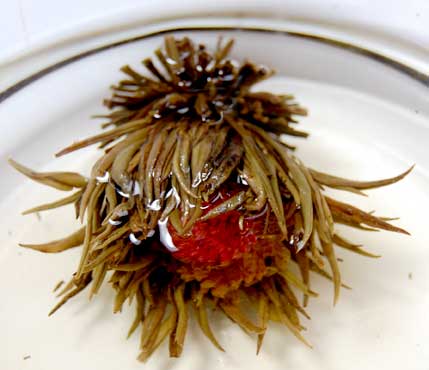
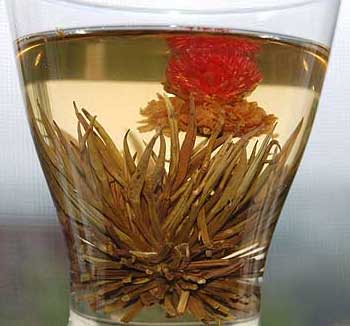
Did you guess what the little “tea kernel’ from yesterday’s post is? Here it is, opening up to reveal its hidden treasure. Meet Jasmine Blossom tea, a specialty hand-tied display tea from China. The leaves are plucked and processed as green tea. Then a bunch of leaves are tied together around a beautiful pink flower which is revealed once the tea is steeped in hot water.

openjasmineblossom.jpg

Once fully steeped and opened, it looks like an exotic sea creature to me. The tea leaves have been scented with blooming jasmine flowers, giving them a delicate floral aroma and taste. This tea is a feast for many senses!

blossominglasscup.jpg

Do you like scented teas?

Saturday Morning Tea – a Hint

jasmineblossomunopened.jpg

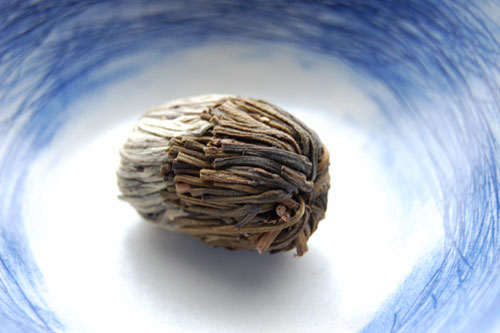
Today I have my polymer clay guild meeting. It is “Goddess” Day and we are going to create little clay Goddesses. A future post. So, as I run out the door to my meeting, I leave you with a hint of Saturday Morning’s tea in the photo above. All will be “revealed” Sunday morning!

Can you guess what it is?

Saturday Morning Tea

fudingdryleaf.jpg

A storm blew through last night with vivid lightning and crashing thunder. The drumming rain washed the world clean and bright with fresh cool breezes that speak of the coming of fall. As the first half of August turns over into the second half, I can feel a shift in the air, signaling cooler days.

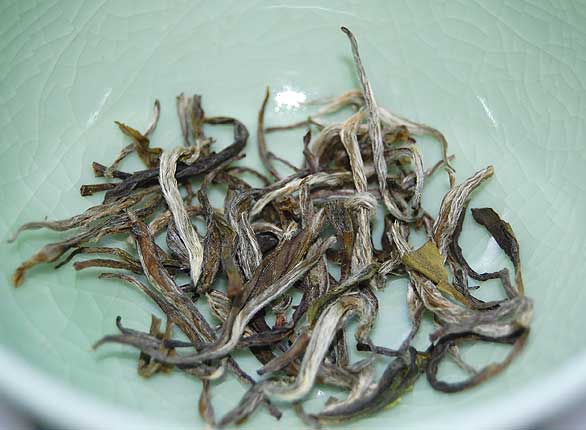
This Saturday morning’s cup of tea is Fuding White Treasure, a China white tea. The dry leaf is full and silvery but look at how the color of the leaf changes after a 3-minute steep.

fudingwetleaf.jpg

The leaves open up and turn a paler green, whispering gently of the springtime when the leaf was plucked. So, just as we are beginning to feel a transformation starting as we move from one season to the next, my little tea leaves have experienced their own transformation as they have infused my water with their lovely flavor and color. The aroma, flavor and color are all very delicate with hints of vegetal and toasty nuttiness. The tea liquor slides like silk over your tongue it is that smooth.

fudingcuppa.jpg

Because of the unoxidized polyphenols in the leaf, white tea is reputed to have health benefits. So, not only does it taste wonderful, it is good for you, too!

What are your experiences with white tea?

Saturday Morning Tea

xuanyi.jpg

A quiet Saturday morning with a gentle breeze coming through the window. My daughter is away on a trip and I am lazily sipping a cup of green tea and recharging from a busy week. This morning my cuppa is China green Xuan Yi, pronounced Schwan-Yee. It is strong for a green tea, with a hint of sweet nuttiness.

xuanyileaf.jpg

“Seek first to understand and then to be understood” I have been thinking about this phrase the last several days. It is the 5th Habit of 7 from the book “The 7 Habits of Highly Effective People”. I haven’t read the book yet but my life coach told me she had been thinking of this phrase in connection with me all week. So, now I am thinking about this phrase and what it means to me. In terms of my art, I think it speaks of discovering and connecting with the world around me first before creating my art. What do you think?

A cup of Oolong tea

acupofoolongtea.jpg

Black tea is created by allowing the leaf to oxidize and turn dark. Green and white teas are created by not allowing the leaf to oxidize. But within the Oolong tea category, the leaf is allowed oxidation at varying levels. There are the “greener” Oolongs, oxidized at 12%-20% and the “darker” Oolongs, oxidized anywhere between 40%-70%. In my photo, I have just brewed a cup of Formosa “Tung Ting” Oolong, a greener Oolong which looks very light in the cup, much like green tea. I am in constant awe that a leaf that is picked from the very same plant can produce such different flavors depending on what happens after that leaf is picked. In addition to its processing, soil conditions also contribute to the tea’s ultimate flavor. To produce an Oolong tea, the leaves are laid out in the sun after picking and allowed a “partial withering”. In other words, the leaves shrivel up. Then they are placed in large bamboo baskets and shaken up periodically to bruise the leaf which allows even oxidation. Oxidation naturally occurs by allowing the leaves exposure to fresh air. To halt the oxidation, the leaves are heated by pan roasting. Knowing exactly when to heat the leaf is a skill that comes from years of experience. Tea masters participate in processing competitions to demonstrate their skill in this fine art. So, in a way, knowing when a tea’s oxidation is complete is like knowing when a piece of artwork is finished. All of the elements are just right and its full expression has been manifested.

A very common way to brew Oolong tea is called “Gong Fu” style. In this method of brewing the tea, a small unglazed ceramic teapot is used and the tea leaves are brewed in multiple short infusions as many as 5-8 times. First, fresh spring water is heated to just under the boiling point, ideally 185-205 Fahrenheit. The teapot is filled 1/4-1/3 with tea leaves and water is added to the halfway point. This water is not for infusing but for rinsing the leaves to rid them of any tea dust. It also allows the tea leaves to “awaken” and start to unfurl. This water is poured off after 10 seconds and then the teapot is immediately filled with water again for the first drinking infusion. The leaves are brewed for 30 seconds-1 minute for the first infusion. Each subsequent infusion lengthens the brewing time. This can always be adjusted to personal taste. Since 80% of the caffeine is extracted within the first 30 seconds of steeping time, each subsequent infusion will be decaffeinated. Even the caffeine sensitive can drink this tea all day and not worry about sleeping at night!

There are so many different flavor notes among Oolong teas from the aromatic, flowery greener Oolongs to the dark chestnut, woody Oolongs. The Silvertip and Fancy Formosa Oolongs have a fruitiness to them reminiscent of a ripe peach. So, drinking an Oolong can be much like an aromatherapy experience, sure to sooth and comfort even on the most stressful of days.

What are your experiences with Oolong tea?