Saturday Morning Tea

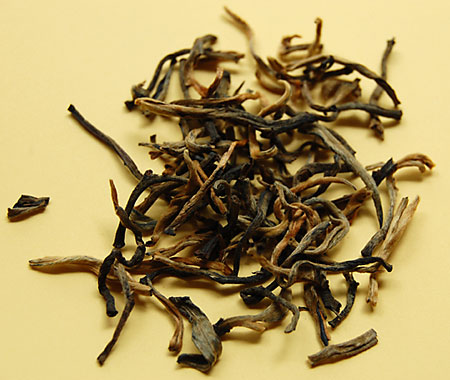
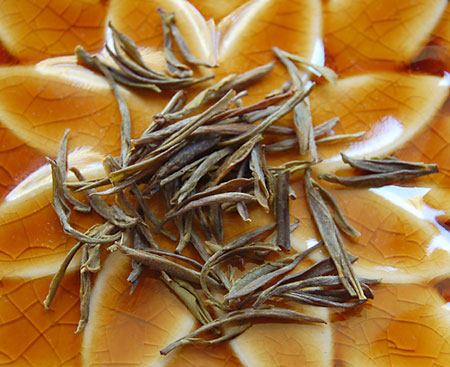
MakaibariFFDry101709

One of my most favorite rites of Spring every year is trying the new first flush Darjeelings as they arrive. Their aromatic fragrance, their brisk character, their fresh flavor…mmmm. But wait, isn’t it autumn now? Well yes, it is, but one of the most interesting first flush teas from the Makaibari estate has just come to my attention and I’d love to share it with you this morning.

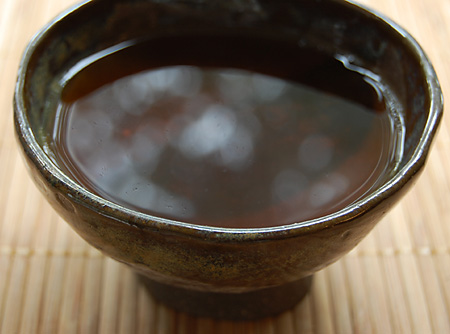
MakaibariFFSteep101709

Called Makaibari estate Long Leaf first flush, it is the 11th lot harvested from their first flush season. The leaves are a gorgeous variegation of color and size. I steeped them in my glass teapot for 3 minutes in 212 degree F (boiling) water.

The Makaibari tea estate is a biodynamic, Fair Trade estate located in the West Bengal state in eastern India. The goal of their agricultural practices, as stated on their website:

“The goal of biodynamic practices coupled with permaculture, to usher harmony between soil, microorganisms, plants, animals and man, is a shining model at Makaibari for all of mankind to emulate….. Makaibari follows a form of integrated forest management called permaculture where the tea bush is part of a multi-tier system of trees and plants typical of a sub-tropical rainforest, as opposed to a monoculture–a farm that grows only one crop. Makaibari retains 70% of its entire area under forest cover.”

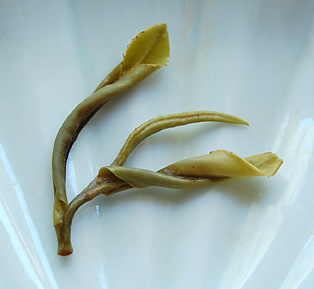
MakaibariFFWet101709

The aroma wafting up from the wet leaf reminds me of a woodland walk.

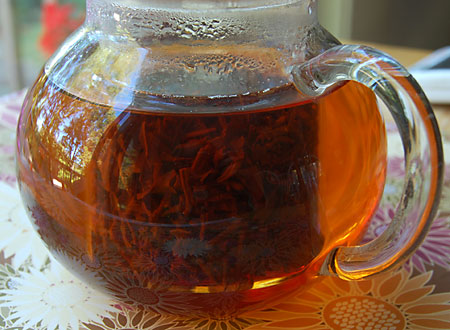
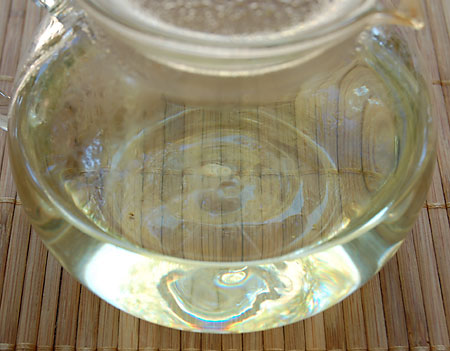
MakaibariFFTeapot101709

The light amber color of the tea liquor reflects the golden autumn palette of our backyard trees. Everything seems to be glowing at this time of year here in New England.

With my first sip, I detect a light citrus quality followed by a nutty note which I find to be very characteristic of Makaibari teas. The tea is smooth and light.
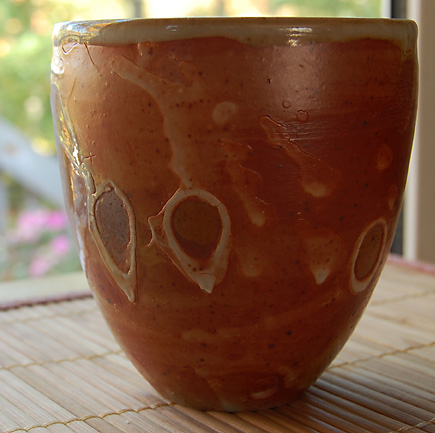
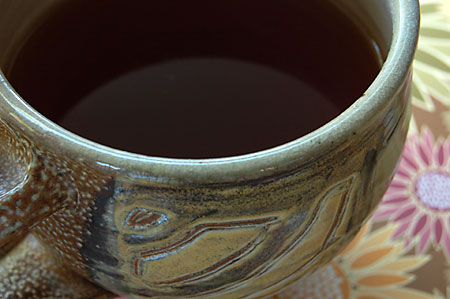
MakaibariFFTeacup101709

My teacup is one that I purchased at Rottenstone Pottery in Arroyo Seco, NM. The potter’s finger marks are still visible from when they dipped the cup into the glaze. I gently place my fingers on those marks and feel connected to the artist of this wonderful creation cradling my beloved tea.

MakaibariFFTeacupRefl101709

This weekend will be spent over at my new place, priming and painting. I just found out this past week that we will be totally gutting the bathroom – walls, ceiling, floor – and starting from scratch. Yesterday afternoon was spent looking through hundreds of ceramic tile choices until my eyes glazed (pun intended, lol) over and I could do no more. Not only are there hundreds of choices but then a multitude of ways to put those choices together in a design. What an amazing learning experience this is blossoming into, in many ways.

…It’s another

beginning, my friend, this waking in a

morning with no haze, and help coming

without your asking!  A glass submerged

is turning inside the wine.  With grief

waved away, sweet gratefulness arrives.

~Rumi (excerpt from So We Can Have What We Want)


Saturday Morning Tea

GyokuroKamDry101009

After several days of rain, the trees are glowing with vibrant washes of gold, russet, ruby and magenta. The wind sighs through the branches, releasing a cascade of leaves that float and dance across the lawn. Autumn has truly embraced us here in New England.

2 years ago I reviewed a tea called Japanese Gyokuro Kamakura, a green tea. You can read that review here. This year’s harvest of Gyokuro is splendid and I am pleased to review it once again.

GyokuroKamTeaptInsde101009

Its deep emerald leaves match the saturation of the reflected autumn palette. The cut of the leaf reminds me of freshly mown grass.

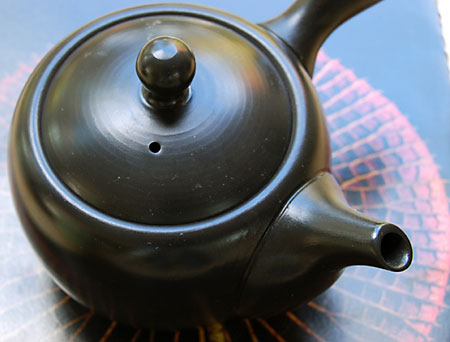
In the purging process in preparation for my imminent move, I found this little beauty tucked away at the back of my kitchen cabinet. It is called a Yokode Kyusu, or commonly known as a Sencha teapot, with the handle being on the side of the teapot. The Japanese word for teapot is kyusu.

GyokuroKamTeapot101009

The strainer, located inside of the teapot at the base of the spout, allows me to steep the leaves directly in the water. I steeped for 3 minutes with 170 degree F water.

GyokuroKamSteep101009

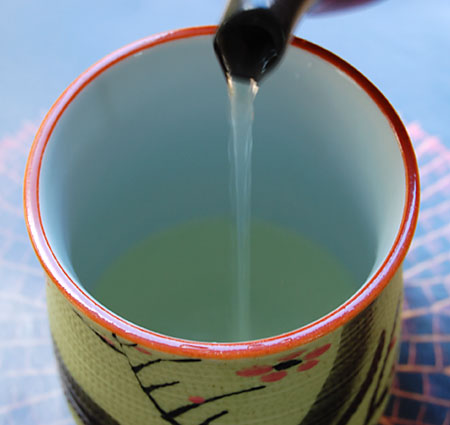
This is the tea that I will recommend to folks looking for a truly green colored tea. Most steeped green tea is not pure green but varying shades of brownish or yellowish green. China Pi Lo Chun even has a pinkish tinge to its liquor.

GyokuroKamPour101009

The first word that comes to mind as I inhale its aroma and take my first sip is fresh.

So very clean and fresh. Delightful! Quite vegetal, with a whisper of asparagus, but oh! so very smooth. No astringency or tang in the finish. As it cools, the smooth quality becomes even more pronounced.

GyokuroKamTeamug101009

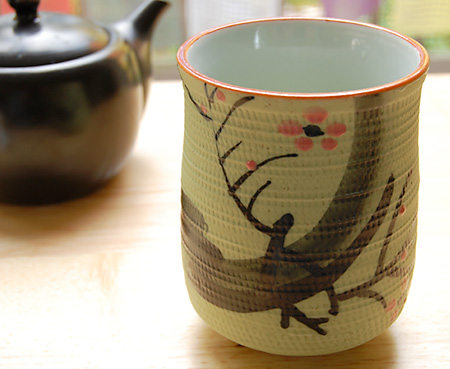
I am enjoying my tea in a Japanese pottery mug I purchased at the Wabi Sabi gift store in downtown Taos, NM. I immediately knew it was my kind of place because as I entered, wide eyed and entranced by all of the teaware surrounding me, I was pleasantly asked by the store clerk if I would like a cup of Sencha tea.

Oh, yes, please.

GyokuroKamTeamug2101009

I am happy and excited to report that after 5 months of waiting, the closing on my condo has finally taken place this past week! This has definitely been a lesson in perseverance and patience and hanging in there for what you truly want. So, starting this weekend, a transformation will begin to take place as I pick up my paintbrush (and roller) and paint Morning Sunshine (Benjamin Moore) throughout my new living room and kitchen space.

The first step in this new chapter of my life…

“A journey of a thousand miles begins with a single step” ~Lao-tzu

Saturday Morning Tea

HubeiGoldenTeacup100309

Hello, my friends. The week has flown by and we are back together sharing another cup of tea.

I awoke very early this morning to the sound of a steady rain persistently tap, tap, tapping at my bedroom windows. As I prepared myself to get up, my sleep fogged brain remembered that it was the weekend and, oh joy, I could indulge in some extra sleep. Don’t you love those kind of mornings, especially when the rain can gently lull you back into your dreams?

HubeiGoldenDry100309

On this gray, drippy morning, I am warming myself with a cup of China black tea called Hubei Province Golden Tips. The profusion of beautiful, golden buds are shown off above on a paint chip called Caribbean Sunset. What do you think of the color?

All of this golden goodness is sure to ward off the dreariness of this sodden day.

Hubei Province is located right in the heart of central China. Its name means “north of the lake”, referring to Lake Dongting, famous for the origin of Dragon boat racing.

HubeiGoldenWet100309

Only the new growth, the tea buds, are plucked to produce this tea. The appearance of the dry leaf reminds me of a golden Yunnan black tea but, after steeping for 4 minutes with boiling point (212 F) water, I discover that the flavor is very different.

HubeiGoldenSteep100309

I’ve been pouring over these paint chips trying to decide on a color to paint my new place. I want to be surrounded with warm, bright color.

The aroma of this tea is dark and sweet. As for its flavor, I have one word.

Smoky. Like hickory smoked bacon smoky.

That being said, it does not overwhelm in its smokiness but gently teases and entices you to want to try another cup.

And another. And another.

HubeiGoldenTeapot100309

Despite, or rather I should say because of, this flavor note, this unique tea has become a fast favorite amongst my colleagues and I and we have been drinking it for our morning tea everyday this past week. It seems strange that my vegetarian nature would enjoy the flavor note that lingers on in my mouth for quite some time like the memory of a haunting melody.

HubeiGoldenTeacupBlur100309

This is the kind of tea that needs to be savored over a period of time so one can slowly get to know and appreciate it.

I thought that I would be painting my new place this weekend but still, no closing. Hopefully, I will be washing Caribbean Sunset onto my walls very soon. Instead, I will be putting the finishing touches on my Taos shrug. Photos soon!

A Voice Through the Door

Sometimes you hear a voice through

the door calling you, as fish out of

water hear the waves, or a hunting

falcon hears the drum’s come back.

This turning toward what you deeply

love saves you.  Children fill their

shirts with rocks and carry them

around.  We’re not children anymore.

Read the book of your life which has

been given you.  A voice comes to

your soul saying, Lift your foot;

cross over; move into the emptiness

of question and answer and question.

~Rumi

Saturday Morning Tea

MelengAssamDry092609

As our weather changes over from the warmth of summer to the crispness of autumn, I’ve been thinking about exactly what is the most ideal weather conditions for growing tea.

A study conducted at Zhejiang Agricultural University on famous tea growing areas in China came up with these ecological climactic characteristics:

“…more amounts of clouds and fog, less percentage of sunshine, abundant rainfall and high relative humidity in the air, temperatures that rise and fall slowly, daily and annual temperature ranges that are smaller, more days that are suitable for tea growing and low wind speeds in the lee-sides and valleys of mountains. All of these factors are favorable for growth of tea trees.”

It appears that high humidity, abundant rainfall, and a smaller range of temperature variables that rise and fall slowly are key to producing the best quality tea.

Another reason I was thinking about the weather is that the conditions in the Assam tea growing region in India this year were not ideal. Drought conditions resulted in a smaller crop and tea that has a harsher, much more intense and astringent flavor to it.

MelengAssamSteep092609

My morning tea is a black tea called Meleng estate Assam. The Meleng tea estate, founded by a Mr. J.E. Jood in 1852, takes its name from a river that runs through the garden. Tea is planted on both sides of the river.

I find myself gravitating towards darker teas as the weather gets cooler and the light levels fall. Why is that, I wonder? Darker weather, darker tea?

With the more intense, astringent flavor in mind, I steeped my Assam leaves in 212 degree F (boiling point) water for only 3 minutes instead of my usual 4-5 minutes.

MelengAssamWet092609

I was delightfully surprised by how much the astringent factor was mellowed out at the shorter steeping time. The flavor was much smoother, revealing a whisper of cocoa. The leaves have a rich, malty aroma and, after steeping, a cooked sugar note wafted up from my teapot.

MelengAssamTeapot092609

The deep russet color of the tea blends with the glorious blue sky reflection in my teapot resulting in a dreamy lavender patch.

I love the colors of tea.

MelengAssamTeacup092609

I drank the whole pot of tea without a drop of milk. That said, my second pot will be steeped longer and enjoyed with milk.

Ah, the variations and joys of tea experimentation…

Only the heart knows how to find what is precious.

~Fyodor Dostoyevsky

Saturday Morning Tea

DongYangDongBeiDry091909

Hello friends! It’s wonderful to be back, sharing a cup of tea with you again. It seems that while I have been away in New Mexico, Fall has arrived on our doorstep and established itself here in New England.

While in Taos, I purchased a lovely lotus plate to display my tea leaves. The color reminds me of melted caramel, all ready to drizzle on a crisp red apple. Mmmm…

This morning I am sipping a cup of China green tea called Dong Yang Dong Bei.  The intact leaf sets show the fine plucking and meticulous hand crafting that takes place during its processing.

DongYangDongBeiWet091909

The tea is grown at approximately 2500 feet above sea level in Dong Yang county in Zhejiang Province in China. It is picked in the spring months of April and May right as the tea bushes are coming out of their winter dormancy.

DongYangDongBeiSteep091909

I steeped the leaf for 3 minutes in 180 degree F water. As I lifted the lid of my teapot to remove the steeping basket, a delicate, floral aroma greeted me. As you can see, the tea liquor is quite pale.

DongYangDongBeiTeapot091909

The first word that came to mind as I poured my first cup was “soft”.

DongYangDongBeiPour091909

Everything about this tea is so soft – the color, the aroma, the taste. It is the kind of tea that brings you fully into the present moment to enjoy its wonderfully delicate qualities. I detected sweet and floral in the flavor notes. As there is only a whisper of vegetal quality, this would be a perfect tea for those tea lovers who don’t especially enjoy a pronounced vegetal (green) flavor.

DongYangDongBeiTeacup091909

After being constantly on the go during my 10-day vacation and then returning to work the day after my evening return, today is a good day for resting, relaxing and enjoying a gentle cup of tea. Or two. Or three.

Stay tuned, dear friends, for tales of my Taos journey…

There are only two ways to live your life.  One is as though nothing is a miracle.  The other is as though everything is a miracle.

~Albert Einstein