Saturday Morning Tea

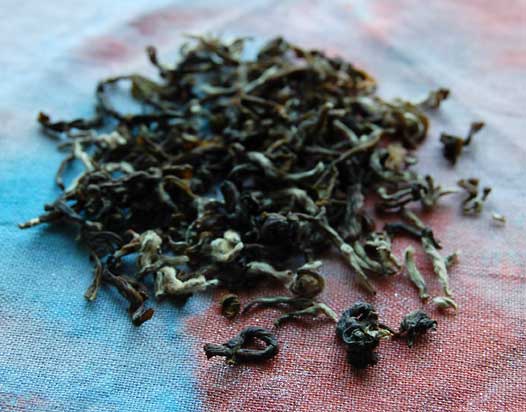
Good morning, dear tea friends! This is the time of year when new lots of China teas arrive, one of them being a favorite of mine called Pi Lo Chun Bao Wei, a green tea. Please enjoy my review of this tea from last November and then next week I’ll review the new lot to see how the two compare. Enjoy your week!

I’ve returned from my trip to New Mexico and am glad to be here, sharing a cup of tea with you once again. As promised, today I am brewing up a pot of Chinese green tea called Pi Lo Chun Bao Wei.

Pi Lo Chun, or Green Snail Spring, is a well-known China green tea from Jiangsu province. Its distinct spiral leaf shape is created during the firing step of its processing. After the fresh leaf is plucked, usually in the morning, it is brought to the factory in either baskets or cloth pouches to protect the leaf and allow for air circulation. Once at the factory, the leaf is spread out on floor mats to air-dry and reduce the moisture content of the leaf.

As Pi Lo Chun leaf must be manipulated during the next step, the firing step, it is placed in short, round metal drums which are placed over a heat source. A gentle twist and roll motion of the hand as heat is applied coaxes the leaf into its characteristic shape, resembling a tiny fiddlehead fern shape. In fixing the leaf into a specific shape, its chi, or energy, remains fixed in the leaf until the moment of steeping when it is released into the cup of tea.

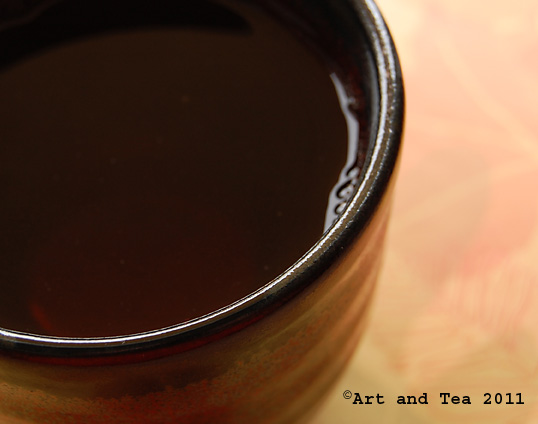
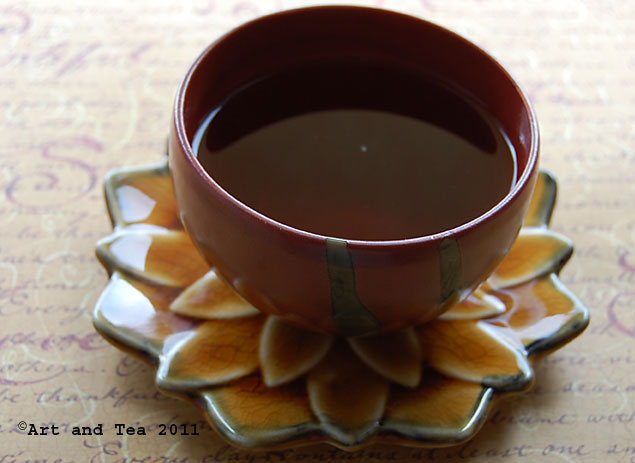
I steeped the leaves for 3 minutes in 180 degree F water. The pale golden liquor gives off a distinctly sweet aroma.

As I take my first sip, a pronounced licorice/anise flavor note surprises me in its intensity. It mellows out as my tea cools revealing a light floral note of honeysuckle. As I usually find a Pi Lo Chun to have fruity notes, this is quite unique. And yummy. Interestingly enough, there are no vegetal notes in this green tea.

As the days shorten and the nights wrap us in a longer, darker cloak, I find myself turning inward in solitude and reflecting upon the year that is flowing towards its end. I find my center and a measure of comfort in the following enduring prayer.

All shall be well,

And all shall be well,

And all manner of things shall be well.

~Dame Julian of Norwich, a 13th century English mystic
Saturday Morning Tea

Good morning, dear tea friends! For this last Saturday in October, I’ve chosen an Assam which has been described as “a stout cup”. I wanted to review an Assam that knocks your socks off in strength and body.

Meet Langharjan estate TGFBOP Tippy.

Langharjan estate is located near the town of Naharkatiya in extreme northeastern India.

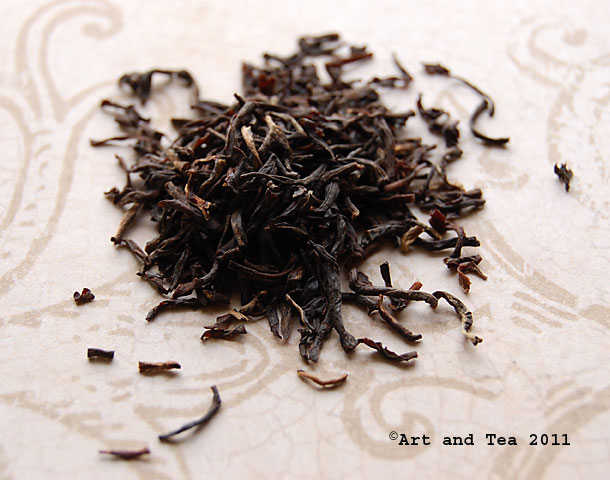
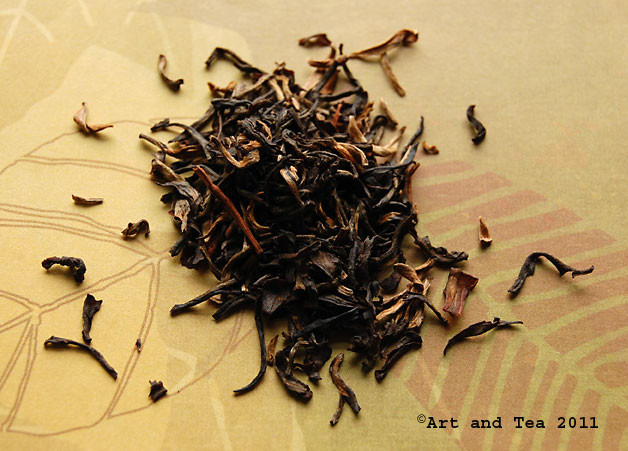
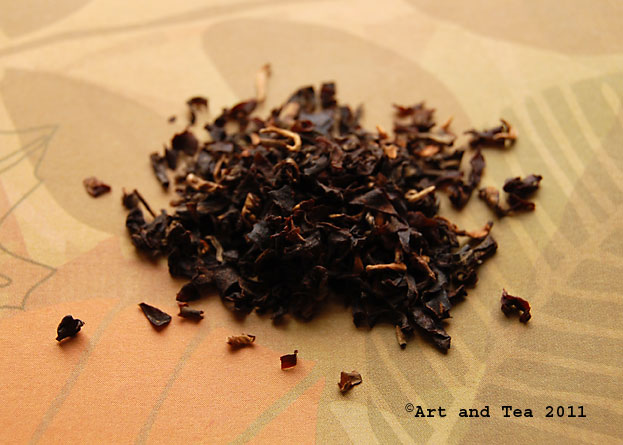
As you can see from the dry leaf above and its leaf designation, TGFBOP or “Tippy Golden Flowery Broken Orange Pekoe”, this is a tea with a lot of leaf tip. I find that the tippier Assams are a lot smoother. And this one is so incredibly smooth.

I steeped the leaves for 4 minutes in boiling point (212F) water.

The aroma is lightly malty and rich with a hint of toastiness.

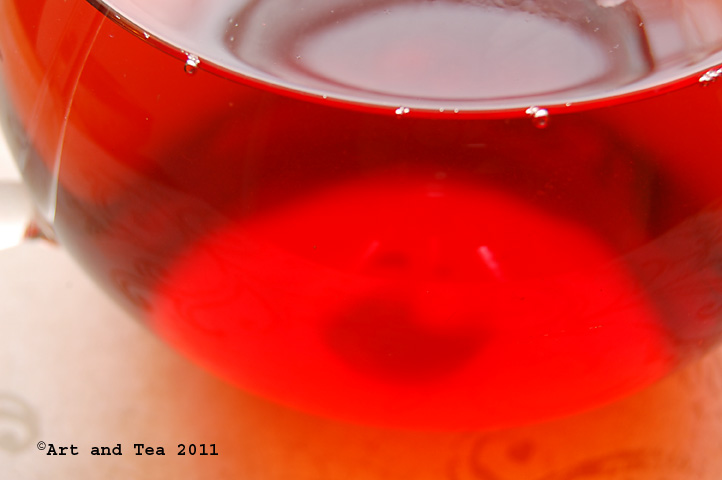
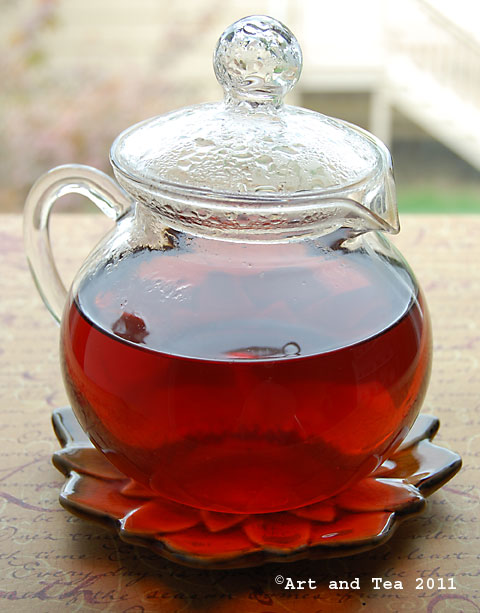
Despite the greyness of the day outside, my teapot glows as if a fire is burning inside of it.

This tea delivers in every way. Rich, malty, smooth as silk, my type of Assam. You could probably coax some astringency out of it by pushing the steep time to 5+ minutes. At that point though you might want to add some milk or cream.

Unbelievably, especially after the winter we had last year, a snowstorm is predicted for our area tonight and into tomorrow. I am not ready for this type of weather again so soon! I will need many cups of tea for comfort as the white stuff descends upon us so unseasonably early.

Stay warm, dear friends, with your hands curled around your favorite cup of tea!

“I like living.  I have sometimes been wildly, despairingly, acutely miserable, racked with sorrow, but through it all I still know quite certainly that just to be alive is a grand thing.” ~Agatha Christie

Saturday Morning Tea

Good morning, dear tea friends! In continuing Assam month here at Art and Tea, I have an unusual Assam filling my cup today, a first flush selection from the Amgoorie estate.

Most Assams are harvested during the summer months, or the second flush season. They are well known and loved for their characteristic full-bodied, hearty, malty flavor profile. This first flush was harvested in the springtime, the first growth of the tea leaves. While the characteristic Assam flavor notes are still there, it usually has a much lighter body.

Even though it’s a whole leaf tea, I steeped the leaves in boiling point (212F) water for only 3 minutes because it’s a first flush and since I wasn’t planning on adding milk. It can be steeped for a longer time if adding milk and/or sweetener, or if you like a brighter quality to your plain tea.

I found this photo of the Amgoorie estate factory. Being a confessed clean freak myself, I’m greatly comforted to know how clean their operation is there. Yes, tea leaves are usually sorted and piled on floors.

The wet leaf has a hint of cocoa aroma that is revealed in its flavor as well. The tea liquor is quite smooth with a fuller body than what I was expecting.

The color in my glass teapot reflects the myriad of oranges and reds flaming across our New England fields and forests.

The flavor is lightly malty with a kick of brightness in the finish.

The last 2 weeks have taken me on a journey I’ve never experienced before. Someone very close to me had major surgery and was in a Boston hospital for 10 days, 5 of those in the ICU. I was brought to a place of seeing and then knowing how your life can change forever in an instant revelation of news we all dread to hear. I felt my heart crack wide open as I traveled each step of the recommended path with my beloved friend and observed the compassionate caring of everyone there to help him through the long process. He is finally home and the healing has begun. Nothing is certain in this life, things change constantly and the best we can do is to live and treasure the moments each one at a time. Until next week, dear tea friends…

“It is by going down into the abyss that we recover the treasures of life. Where you stumble, there lies your treasure.” ~Joseph Campbell

Saturday Morning Tea

Welcome to Assam month here at Art and Tea!

I’m starting off the month with an Assam from one of my most favorite estates, the Mangalam estate. As I look back on my tea posts, I’m surprised to see that I’ve only reviewed a Mangalam once, way back in 2008. You can read that review here.

Assam, located in northeast India, has one of the richest biodiverse climates in the world with tropical rainforest, bamboo and deciduous forests, grasslands and wetlands. The tea plant, Camellia sinensis, was found growing wild there in the 1830s, one of the few areas in the world where tea is a native plant.

I’ve read that this estate was named after one of the estate owner’s sons (who later became one of its managers) and that the word Mangalam means “auspicious” in the Sanskrit language. The estate was founded in 1973.

When I opened the tea packet, a hint of cocoa wafted up from the dry leaf. There is a profusion of beautiful golden tips (new growth) peppered amongst the deep brown whole leaf.

I steeped the leaves for 4 minutes in boiling point (212F) water. I discovered that for enjoying this tea plain, this is the perfect steeping time.

The tea liquor’s aroma is rich with a hint of malt and red wine. The flavor is silky smooth with a thick mouthfeel and a sweetness that lingers on my palate. It has a richness that would stand up well to any additions but if you are going to do that, I recommend steeping the leaves for longer than 4 minutes. As always, experiment and see what works best for you.

Even on this grey, drizzly day, the tea glows like rich antiqued copper in my glass teapot.

This tea is a great choice for anyone who doesn’t like the characteristic astringency of Assam. Speaking of astringency, one thing to watch out for is no matter how you steep the loose tea leaves, make sure that all of the leaf, including the smallest bits which might escape from your infuser, are removed from the tea. Those small bits not removed will continue to steep in your tea and lend more astringency to the flavor.

My parents are visiting me next weekend so there won’t be a new tea review next Saturday. However, I will search my archives and post another “oldie but goody.” Until next time, dear tea friends, I wish you many delicious cuppas…

October by Robert Frost

O hushed October morning mild,

Thy leaves have ripened to the fall;

Tomorrow’s wind, if it be wild,

Should waste them all.

The crows above the forest call;

Tomorrow they may form and go.

O hushed October morning mild,

Begin the hours of this day slow.

Make the day seem to us less brief.

Hearts not averse to being beguiled,

Beguile us in the way you know.

Release one leaf at break of day;

At noon release another leaf;

One from our trees, one far away.

Retard the sun with gentle mist;

Enchant the land with amethyst.

Slow, slow!

For the grapes’ sake, if they were all,

Whose leaves already are burnt with frost,

Whose clustered fruit must else be lost–

For the grapes’ sake along the wall.

Saturday Morning Tea

Fall has arrived under a grey blanket sky. We’re in a rainy weather pattern here in New England and I don’t think we’re supposed to see the sun for a week. It’s a good day for a rich, warm Assam black tea in my morning cup, this one from the Banaspaty estate, a small organic tea garden tucked into the hills of Kabi Anglong district in northeast India.

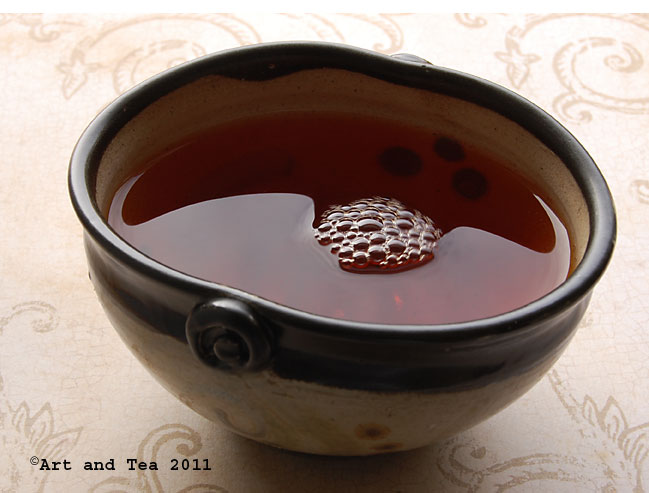
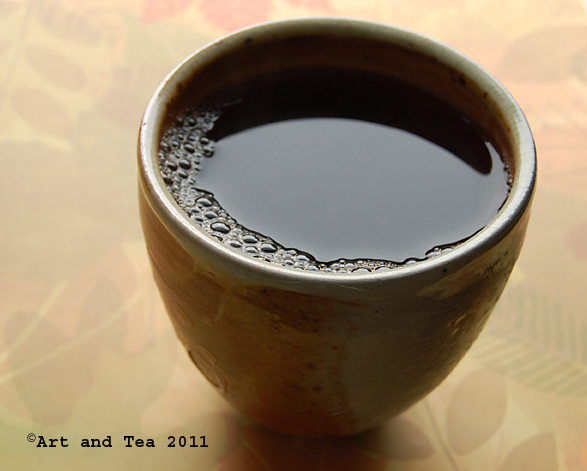
This particular Assam is a broken leaf tea so I steeped it for only 3 minutes in boiling point (212 F) water. Assams have such a gorgeous russet color, don’t they? It reminds me of the warm colors of the setting sun.

The wet leaf has a pronounced malty aroma, foretelling of its rich malty flavor notes. As I took my first sip, I detected a crisp astringency that could be enjoyed plain or toned down with a splash of milk.

There’s nothing like a pot of tea to brighten up a gloomy day.

As my tea cooled, some fruity hints were revealed, darkly sweet like the sweetness of raisins. We’ve just received a big shipment from India so I look forward to reviewing more Assams in the weeks to come. Shall I make October Assam month? Or do you like to read about a different type of tea every week? I welcome your feedback!

Have a wonderful week, dear tea friends…

“The ordinary acts we practice every day at home are of more importance to the soul than their simplicity might suggest.”  ~Thomas Moore