Saturday Morning Tea

A happy Labor Day weekend to one and all! Are you saying to yourself: now where did the summer go? Those long, hazy days seem to always fly by, quickly fading into the coolness of the fall.

This morning I’m enjoying a cup of Ceylon black tea from the Manikkanda estate. It has a leaf style designated as “FF” or “Fancy Flowery”, a special production from this particular estate. I believe the FF means that there is an abundance of golden tip, or new growth.
Historically named Ceylon as a British crown colony, the name is an English translation of the word Ceilão, a name given to the island by the Portugese in 1505. The island officially became known as the “Free, Sovereign and Independent Republic of Sri Lanka” in 1972 and then in 1978 to the “Democratic Socialist Republic of Sri Lanka”. A Sanskrit word, Sri Lanka translates to “venerable island” in English.

The Manikkanda tea estate is located in the southwestern Galle district, a district of the Southern province at the southernmost point on the island.

I steeped the leaves for 4 minutes in boiling point (212 F) water, producing a rich russet liquor with a brisk aroma.

Look at that gorgeous color, a deep glowing fall color.

The tea liquor wakes up my palate with its brisk astringency and sweet flavor. I’m enjoying my tea plain but I bet it would taste great if you wanted to added milk and/or sweetener. This tea would also make a wonderful iced tea for those remaining warm days of late summer.

Enjoy this long weekend, dear tea friends!

“September’s song is a two-part harmony, as summer’s lighthearted serenade ends and a deeper melody begins.” 

~Sarah Ban Breathnach

Saturday Morning Tea

I’ve felt a shift in the air this week as we enter the second part of August. The sun sets earlier, the nights are cooler and I’ve even caught the faint whiff of woodsmoke as folks start to get a little cozier in the evenings by the fireplace. Lowe’s has row upon row of chrysanthemum pots in beautiful fall colors and rich burgundy blooms now adorn my front porch.

With a cooler breeze wafting in my windows, it’s the perfect morning for an Assam tea. Just as I love first flush Darjeelings in the springtime, I always enjoy Assam teas best in the fall. Their rich warmth is a wonderful balance to the cooler temps here in New England.

The Assam tea growing region is located in northeast India and the teas produced in that area were my first tea love. Their dark, full body reminds me so much of the tea my Mom used to drink when I was young. As the granddaughter of Irish immigrants, she always enjoyed her “cuppa”. And, of course, that’s what I was served whenever I wasn’t feeling well. So, as I grew up, I always associated black tea with comfort and feeling better.

My morning tea is an Assam from the Marangi estate, a 700 acre tea garden located in the hills of Assam. Every season there are a few outstanding teas that embody the best qualities of an Assam tea. This tea is definitely one of those teas!

The leaf is generously laced with golden tip, indicating a premium tea. I find that the golden tip also smooths out the astringency level in the tea liquor. This tea is a fine example of that as it is just smooth as silk.

I steeped the leaves for 5 minutes in boiling point (212 F) water. While the tea is very hearty and would stand up well to milk or cream, I’m drinking mine straight up.

The aroma is rich and malty which carries on into the complex flavor. Layers of malt are enhanced with a hint of dried fruit sweetness. This tea is a real treat!

Note to self: this would be the perfect birthday gift for my Assam loving friends. For myself, it would make the perfect companion to a cinnamon crunch bagel from Panera Bread!

What is your favorite tea in the fall?

“Autumn to winter, winter to spring,

Spring into summer, summer into fall—

So rolls the changing year, and so we change;

Motion so swift, we know not that we move.

~Dinah Mulock Craik

Saturday Morning Tea

I sit here quietly and sip my tea, the sounds of summer all around me – the faint buzzing of a lawn mower, the electric sound of the cicadas in the trees, the caw-caw of one crow to another as they fly over my house. As we enter the warm, hazy days of late summer, the fuschia impatiens dress my garden in their rich color.

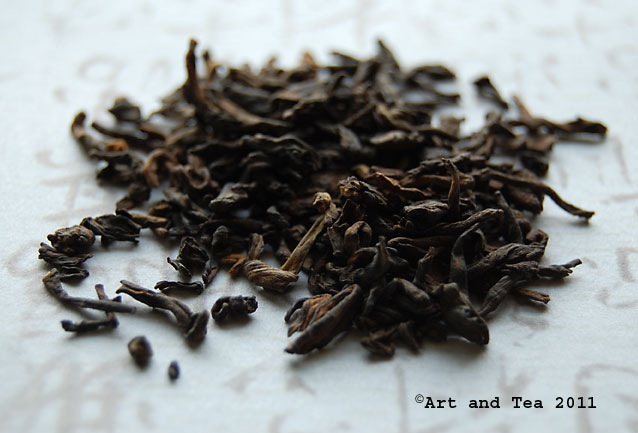
In my cup this morning is a very dark tea, a China tea called Organic Pu-Erh 2nd Grade. Back in June, I wrote about the 1st grade here.

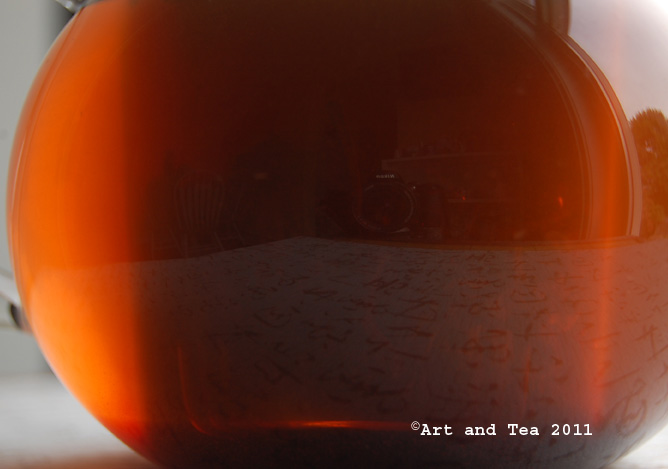
I steeped the leaves for 8 minutes in boiling point (212 F) water and, as you can see, the water quickly gets very murky on its way to becoming as black as night. Pu-Erh goes through a “composting” step during its processing. The leaves are piled into heaps, much like a compost pile, creating a heat in its core and transforming the leaves into this very unique tea.

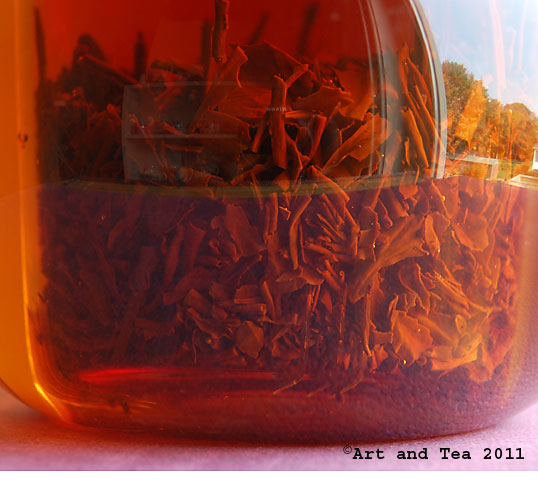
Everything about this tea is so dark – the dry leaf, the wet leaf and the tea liquor after steeping. A rich, sweet, earthy aroma rises from my glass teapot as I remove the infuser basket.

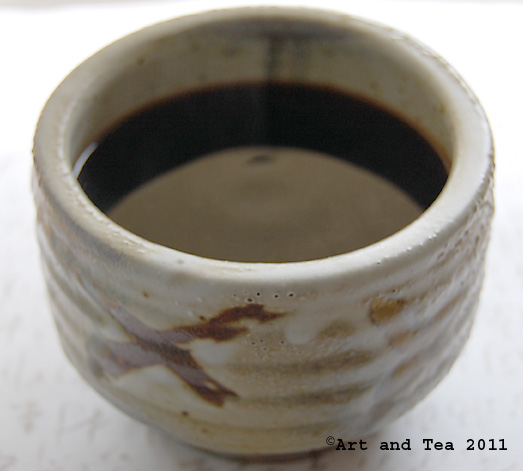
I find that if I gaze at the tea liquor long enough, I can see a mulberry tinge around its edges. Can you see it?

The flavor is mellow and quite smooth, not as strong as its aroma. Characteristic notes of autumn leaf and forest floor mingle with a sweet molasses syrup flavor. I find myself enjoying it more and more with each sip.

While I was visiting my family in Michigan last month, we visited a quaint little village called Saugatuck, located on a river very near Lake Michigan. As we were strolling the shops, I came upon a pottery shop and purchased a few teabowls there. The artist’s name is Jeff Blandford and his business is called Volmod Ceramics. Voluptuous. Modern. Ceramic. He had some really cool pieces. As he was ringing my purchase, he told me that the teabowls I chose were created during a very creative time at the end of his student days at Michigan State University, over 3 years ago. So, I’d like to think that these lovely teabowls were sitting on the shelf patiently waiting for me to come along and bring them home to Massachusetts with me so I could enjoy many tea moments with them.

Until next week, dear tea friends…

“The world is round and the place which may seem like the end may also be only the beginning.”   ~Ivy Baker Priest

Saturday Morning Tea

This morning I’m enjoying another tea from the Jun Chiyabari estate in Nepal. Called Himalayan Oolong, it reminds me very much of a tea I reviewed about a year ago in this post.

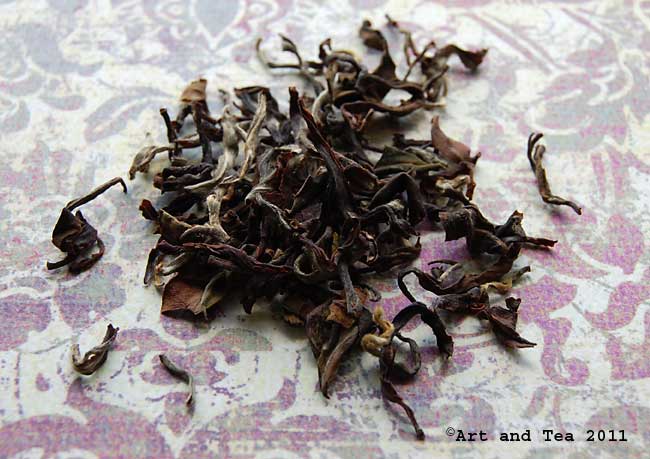
The leaves look very much like an Oolong tea, large and rolled, yet there are some differences in the taste, creating a tea, in my opinion, whose flavor notes are a melding of Oolong and Darjeeling. As I said in a previous post, their Himalayan Oolongs are created with a secret process resulting in a black tea with the characteristics of a Silvertip Oolong tea. True Silvertip Oolong teas come from Taiwan (Formosa).

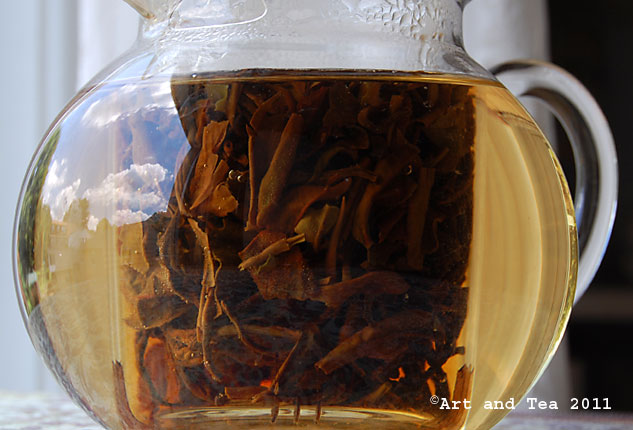
The dry leaf gave off a sweet cookie aroma as I spooned the leaves into my glass teapot. Since they’re so huge, I used 2 teaspoons per cup. I steeped the leaves for 4 minutes at a water temperature of approximately 185 degrees F. Based on my experience several weeks ago, I’m trying a longer steeping time initially. After steeping, I detected a light floral aroma in the wet leaf, a faint whisper of a green Oolong’s (like Spring Dragon) floral characteristic.

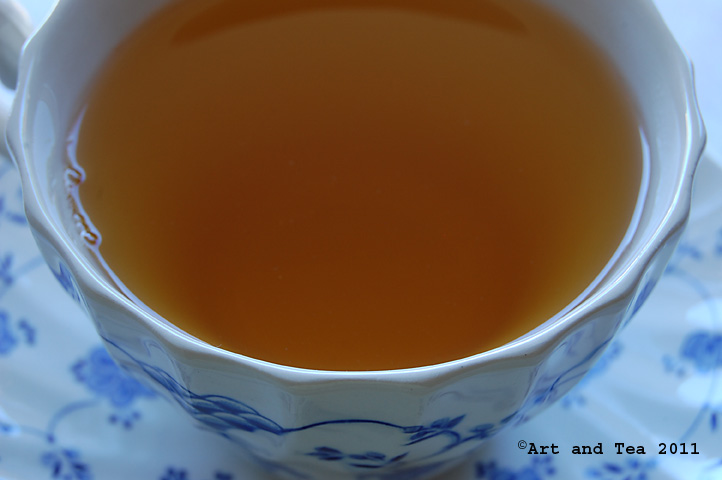
As you can see, the tea liquor is a lighter amber color than the Himalayan Oolong I reviewed last year. It’s also lighter-bodied in the cup. The flavor is rich and fruity and quite smooth. I might try steeping for 5 minutes at the lower temp and see what happens.

Isn’t it fun to experiment with your tea and see what happens? Some wonderful surprises and some….well…I guess that didn’t work. But then you know and you go on from there.

Some people like to stick with a tea and try different steeping times until the flavor suits them and others don’t want to be bothered with the “fuss”. One’s not right and one’s not wrong. They’re just different ways of approaching something. I think you can tell which way I am. Which way are you?

“It is the soul’s duty to be loyal to its own desires.  It must abandon itself to its master passion.”  ~Rebecca West

Saturday Morning Tea

I’m back from vacation and feeling rejuvenated despite a busy return to work this week. I’d like to share an interesting experience I had a few days ago. My colleague brewed a pot of a newly arrived Castleton estate second flush Darjeeling and the first word that popped into my head as I took my first sip was

PHENOMENAL!

It had a honeyed peach aroma with rich peach and muscatel flavor notes.

Ambrosia.

Naturally, we all requested it for our morning tea the following day. As I took my first sip that morning, I thought I had poured the wrong tea into my cup. While it was a very good Darjeeling, all of the wonderful flavor notes I had experienced the day before weren’t there. As my tea cooled, however, I detected them but they were very subtle.

So, what happened?

Different steeping times.

The first cup was steeped at 4 minutes and the second at 3 minutes. What a difference a minute makes, huh?

Look at this gorgeous leaf. It’s huge and chock full of tips/intact leaf sets.

Just like your water source can make all the difference in your resulting cup of tea so too can your steeping time. In light of my recent experience (and it’s happened to me before), I highly recommend that you experiment with different steeping times to find what works best for you. A tea you don’t like with your first cup could end up being your favorite tea by just making an adjustment to the steeping time!

This is the tea steeped for 3 minutes in boiling point water – a glowing medum amber hue.

The cup on the right is the tea steeped for 4 minutes. The color goes deeper and the peach/muscatel aroma and flavor are much more pronounced.

As my tea cooled, I was expecting the longer steeped tea to develop that characteristic “bite” but it never did. I might even try this tea steeped for 30 seconds longer. I like to push the steeping time to just before it develops that bitterness, that well known bitterness of being oversteeped.

So, I encourage you, dear tea friends, to experiment with the steeping times for your tea. That being said, however, I think that it’s best not to change the water temperature or the amount of tea leaves used per cup.  Those should remain consistent.

For this tea, I used 2 teaspoons of leaf per cup since the leaf is so huge and boiling point water.

Do you have a story similar to mine? If so, please share!

Enjoy your weekend!