Saturday Morning Tea

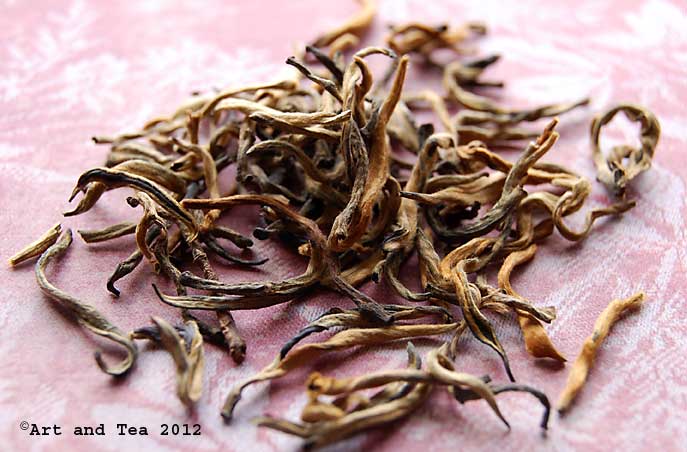
Even though I reviewed a Yunnan black tea very recently, I just couldn’t resist this morning’s tea. Just enjoy gazing upon that gorgeous leaf filled with warm golden tips, named quite fittingly Golden Tip Yunnan.

As evidenced by the intact tip, this tea is plucked and processed meticulously by hand. It shows that very special care.

In steeping the leaf, I used boiling point water (212F) for 5 minutes.

Ah, there are those little swords again except this time in a black tea. I know I’ve said it many times before but it constantly amazes me how many different kinds of tea can come from one kind of plant.

In Yunnan province, ancient tea plants have grown into large trees producing enormous sized leaves. These leaves are traditionally used to produce Pu-erh tea. I imagine a grove of venerable old trees having seen many changes around them over the centuries.

The tea liquor glows like a sunset in my glass teapot. An aroma of sweet peach nectar arises as I pour my first cup. My first sip is like ambrosia on my tongue with notes of peach and spice. Full-bodied and complex, the rich flavor lingers on my tongue like a fine wine.
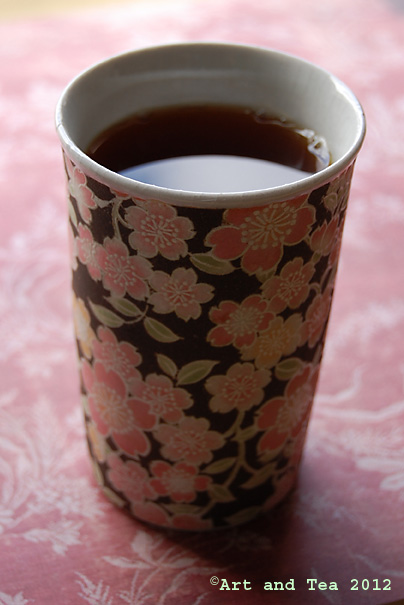
It has now been one year since the earthquake in Japan and I honor them by enjoying my tea in one of my Japanese mugs. The cherry blossoms symbolize new growth and hope for continued healing in their country. I have heard positive reports for the 2012 tea harvest over there and hope that I will have the opportunity to review some new Japanese teas here soon.

Time to go pour another cup! Enjoy your week, dear friends.

“I find hope in the darkest of days, and focus in the brightest.  I do not judge the universe.”  ~Dalai Lama

Saturday Morning Tea

Good morning, dear tea friends! You must be wondering about the picture above – now where are the tea leaves? They are there. They’ve just been compressed. If you look closely, you can see the outline of a few leaves. The tea in my cup this morning is called Pu-Erh Mini Squares.

I know, I know, it sounds kinda like a breakfast cereal. But, of course, it’s not, it is a rich, full-bodied China tea from the mountainous Simao region of Yunnan province.

As I’ve written about before, Pu-ehr tea is divided up into 2 classifications, raw and cooked, depending upon the processing method. This particular tea falls into the cooked category. It undergoes a double fermentation not unlike what happens in a compost pile. The leaves actually begin to decompose, giving them a strong earthy taste when steeped. For this particular tea, the leaves have been steamed after processing and then pressed into a large, flat “cake”. After it dried, the “cake” was then cut up into small squares, each square perfect for preparing a 6-8 ounce cup of tea.

To aid in full flavor extraction during steeping, I broke the square up into little pieces. This is fairly easy to do with your hand. If you experience any difficulty, I find that a hammer helps to start that process. Please watch out for your fingers! I steeped the broken pieces for 5 minutes in boiling point (212 F) water.

This traditional compressed form of tea has been produced in China for hundreds of years. It was the most common form transported on the ancient caravan routes because it was less susceptible to physical damage and easier to transport.

The tea is so incredibly dark, like the darkest chocolate. A sweet earthy aroma rises from my glass teapot as I pour my first cup.

Although this tea has that quite distinct Pu-Erh flavor of earth and forest floors, it is lighter than other Pu-Erh teas I’ve tried. And it is so incredibly sweet and smooth. There is also a whisper of dark cocoa that lingers in my mouth with each sip. I’m quite enjoying this tea!

I’m spending the day today with my daughter and granddaughter. A girls day! I’m so looking forward to it. More good news – I might have an art post to share with you this week. Stay tuned…

Have a wonderful week and enjoy your tea!

Saturday Morning Tea

Good morning, dear tea friends! A couple of weeks ago at work, I took part in a cupping of some China green teas – the Chun Mees and the Young Hysons. This morning I have brewed up a pot of my favorite tea of that grouping – Chun Mee Moon Palace. I do admit that part of its charm lies in its cool name but, for me, it really shined in its flavor.

The name Chun Mee translates to “precious eyebrows”. After withering and steaming, the leaves are rolled into thin curved shapes resembling a porcelain doll’s eyebrows. I wrote about another lot of Chun Mee here.

The Chinese are very fond of naming their teas.

I steeped the leaves for 3 minutes in 180 F water as I do with most green teas. After steeping, the leaves look more like bushy eyebrows, don’t you think?

The deep yellow liquor gives off a fresh vegetal fragrance. The flavor is also vegetal, lightly so with pronounced fruity nuances, like pear and melon. It is the fruity nuances that make this tea so enjoyable for me. As my tea cooled, it got sweeter.

As I continued to sip this tea, an astringency began to flower, leading me to think that I probably oversteeped it. So with my next pot of tea, I’ll experiment by pulling back on the steeping time, probably starting with a 2 1/2 minute steep and then possibly working back to a 2 minute steep.

As I’ve talked about before, it’s amazing how different a tea can taste when you adjust the steeping time a small amount of time. I like to be open to the positive qualities of a tea and believe that I can develop a relationship with it with some minor adjustments. Too often I hear stories of folks thinking that something is wrong with a tea after just one steeping. I encourage everyone to experiment and see what works best for them. After that period of experimentation, if you still don’t like it, well, that’s just what it is – you just don’t like it. It doesn’t necessarily mean that there’s something wrong with the tea. Enjoy the journey!

Next week I will be attending my art guild meeting so there won’t be any new tea post on Saturday. I’ll be back in 2 weeks to share another cup of tea with you. Until then, dear friends, happy sipping!

“Thousands of candles can be lighted from a single candle, and the life of the candle will not be shortened. Happiness never decreases by being shared.”  ~Buddha

Saturday Morning Tea

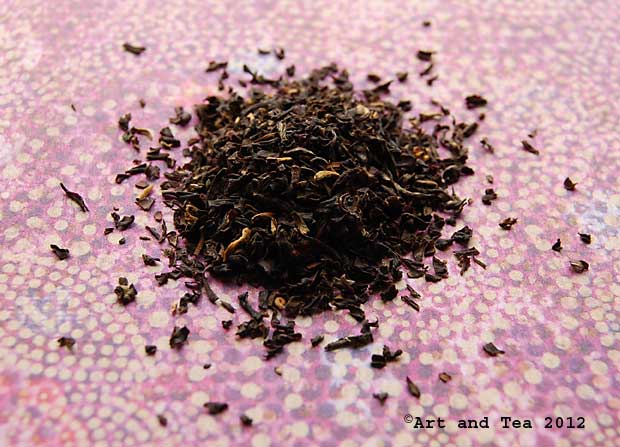
A couple of days ago, we did a Yunnan black tea cupping at work, comparing 8 of our current Yunnan selections. I enjoy the cuppings very much because I find it so interesting to taste the teas side by side and discern their similarities and differences, especially within a category. So, with that cupping still fresh in my mind, I chose one of those Yunnan teas as my morning tea today. It’s the only broken leaf one of the group, called Yunnan FBOP (Flowery Broken Orange Pekoe).

From mountainous Yunnan province in southwestern China, this black tea consists of mainly dark leaf with a small amount of yellowish tip sprinkled in. Yunnan teas have traditionally been plucked from very large, old tea trees but I have heard that some of those trees are being cut down or cut in half to make way for monoculture plantings. Hearing that makes me sad but I also know that demand is up for these teas and perhaps that is how they’re accommodating that demand.

I steeped the leaves for only 3 minutes in boiling point (212 F) water. The aroma wafting up from the steeping leaves is sweet and earthy.

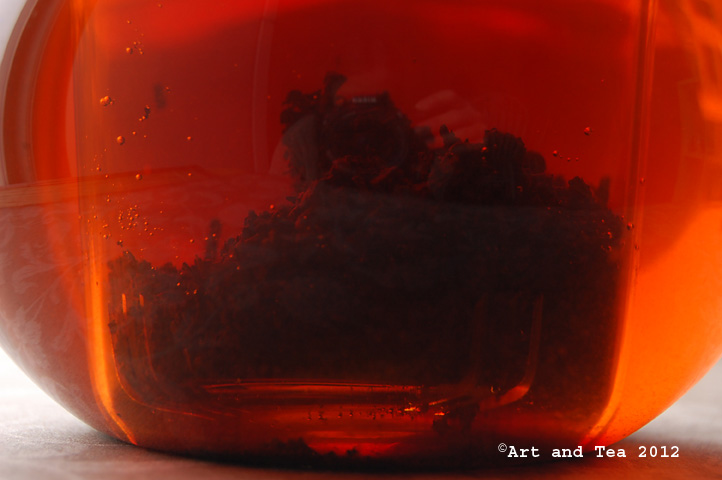
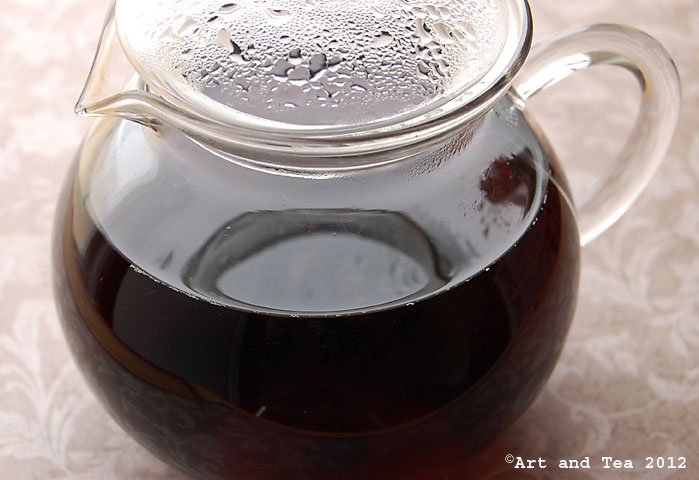
The Chinese have traditionally called black tea “red tea” and you can certainly see why as the tea glows a gorgeous russet color in my glass teapot.

The flavor is so incredibly sweet with notes of pepper and earth and a whisper of smoke. The sweet and smoke linger in my mouth reminding me of sweet pipe tobacco. This tea would stand up to milk well but I don’t recommend any sugar because it is plenty sweet already.

I like my wide mouth tea bowl because it allows the tea to cool quickly, revealing the flavor notes. I find it hard to pick out all of the flavor notes when the tea is really hot. How about you?

We had a dusting of snow fall from a gray blanket sky this morning, however, it must be warming up outside because the snow is gone and everything just looks damp now as I gaze out my window. I’ve recently ordered some metalworking supplies, a disk cutter and a dapping set. I’m looking forward to getting back into my studio after an incredibly long period of drought. Way too long…

Happy tea drinking!

“Clouds come floating into my life, no longer to carry rain or usher storm, but to add color to my sunset sky.” ~Rabindranath Tagore

Saturday Morning Tea

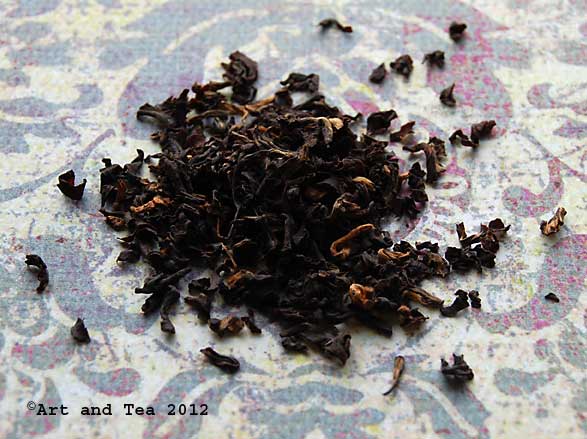
Good morning, dear tea friends. It’s great to be sharing a cup of tea with you once again. On this brisk, blue sky morning, I’ve brewed up a pot of a broken-leaf Assam from the Daisajan estate. As you can see, the broken bits of leaf are fairly large with a sprinkling of tip (the yellowish leaf).

I’ve read that this estate’s name derives from the Assamese words “Doichha Jaan”, meaning “the river with two heads”. It’s located in the Doom Dooma district in the northeast tip of Assam in India, an area once covered in jungle and populated by elephants.

I steeped the leaves for 3 1/2 minutes in boiling point water. As I lifted the infuser from my glass teapot, I noted a rich malty aroma with nuances of red wine. The aroma hinted a stout cup and, to me, that usually means astringency, the kind you can feel in your teeth. Boy, was I surprised.

I was amazed at the silky smoothness of the tea liquor. All of the broken-leaf intensity was there with a fullness suggesting incredibly dark chocolate, the 88% cocoa kind (my favorite).

So dark yet so amazingly smooth. Notes of malt and red wine mingled with the dark chocolate fullness.

If you enjoy milk in your Assam, I would recommend experimenting with pushing the steep time on this one, perhaps 4 minutes or so.

This is a great selection for coffee drinkers who want to transition over and explore the world of tea. Now, I don’t drink coffee anymore because of my sensitivity to its caffeine but I remember that bitterness in a cup of coffee that isn’t quite astringency but could be likened to the bitterness of dark chocolate or a really dark beer. To me, anyway. That is present in this cup but I don’t want to use the word bitter because, in tea, it is used to describe oversteeping. Forgive me if my description falls short of clarity. The bottom line is I love this Assam, in fact, I’d go so far as to say it’s my current favorite.  And for this Darjeeling fanatic, that’s saying a lot!

Enjoy your week and your tea!

“I long, as does every human being, to be at home wherever I find myself.”

~Maya Angelou