Saturday Morning Tea

Good morning, dear tea friends! For this last Saturday in October, I’ve chosen an Assam which has been described as “a stout cup”. I wanted to review an Assam that knocks your socks off in strength and body.

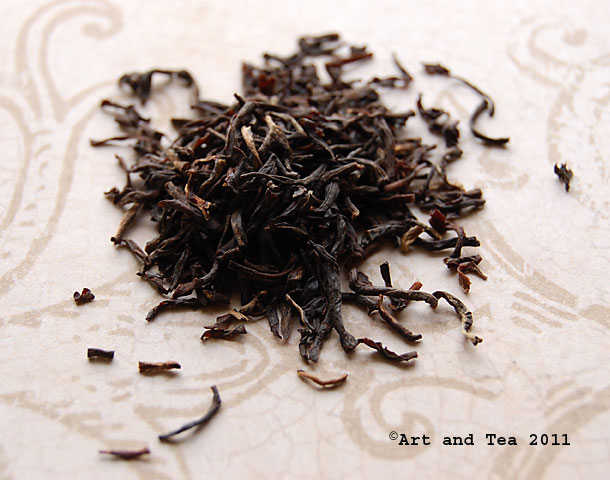
Meet Langharjan estate TGFBOP Tippy.

Langharjan estate is located near the town of Naharkatiya in extreme northeastern India.

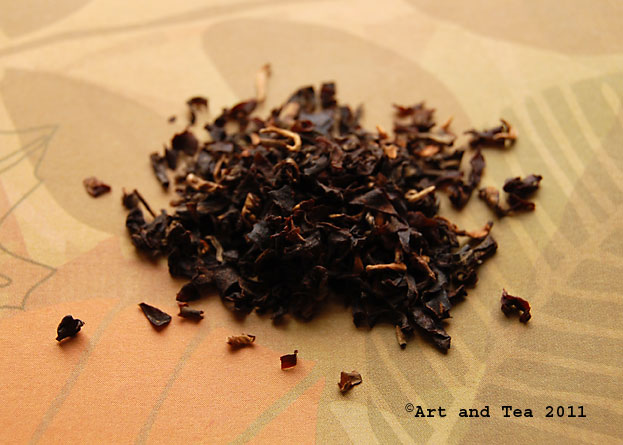
As you can see from the dry leaf above and its leaf designation, TGFBOP or “Tippy Golden Flowery Broken Orange Pekoe”, this is a tea with a lot of leaf tip. I find that the tippier Assams are a lot smoother. And this one is so incredibly smooth.

I steeped the leaves for 4 minutes in boiling point (212F) water.

The aroma is lightly malty and rich with a hint of toastiness.

Despite the greyness of the day outside, my teapot glows as if a fire is burning inside of it.
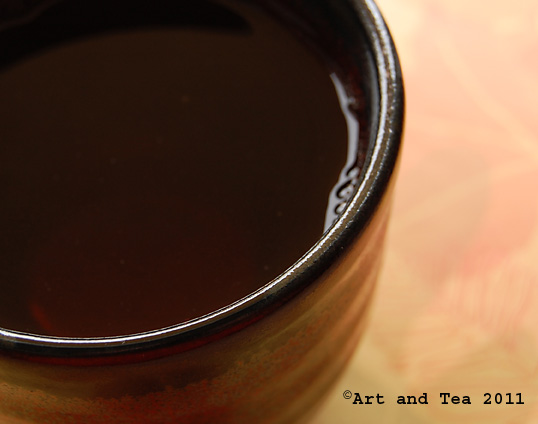
This tea delivers in every way. Rich, malty, smooth as silk, my type of Assam. You could probably coax some astringency out of it by pushing the steep time to 5+ minutes. At that point though you might want to add some milk or cream.

Unbelievably, especially after the winter we had last year, a snowstorm is predicted for our area tonight and into tomorrow. I am not ready for this type of weather again so soon! I will need many cups of tea for comfort as the white stuff descends upon us so unseasonably early.

Stay warm, dear friends, with your hands curled around your favorite cup of tea!

“I like living.  I have sometimes been wildly, despairingly, acutely miserable, racked with sorrow, but through it all I still know quite certainly that just to be alive is a grand thing.” ~Agatha Christie

Saturday Morning Tea

Good morning, dear tea friends! In continuing Assam month here at Art and Tea, I have an unusual Assam filling my cup today, a first flush selection from the Amgoorie estate.

Most Assams are harvested during the summer months, or the second flush season. They are well known and loved for their characteristic full-bodied, hearty, malty flavor profile. This first flush was harvested in the springtime, the first growth of the tea leaves. While the characteristic Assam flavor notes are still there, it usually has a much lighter body.

Even though it’s a whole leaf tea, I steeped the leaves in boiling point (212F) water for only 3 minutes because it’s a first flush and since I wasn’t planning on adding milk. It can be steeped for a longer time if adding milk and/or sweetener, or if you like a brighter quality to your plain tea.

I found this photo of the Amgoorie estate factory. Being a confessed clean freak myself, I’m greatly comforted to know how clean their operation is there. Yes, tea leaves are usually sorted and piled on floors.

The wet leaf has a hint of cocoa aroma that is revealed in its flavor as well. The tea liquor is quite smooth with a fuller body than what I was expecting.

The color in my glass teapot reflects the myriad of oranges and reds flaming across our New England fields and forests.

The flavor is lightly malty with a kick of brightness in the finish.

The last 2 weeks have taken me on a journey I’ve never experienced before. Someone very close to me had major surgery and was in a Boston hospital for 10 days, 5 of those in the ICU. I was brought to a place of seeing and then knowing how your life can change forever in an instant revelation of news we all dread to hear. I felt my heart crack wide open as I traveled each step of the recommended path with my beloved friend and observed the compassionate caring of everyone there to help him through the long process. He is finally home and the healing has begun. Nothing is certain in this life, things change constantly and the best we can do is to live and treasure the moments each one at a time. Until next week, dear tea friends…

“It is by going down into the abyss that we recover the treasures of life. Where you stumble, there lies your treasure.” ~Joseph Campbell

Saturday Morning Tea

I’ve felt a shift in the air this week as we enter the second part of August. The sun sets earlier, the nights are cooler and I’ve even caught the faint whiff of woodsmoke as folks start to get a little cozier in the evenings by the fireplace. Lowe’s has row upon row of chrysanthemum pots in beautiful fall colors and rich burgundy blooms now adorn my front porch.

With a cooler breeze wafting in my windows, it’s the perfect morning for an Assam tea. Just as I love first flush Darjeelings in the springtime, I always enjoy Assam teas best in the fall. Their rich warmth is a wonderful balance to the cooler temps here in New England.

The Assam tea growing region is located in northeast India and the teas produced in that area were my first tea love. Their dark, full body reminds me so much of the tea my Mom used to drink when I was young. As the granddaughter of Irish immigrants, she always enjoyed her “cuppa”. And, of course, that’s what I was served whenever I wasn’t feeling well. So, as I grew up, I always associated black tea with comfort and feeling better.

My morning tea is an Assam from the Marangi estate, a 700 acre tea garden located in the hills of Assam. Every season there are a few outstanding teas that embody the best qualities of an Assam tea. This tea is definitely one of those teas!

The leaf is generously laced with golden tip, indicating a premium tea. I find that the golden tip also smooths out the astringency level in the tea liquor. This tea is a fine example of that as it is just smooth as silk.

I steeped the leaves for 5 minutes in boiling point (212 F) water. While the tea is very hearty and would stand up well to milk or cream, I’m drinking mine straight up.

The aroma is rich and malty which carries on into the complex flavor. Layers of malt are enhanced with a hint of dried fruit sweetness. This tea is a real treat!

Note to self: this would be the perfect birthday gift for my Assam loving friends. For myself, it would make the perfect companion to a cinnamon crunch bagel from Panera Bread!

What is your favorite tea in the fall?

“Autumn to winter, winter to spring,

Spring into summer, summer into fall—

So rolls the changing year, and so we change;

Motion so swift, we know not that we move.

~Dinah Mulock Craik

Saturday Morning Tea

I sit here quietly and sip my tea, the sounds of summer all around me – the faint buzzing of a lawn mower, the electric sound of the cicadas in the trees, the caw-caw of one crow to another as they fly over my house. As we enter the warm, hazy days of late summer, the fuschia impatiens dress my garden in their rich color.

In my cup this morning is a very dark tea, a China tea called Organic Pu-Erh 2nd Grade. Back in June, I wrote about the 1st grade here.

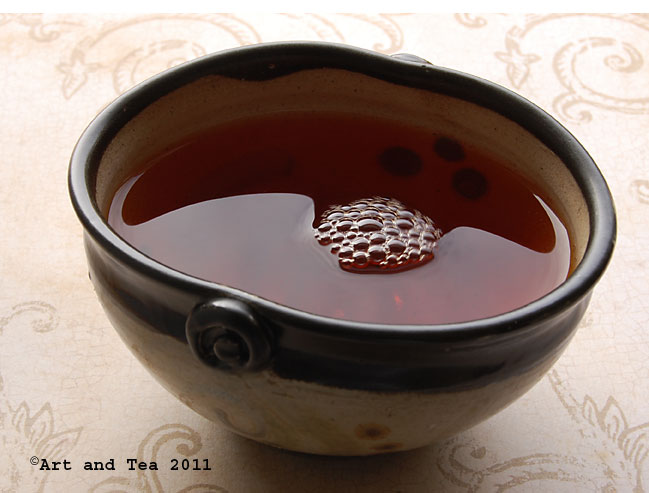
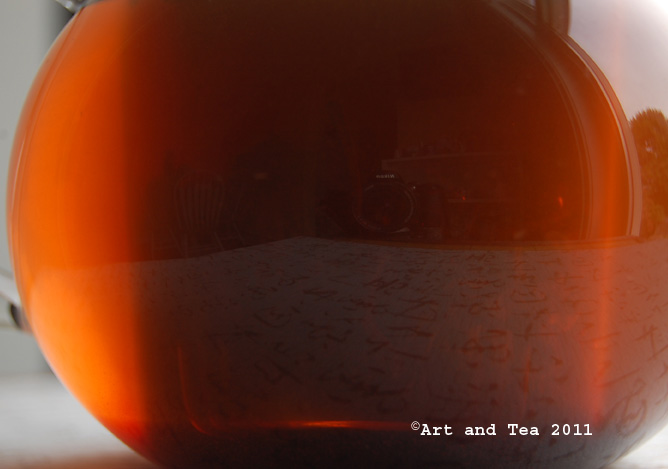
I steeped the leaves for 8 minutes in boiling point (212 F) water and, as you can see, the water quickly gets very murky on its way to becoming as black as night. Pu-Erh goes through a “composting” step during its processing. The leaves are piled into heaps, much like a compost pile, creating a heat in its core and transforming the leaves into this very unique tea.

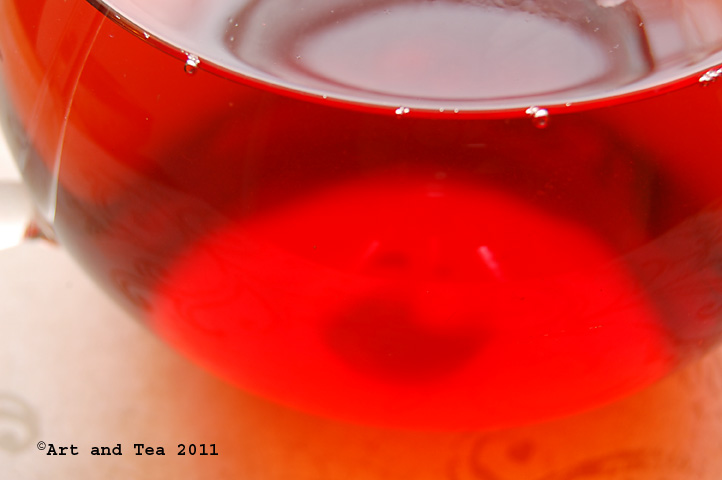
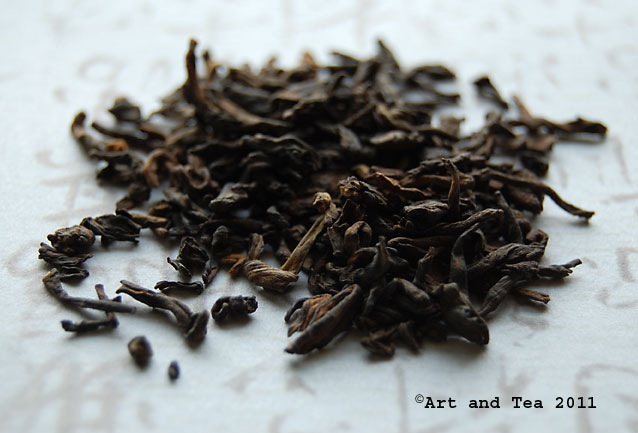
Everything about this tea is so dark – the dry leaf, the wet leaf and the tea liquor after steeping. A rich, sweet, earthy aroma rises from my glass teapot as I remove the infuser basket.

I find that if I gaze at the tea liquor long enough, I can see a mulberry tinge around its edges. Can you see it?

The flavor is mellow and quite smooth, not as strong as its aroma. Characteristic notes of autumn leaf and forest floor mingle with a sweet molasses syrup flavor. I find myself enjoying it more and more with each sip.

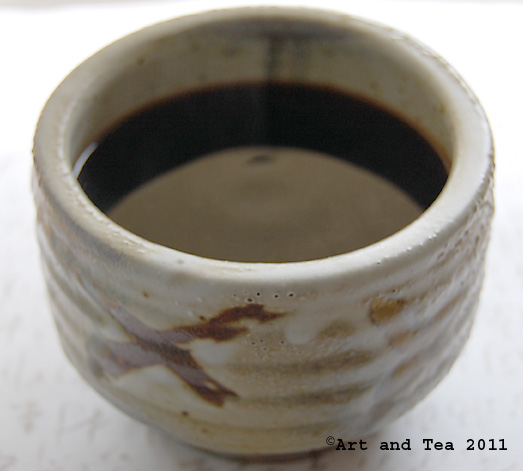
While I was visiting my family in Michigan last month, we visited a quaint little village called Saugatuck, located on a river very near Lake Michigan. As we were strolling the shops, I came upon a pottery shop and purchased a few teabowls there. The artist’s name is Jeff Blandford and his business is called Volmod Ceramics. Voluptuous. Modern. Ceramic. He had some really cool pieces. As he was ringing my purchase, he told me that the teabowls I chose were created during a very creative time at the end of his student days at Michigan State University, over 3 years ago. So, I’d like to think that these lovely teabowls were sitting on the shelf patiently waiting for me to come along and bring them home to Massachusetts with me so I could enjoy many tea moments with them.

Until next week, dear tea friends…

“The world is round and the place which may seem like the end may also be only the beginning.”   ~Ivy Baker Priest

Saturday Morning Tea

Good morning, dear tea friends! This morning I am on my way out the door to my polymer clay guild meeting, travel mug in hand. I leave you with a post I did to welcome in spring, with the lovely Magnolia Blossom Oolong. Enjoy!

The crocus I planted last fall are pushing their way up through the earth and their leaf blanket. As the days lengthen and warm, they are drawn to grow and burst into bloom. A big welcome to Spring this weekend!

To celebrate the first day of Spring, my morning tea is a scented tea from China called Magnolia Blossom Oolong. Grown and processed in the Guangdong province in South China, this tea is often described as “Orchid Oolong” as the flowers come from a tree that native Chinese call “yulan”, meaning jade orchid. Despite its translation, yulan is actually a type of magnolia tree (Magnolia denudata) which originated in southern China.

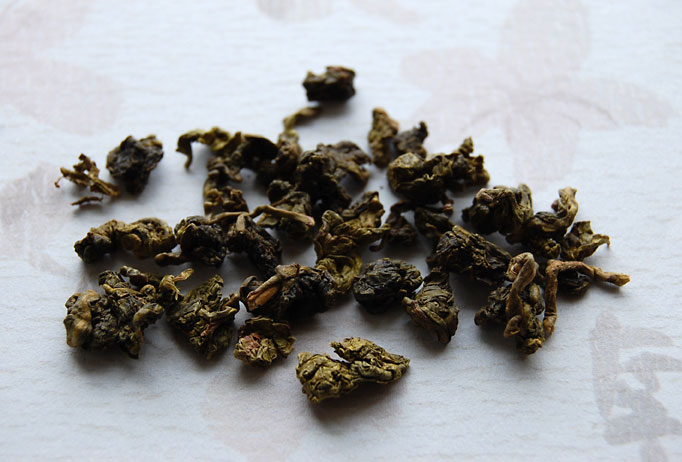
The leaves look very much like a Jade Oolong to me, rolled into compressed shapes. I steeped them for 3 minutes in 190 degree F water.

The shapes released as they steeped, giving off a wonderful fragrance. As I lifted the lid from my glass teapot, it was like putting my face into a bouquet of freshly cut flowers!

I find the floral flavor to be similar to a jasmine tea. The flower notes are very strong and sweet but not cloying. The flavor of the Oolong tea comes through the scenting, adding a fuller, silky smooth mouth feel. It doesn’t have the delicacy of a jasmine tea though.

I was able to find out more information about my Hawaiian teabowl. Created by Clayton Amemiya on the Big Island, it was fired in a traditional Japanese kiln called an anagama. Clayton’s work combines Japanese tradition with the unique style of the Big Island. What I thought was glaze on the bowl is actually ash and wood. From his brochure:

“No glaze has been used. A glazed appearance is made by the firing process. Flying ash and wood particles fuse to the clay as they draft through the kiln. Because this is done by the fire, no two pieces can ever be the same. Individual woods have many of their own firing properties. This understanding gives Clayton the opportunity to collaborate with a force of nature.”

Knowing this makes my teabowl that much more special to me. As tea drinkers, we also collaborate with nature when we steep our leaves and transform them into a cup of tea.

Happy Spring!

“All you need is deep within you waiting to unfold and reveal itself.  All you have to do is be still and take time to seek for what is within, and you will surely find it.” ~Eileen Caddy

Unless otherwise noted, all text and photos are the property of Art and Tea at http://www.artandtea.wordpress.com, copyright 2007-2011.