Saturday Morning Tea

While Labor Day weekend marks what most consider the official end of summer, this is the actual last weekend of summer. While I am feeling somewhat wistful thinking about the passing of all of those deliciously warm days spent outside in the garden and lazing on the backyard deck afterwards, iced tea in hand, I am also looking forward to the crisp, colorful fall and a cup of a darker, spicier tea warming my hands. Not quite yet though.

In honor of the summer’s passing, this morning I’m sipping a very very light tea, a white Ceylon from the Adam’s Peak estate. The leaf is gorgeous, long thin slightly curved pieces resembling the delicate ribs of a fan. This represents the newest leaf on the tea plant, the tender budding leaf.

This tea is entirely processed by hand from the careful plucking to drying in the sun to the heating process to stop oxidation. Here is an interesting article from the BBC news about the processing of a white tea from a Sri Lankan tea estate.

A soft sweet aroma drifts up from my white porcelain teabowl as I savor my first sip. I have steeped the leaves in 165 degree F water for 3 1/2 minutes. The liquor holds a hint of color and tastes smooth with light fruity flavor notes.

The softness and delicacy of my white tea slows me down to focus on each sip, helping me transition from a very busy workweek to the more relaxed pace of my weekend. A perfect tea for meditating on the most recent happenings of my life and the change I can feel in the air.

If you reveal your secrets to the wind you should not blame the wind for revealing them to the trees.

-Kahlil Gibran

Studio Wednesday

Today I had 2 goals in my studio. First, to prepare the face cab for my first journal bracelet. Second, to work on my freeform bracelet.

I found some old leaf canes in my polymer clay stash and reduced them to a very small size. Then I framed the porcelain face cab (on the left) with cane slices. Well, I liked the look so much that I took out one of the glazed face cabs I created last January and did the same thing with it. So, I’ve decided to use the 2 face cabs, one for September and one for October. In a previous post, I talked about honoring the trees that were taken down in our backyard last week. There were 2 of them so I’ll create a bracelet to honor each tree. I’ve also created a whole bunch of leaf beads from the canes so I can also use those in my bracelets.

After my polymer clay work, I started balancing out my freeform bracelet by working on the side that was bowing in. I’m hoping to be able to finish with the body of the bracelet soon. Then I’ll document how I create the pearl and loop clasp.

The Birth of a Freeform Peyote Bracelet – Part 4

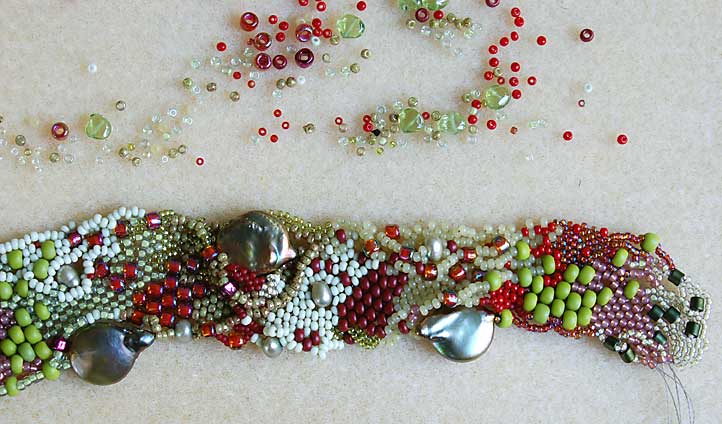
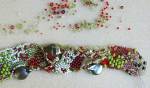
My bracelet is progressing, slowly but surely. Originally, I was going to add one coin shaped pearl but I loved their shape and color so much that I decided to add 3 of them. You can see how it doesn’t grow in an even way. Just like life where we will focus our attention to certain parts, my bracelet is growing more on one side than the other. As I go with the flow of the beads, I will feel a pull to work on one particular part and help that grow. Then I will notice the gaps in the other parts of the bracelet and move over to those places to seek balance.

As the bracelet grows, I am still working in peyote stitch here and there but find myself adding whole loops of beads to create bridges to other parts of the bracelet. As in life, flexibility is key as you listen to your inner voice to see what the next step should be.
I’ve been read a fascinating book called “The Kaizen Way: One Small Step can Change your Life” by Dr. Robert Maurer. Kaizen is a Japanese technique using small, steady steps to achieve lasting success with a goal. You can read more about it and Dr. Maurer here.

There is a part of our brain, located in the midbrain and called the amygdala, that is crucial to our survival because it controls the fight-or-flight response. This response is a natural alarm that alerts certain parts of our body for action in the face of immediate danger. When the alert happens, other parts of our body are slowed or shut down to allow all of our energy and resources to get us out of the danger. One nonessential (at the time) function that shuts down is our rational and creative thought processes. Even though most of us aren’t in situations where a dangerous animal is charging at us, this response is appropriate and vital in our lives today in emergency situations such as someone breaking into our house or reacting to a driver who has run a red light and threatens to hit our car. Where it can create a problem, however, is when we are faced with a new situation that is not part of our usual, safe day-to-day routine, such as the challenge of finding a new job or quitting a habit such as smoking or overeating. This situation can trigger fear and the fight-or-flight response can be triggered from our fear which will then shut down the thinking part of our brain. Big goals can trigger fear also. So, taking very small steps towards a big goal or new situation can bypass those fears. With each small step, new neural pathways are laid down in our brain and we build new habits, working towards our goals and a new situation in a comfortable way for us.

So, what does this Japanese technique have to do with creating a freeform bracelet, you ask? As I’ve read different comments from my readers about their experience with freeform peyote, I’ve heard that this kind of project might feel overwhelming, especially when it is such a free flowing creation. There really isn’t an exacting set of instructions regarding what to do. So, I suggest to fool that fear response and accomplish this creative task with teeny, tiny steps. Set aside 5 minutes a day to add a couple of beads at a time. Put a little sign next to your growing creation that says something like, “whatever I create is beautiful”. There is no right way or wrong way. Whatever you create is a beautiful expression of you, one tiny bead at a time.

Saturday Morning Tea

There is nothing like returning to a place that remains unchanged

to find the ways in which you yourself have altered.

-Nelson Mandela

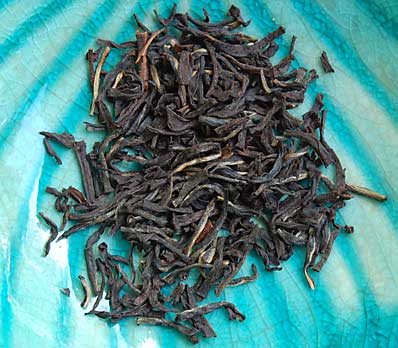
Have you ever been in a situation where all of a sudden something happens, you are given a new piece of information and then it’s like something clicks into place inside of you and you’re looking at your world with whole new eyes? Well, it’s been that kind of eye opening week for me that has rocked the very foundation of my psyche. The universe is showing me a whole new direction these days. Maybe that is part of turning 50. So, after my week, this morning I decided on a nice strong cup of tea, a Ceylon black from Homadola estate.

This tea is produced in the Ruhuna district of Sri Lanka, an area located in the southwestern tip of the island, with an elevation between sea level and 2,000 feet. Most Ceylons black teas are produced in a higher elevation which gives them a lighter, brisk flavor. Most people are familiar with Ceylon tea in a teabag.

This low growing district produces very strong, dark teas that are usually accented with silver tips. Their flavor reminds me more of a China black than a Ceylon tea. The aroma is very rich and sweet with a slight hint of cocoa. The leaves are large broken pieces, some uncurling after steeping. I brewed this tea in boiling water for 4 minutes. The liquor is very rich and dark with earthy, cocoa notes. It stands up very well to milk or cream.

This tea reminds us to be strong, fill our lives with richness and be grounded in our connection to the earth.

Saturday Morning Tea

Tropical Storm Hanna is reaching out her grasp to the New England coastline this weekend. We felt the touch of her outer edge early this morning when a steady rain began to fall. Even though the local weather forecasters have predicted a lull this afternoon, we will be tightly in her grip by tonight with torrential downpours and gusty winds. It’s a good day to brew up a pot of tea and clean my studio.

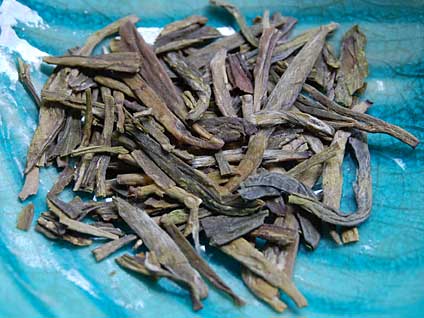
My teapot is filled with a China green called Lung Ching, named after a small village in Zhejiang province, meaning “Dragon’s Well”. Legend has it that a Taoist priest in the 3rd century advised the local villagers to pray to the dragon of a local well to bring rain and end their drought. It worked and the well was named after that dragon. The Dragon’s Well monastery still stands in that spot to this day.

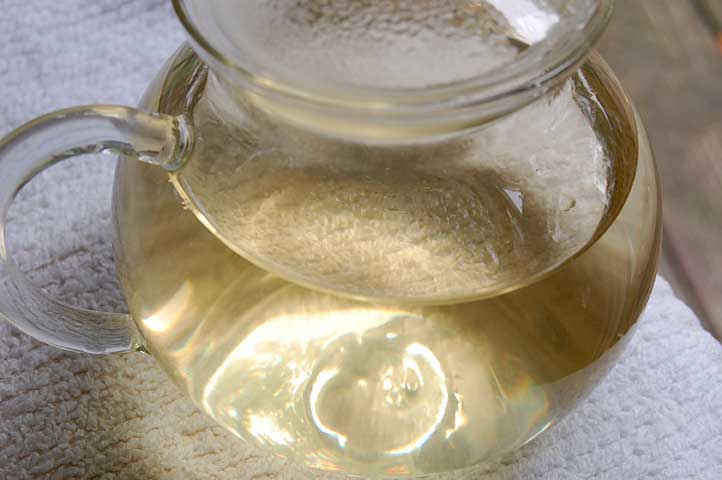
The leaves are carefully plucked by hand and then pan fried in large woks to stop oxidation. Special care taken during processing preserves the whole leaf intact and the motion of the pan frying gives it a unique flat shape. The liquor is a pale yellow with a light greenish tinge and a fresh clean aroma.

The taste is also fresh and clean with a flavor note which reminds me of that first bite of a newly harvested ear of corn.

Time to clean my studio and “batten down the hatches”!