Saturday Morning Tea

Wow, for the first time in 6 weeks, we actually got through a whole week with no significantly nasty weather to deal with. It was such a treat to not have to get up at zero dark thirty to dig myself out before work! Speaking of a treat, this morning’s tea is quite special. It’s a Darjeeling tea, not a black tea but a green tea, called Arya Emerald.
I wrote about the 2007 harvest lot of this tea here. The Arya estate, located in the Himalayan mountains of northeast India, produces special, hand processed tea lots with beautiful gemstone names like Ruby (black), Pearl (white) and Emerald (green). I reviewed Arya Ruby a couple of months ago here.

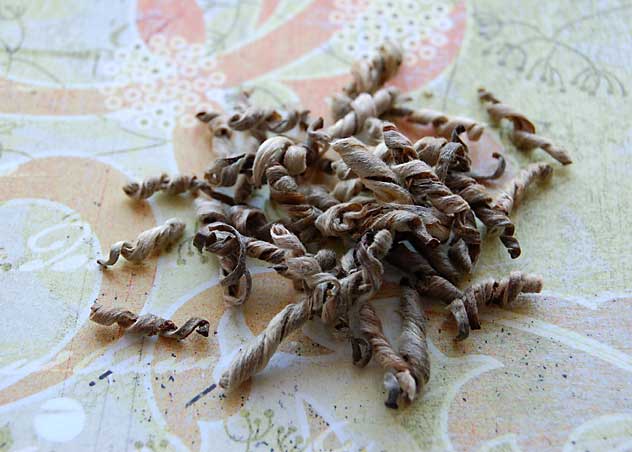
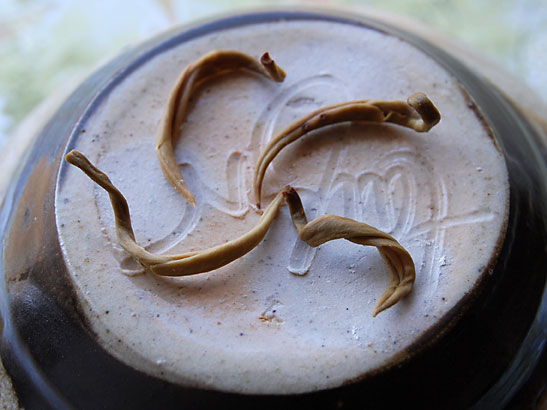
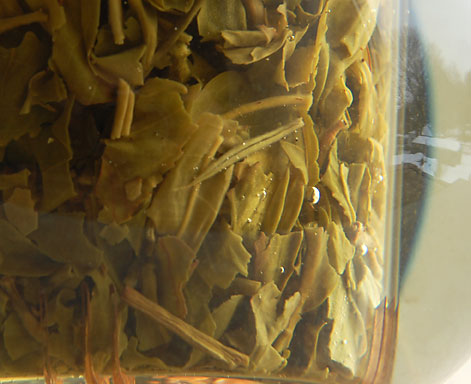
Dry, the dark green leaf is long and twisted with light green bits but a 3 minute steeping unfurled the leaves, revealing many intact leaves that are a beautiful, light olive green. With most green teas, this one included, I use 180 degree F water for steeping.

The aroma is lightly vegetal with a hint of Darjeeling astringency.

The vegetal quality carries on into the flavor but only lightly so, with notes of tart green grapes and sweet pear which I enjoyed very much.

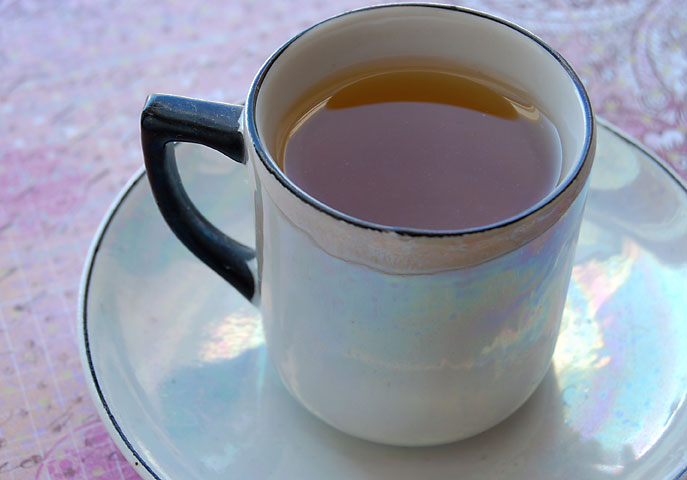
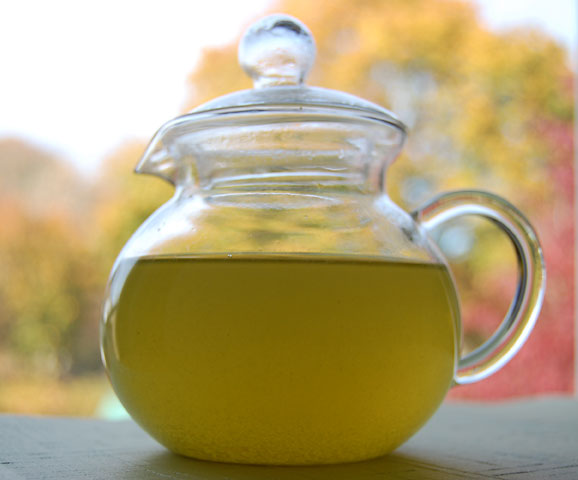
I find it interesting that such intensely green leaves can produce a liquor that is so golden yellow.

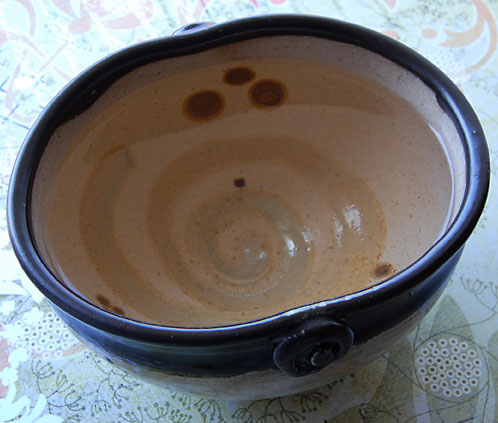
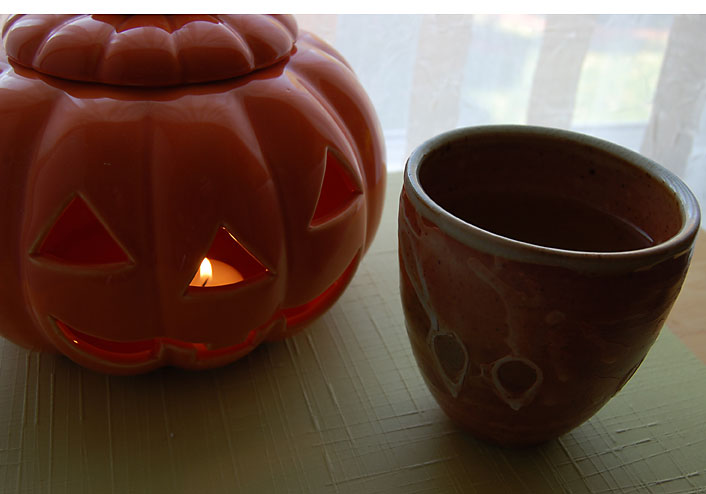
I’ve chosen my spiral teabowl as the light color of the liquor allows me to see the wonderful spiral shape inside the bowl.

Do you have a favorite teabowl or mug? What does it look like? One of the things that influences my choice of mug or bowl is the color of the tea liquor.

I had an odd experience this week. Normally, when I include a link to a former post in my present post, WordPress sends me a “pingback”. Of course, I know about this already because I was the one to place the link in my post. But this week I received one I didn’t recognize. I discovered that another website called rakkatei was posting my latest post in its entirety as if they had written it! I found this quite disturbing, especially when I couldn’t locate any contact information on the site. I did some research and was able to find a company name and promptly sent them a letter requesting that they immediately remove my content from their website. So, if you’re seeing this post on that website right now, please know that it does not belong to them. I am the author, Karen at Art and Tea. Has this ever happened to anyone?

Have a great weekend, dear tea friends, and Happy Valentine’s Day!

“Where there is great love there are always miracles.”

~Willa Cather

Saturday Morning Tea

The sun is shining in a clear blue sky today, sparkling all of the mounds of snow, now 7 inches higher since yesterday’s storm. Here in New England, we’re already above the snowfall norms for the season and more is coming our way next week. We seem to be stuck in a pattern of white.

Good times to be snug inside with a hot cuppa.

Today’s tea is called Jasmine Fannings Organic. Now I am not a fan of scented teas to begin with and even more not a fan of the fannings style of leaf, very finely cut particles of tea leaf so you might be wondering why I chose this tea. The fine bits fall right through my glass infuser basket and even through my strainer when I try to strain it further. With this type of leaf, I think it’s best to use a tea filter paper or really fine mesh infuser, if you have one. Ok, I like a challenge.

After steeping the leaf for 1 and a half minutes in 180 F water, boy, was I pleasantly surprised. Smooth, sweet and lightly jasmine-y, it reminds me of the tea served in Chinese restaurants. It fills my mouth with an almost creamy feeling. There’s no bitterness at all.

Another point to remember with this style of leaf is that it steeps very quickly in a minute or so. So, if you’re the type of tea drinker who likes to pour your water and go fold some laundry for awhile, this tea might not be for you.

As I’ve talked about in previous posts, most jasmine tea leaf is processed first as a green tea and then later that green tea leaf is scented with jasmine blossoms. Tea leaves will absorb the scent of anything placed in close proximity to them so they are perfect for scenting with flowers. Jasmine tea is the most famous scented tea in China, originating from the time of the Song Dynasty 800 years ago.

As I sip my tea, I think about how long its history stretches back. Wow.

I think that the reason I’m not a big fan of jasmine tea, or any flavored teas as well, is that they can be so cloying and overwhelming in their flavor and hide all of the tea flavor. Not so with this tea. The taste of the tea comes through and is caressed gently by the light notes of jasmine.

This tea is teaching me an important lesson. Even if you’ve had an unpleasant experience with something or someone, give them another chance. You might be pleasantly surprised.

Stay warm, dear tea friends!

“One of the secrets of a happy life is continuous small treats.”

~Iris Murdoch

Saturday Morning Tea

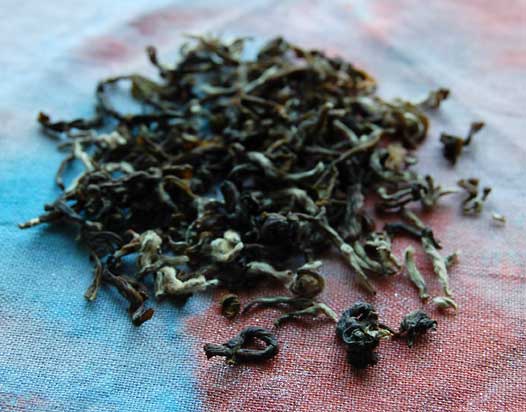
I experienced sheer joy in taking photos of this morning’s tea, a green tea from the Yunnan province in China. It’s called Yunnan green Snow Dragon.

I don’t think that anyone rivals the tea artisans of China in their tea leaf rolling techniques. Corkscrews? Unbelievably amazing, huh?

With such an auspicious name, I wondered where this tea came from so I looked up if there were any mountains called Snow Dragon in Yunnan.  Here’s what I discovered.

Jade Dragon Snow Mountain, located in northern Yunnan province, is the southernmost glacier in the Northern hemisphere. It consists of 13 peaks, the highest one being 18,360 feet. It’s never been climbed. Wow. You can see photos of the area and read about the legend of the creation of Snow Dragon mountain here.

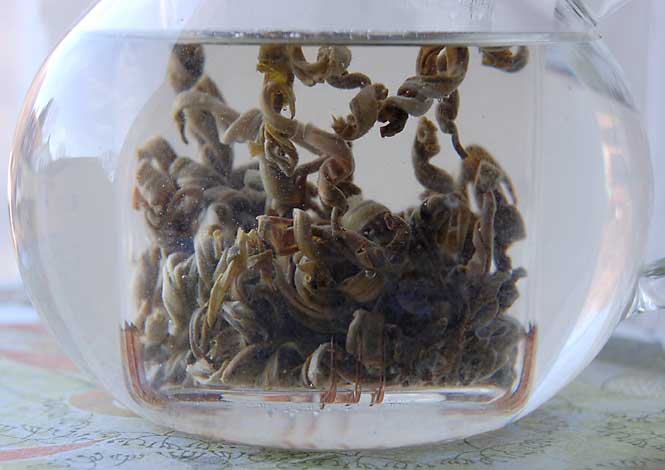
I steeped the little corkscrews for 3 minutes in 180 degree F water. Their shape relaxed considerably towards the end of their steeping time.

As I removed the infuser basket from my glass teapot, I was struck by an intense aroma of fresh pear. This distinct note carried on into the flavor.

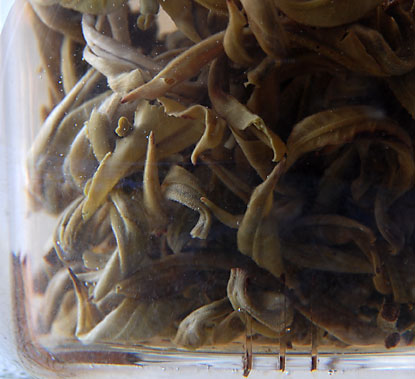
These steeped leaves remind me very much of a white tea, consisting of mainly leaf buds, the newest growth on the tea plant. That said, the further manipulation of the leaf into a shape is the mark of a green (or black or Oolong) tea, not a white tea.

The straw colored liquor is as pale as a white tea though.

The flavor is very soft and delicate with notes of pear and fruit. As the tea cools, its sweetness becomes more defined and lingers in my mouth.

As I watched the leaves steep and release their shape, I thought of how we all have a tendency to hold on to things – people, situations, even sickness and emotional wounds – because we get so comfortable with them, even if it is time to move on and change our shape. Even though the unknown is scary, if we are just able to release and let go, we can discover the beauty in a new way of being. Just like the corkscrew tea leaves released their shape and transformed into a delicious cup of tea.

“People have a hard time letting go of their suffering. Out of a fear of the unknown, they prefer suffering that is familiar.” ~Thich Nhat Hanh

Saturday Morning Tea

Good morning, dear tea friends! I’ve returned from my trip to New Mexico and am glad to be here, sharing a cup of tea with you once again. As promised, today I am brewing up a pot of Chinese green tea called Pi Lo Chun Bao Wei.

Pi Lo Chun, or Green Snail Spring, is a well-known China green tea from Jiangsu province. Its distinct spiral leaf shape is created during the firing step of its processing. After the fresh leaf is plucked, usually in the morning, it is brought to the factory in either baskets or cloth pouches to protect the leaf and allow for air circulation. Once at the factory, the leaf is spread out on floor mats to air-dry and reduce the moisture content of the leaf.

As Pi Lo Chun leaf must be manipulated during the next step, the firing step, it is placed in short, round metal drums which are placed over a heat source. A gentle twist and roll motion of the hand as heat is applied coaxes the leaf into its characteristic shape, resembling a tiny fiddlehead fern shape. In fixing the leaf into a specific shape, its chi, or energy, remains fixed in the leaf until the moment of steeping when it is released into the cup of tea.

I steeped the leaves for 3 minutes in 180 degree F water. The pale golden liquor gives off a distinctly sweet aroma.

As I take my first sip, a pronounced licorice/anise flavor note surprises me in its intensity. It mellows out as my tea cools revealing a light floral note of honeysuckle. As I usually find a Pi Lo Chun to have fruity notes, this is quite unique. And yummy. Interestingly enough, there are no vegetal notes in this green tea.

As the days shorten and the nights wrap us in a longer, darker cloak, I find myself turning inward in solitude and reflecting upon the year that is flowing towards its end. I find my center and a measure of comfort in the following enduring prayer.

All shall be well,

And all shall be well,

And all manner of things shall be well.

~Dame Julian of Norwich, a 13th century English mystic

Saturday Morning Tea

Some of the trees in my neighborhood are looking downright skeletal now as the fall winds blow in chillier temps and winter creeps closer. All Hallow’s Eve marks a threshold into a darker time of year, a time when we focus inward and reach for warmth.

In this last installment of my Japanese tea series, I am reaching for warmth this morning in a cup of Japanese green tea called Sencha Tokujyo Ohashiri, a competition grade Sencha.

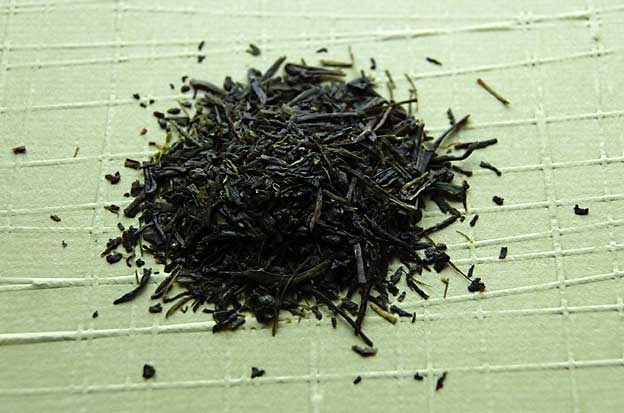
Japanese teas are recognizable by their grassy, needle-like shape. The shape is attained by sending the leaf through a series of rolling machines. Paddles move the tea back and forth over metal ridges while heat is applied so the leaf is slowly formed into its needle shape.

Most Japanese green tea is processed to a half finished state called aracha. Aracha is kept stable in refrigerated, vacuum sealed bags until it is ready to be purchased by tea masters who will refine it and finish its processing.

I found this particular sencha leaf to be incredibly fine and it clogged the slits in my glass infuser basket. It’s probably best to steep the leaves directly in water and then strain as well as you can. The fine dust from the tea leaves settles to the bottom of my teamug.

The most well known Japanese green tea is Sencha which is harvested after Shincha, the first tea of the spring. With each subsequent harvest, the tea becomes stronger and darker with leaves of lesser quality and price.

The spring green liquor of this tea has a strong vegetal aroma which carries on into its flavor. A refreshing pungency cleanses my mouth with each sip.

The basic steps to creating aracha, or crude tea are: plucking, steaming plus 4 steps of rolling/drying/shaping. At the end of this processing, the moisture content of the leaf is approximately 13 percent.

Refining of the leaf brings it into the final stages of sorting, separating and drying which transforms the leaf and brings out the flavor, color and glossy finish. Now the finished leaf is called shiagecha. It is common practice for tea artisans to purchase aracha to refine it in their workshops.

I hope you’ve enjoyed my series on Japanese tea. I know that I really enjoyed exploring a type of tea in more depth and learning more about the country and history of the tea. I look forward to doing this again with another type of tea.

Ooooooooooo………Happy Halloween!

“A house is never still in darkness to those who listen intently; there is a whispering in distant chambers, an unearthly hand presses the snib of the window, the latch rises.  Ghosts were created when the first man awoke in the night.” ~J.M. Barrie