Tea and Cheese Pairing

As a prelude to everyone’s Thanksgiving feast, we had a tea and cheese pairing at work last Wednesday. The cheeses were carefully chosen to represent a variety of offerings, from mild to strong flavor, representing different countries.

A variety of teas to compliment the cheeses were then chosen and prepared to offer each participant the opportunity to see which pairings appealed to them the most.

All of our cheeses were purchased at Wasik’s in Wellesley, MA.

Teas:
Wang Pu-Erh, Formosa Oolong Spring Dragon, Hao-Ya ‘A’ Superfine Keemun, Organic Australian Lemon Myrtle, Organic Lapsang Souchong Gao Ji, Japanese Premium Fukamushi Cha, Sree Sibbari Estate SGFTGFOP Cl., Namring Upper Estate FTGFOP1 First Flush (EX-1).

Cheeses:
Camembart Le Rustique (Normandy, France), Gorgonzola Dolce (Lombardy, Italy), Wasik’s Mountain Harvest Goat Cheese (Vermont, USA), Brie de Lyon (Lyon, France), Swiss Gruyere (Swiss Alps), Goudden Kaas (Holland), Vermont Cheddar (Vermont, USA), Wasik’s Equinox Goat Cheese (Vermont, USA).

Armed with my notebook, I fully intended on trying each cheese with each tea, all the while taking copious notes to share with you. Unfortunately, as it was during a workday, time didn’t allow for me to do this and the reality was that I tried all of the cheeses, 4 of the teas, in random order, and took no notes at all! That being said, here are my thoughts on my favorites.

The strong musky flavor of both the Wasik’s Equinox Goat Cheese and the Gorgonzola went very well with both the malty Assam and the smoky Lapsang Souchong. I especially enjoyed the mild, buttery flavor of the soft cheeses: the Brie, the Camembart and the Mountain Harvest Goat Cheese, with the crisp flavor of the Namring first flush Darjeeling. I also liked the combination of the salty, earthy Gruyere with the very earthy Pu-ehr.

For my very first time partaking in this wonderful experience, I found the prospect of 8 teas and 8 cheeses very daunting indeed. If you would like to try this, I would recommend starting out with only 3 or 4 choices. Perhaps a mild, a medium and a strong flavor, both in cheese and in tea. Try pairing the same flavors together at first and then mix and match to your own taste.

Here’s a great post from a tea lover who was much more organized in his approach than I.
I don’t think that there are any rules here, only room for a lot of fun and enjoyment!

Saturday Morning Tea

MakaibariFFDry101709

One of my most favorite rites of Spring every year is trying the new first flush Darjeelings as they arrive. Their aromatic fragrance, their brisk character, their fresh flavor…mmmm. But wait, isn’t it autumn now? Well yes, it is, but one of the most interesting first flush teas from the Makaibari estate has just come to my attention and I’d love to share it with you this morning.

MakaibariFFSteep101709

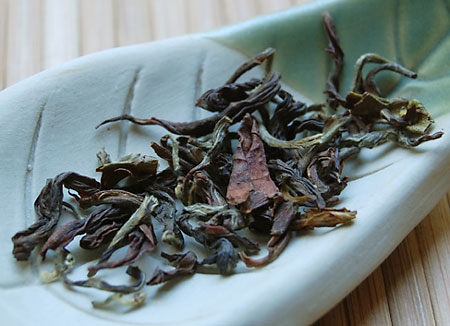
Called Makaibari estate Long Leaf first flush, it is the 11th lot harvested from their first flush season. The leaves are a gorgeous variegation of color and size. I steeped them in my glass teapot for 3 minutes in 212 degree F (boiling) water.

The Makaibari tea estate is a biodynamic, Fair Trade estate located in the West Bengal state in eastern India. The goal of their agricultural practices, as stated on their website:

“The goal of biodynamic practices coupled with permaculture, to usher harmony between soil, microorganisms, plants, animals and man, is a shining model at Makaibari for all of mankind to emulate….. Makaibari follows a form of integrated forest management called permaculture where the tea bush is part of a multi-tier system of trees and plants typical of a sub-tropical rainforest, as opposed to a monoculture–a farm that grows only one crop. Makaibari retains 70% of its entire area under forest cover.”

MakaibariFFWet101709

The aroma wafting up from the wet leaf reminds me of a woodland walk.

MakaibariFFTeapot101709

The light amber color of the tea liquor reflects the golden autumn palette of our backyard trees. Everything seems to be glowing at this time of year here in New England.

With my first sip, I detect a light citrus quality followed by a nutty note which I find to be very characteristic of Makaibari teas. The tea is smooth and light.

MakaibariFFTeacup101709

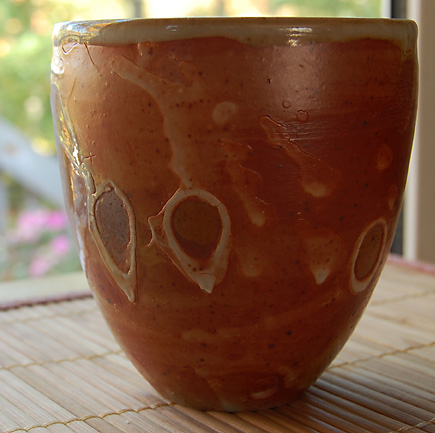
My teacup is one that I purchased at Rottenstone Pottery in Arroyo Seco, NM. The potter’s finger marks are still visible from when they dipped the cup into the glaze. I gently place my fingers on those marks and feel connected to the artist of this wonderful creation cradling my beloved tea.

MakaibariFFTeacupRefl101709

This weekend will be spent over at my new place, priming and painting. I just found out this past week that we will be totally gutting the bathroom – walls, ceiling, floor – and starting from scratch. Yesterday afternoon was spent looking through hundreds of ceramic tile choices until my eyes glazed (pun intended, lol) over and I could do no more. Not only are there hundreds of choices but then a multitude of ways to put those choices together in a design. What an amazing learning experience this is blossoming into, in many ways.

…It’s another

beginning, my friend, this waking in a

morning with no haze, and help coming

without your asking!  A glass submerged

is turning inside the wine.  With grief

waved away, sweet gratefulness arrives.

~Rumi (excerpt from So We Can Have What We Want)


Saturday Morning Tea

Castleton2ndFlDry090509

The hint of fall that was in the air at the beginning of the week has now left us and we are finally blessed with a perfectly glorious summer weekend, not too hot and humid, not too cool, juuuuust right. Even though it is officially considered the last weekend of summer.

Many are celebrating this weekend by going away or getting together with friends and family. As I shared in my last post, I am doing both. This time tomorrow I’ll be on my way to sunny New Mexico to visit my son and his family and also to attend a knitting retreat.

This morning’s tea is a black tea, a second flush Darjeeling from the Castleton estate, one of the most esteemed and well known tea gardens in the Darjeeling tea growing district in northeast India.

A “Castleton” is always a special treat.

“Second flush” is the summer harvest of the tea plants, after the leaves “flush” back from the “first flush”, or spring, harvest. The leaves of this tea are larger than normal with a rich variegation of color.

Castleton2ndFlSteep090509

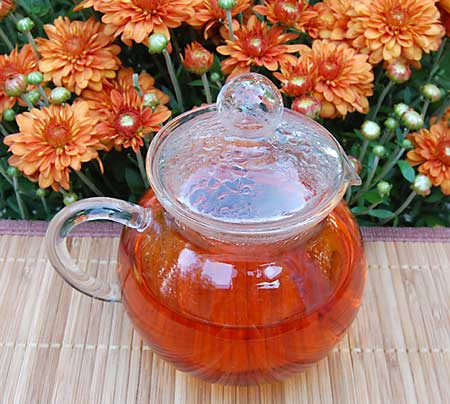
Speaking of rich color, I am enchanted by the harvest pumpkin color of the chrysanthemum flowers I picked up yesterday to adorn our backyard deck. I must be on a color kick because I picked up that exact color in a skein of yarn while shopping with my daughter last night. I am a color slave. But I digress…

I steeped the leaves for 3 minutes in 212 degree F water (boiling).

Castleton2ndFlWet090509

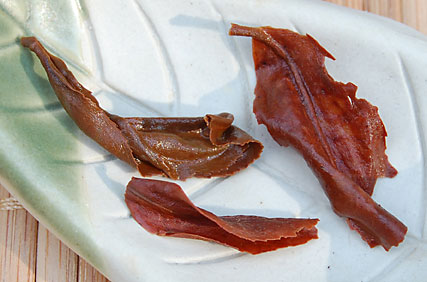
The steeped leaf is another gorgeous fall color. As the leaves are allowed to oxidize during their processing, they turn a dark reddish brown from their original deep green color. I wrote about second flush Darjeelings from other tea gardens here and here.

Castleton2ndFlTeapot090509

The tea liquor is not quite as dark as last week’s China black tea but it comes pretty close, sharing that same reddish brown hue. It leans more towards amber, I think.

The aroma is fruity with a hint of tropical ripeness, reminiscent of a sweet pineapple. How perfect to go along with the CD I’m listening to this morning – a collection of Hawaiian music.

Castleton2ndFlTeacup090509

The fruitiness carries through into the taste, with a pronounced sweetness, but what strikes me the most about this tea is its incredible smoothness, without a hint of that bright, astringent “bite” so characteristic of a Darjeeling tea.

So silky smooth, mmm…

I am sorry to say that I will not be able to join you for Saturday Morning tea next Saturday as I will be away from internet access while in the mountains of New Mexico. That said, I look forward to joining you once again to share tea and stories in 2 weeks.

Enjoy your holiday weekend!

It is good to have an end to journey towards;

but it is the journey that matters in the end.

~Ursula K. LeGuin

Saturday Morning Tea

OkaytiWhiteDry071109

It’s a beautiful summer day (finally!) and I’ve invited a sunny daylily to join me for my morning tea. I love its golden light. It reminds me to let my own light shine through.

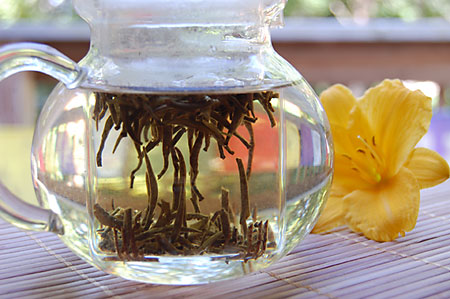
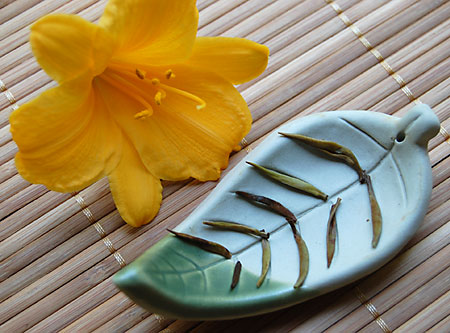
I’m sipping a Darjeeling white tea from the Okayti estate. Processed entirely by hand, this rare production tea is truly an art form. In the photo above, you can see the tiny white hairs on each leaf tip which give white tea its name. White tea is the least processed of all of the different types of tea – just a short wither and steam heated to halt the oxidation process which naturally occurs. The white tea leaf buds are not rolled or bruised at all so each tip looks very much as it did when it was plucked from the bush.

Close to the border with Nepal, the Okayti estate is located at approximately 6000-7000 feet in Darjeeling district’s Mirik Valley of northeastern India. They have been growing tea since the late 1800s.

OkaytiWhiteSteep071109

I steeped the leaves in 180 degree F water for 3 minutes. As I removed the basket, the tea’s sweet aroma lifted gently from my teapot.

OkaytiWhiteWet071109

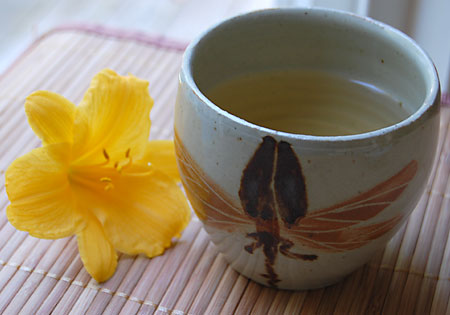
I delighted in sifting through each intact leaf to create this fun design. The tea itself is a light buttery color, a paler version of my daylily. Its flavor is delicate and smooth with an amazing sweetness that lingers after each sip.

OkaytiWhiteTeacup071109

I purchased a new teacup this week and enjoyed pouring my first cuppa in its smooth, rounded shape, a perfect fit for my small palm. Created at Cornwall Bridge Pottery in CT, a beautiful dragonfly has been painted onto its side.

DragonflyTeacup071109

I found this amazing information regarding their symbolism:

“Dragonflies are reminders that we are light and can reflect the light in powerful ways if we choose to do so. “Let there be light” is the divine prompting to use the creative imagination as a force within your life. They help you to see through your illusions and allow your own light to shine in a new vision.”

Wow…

Saturday Morning Tea

PuttabongFFWet053009

It’s time for another first flush Darjeeling. If someone asked me right now what my most favorite tea is, my answer would be a first flush Darjeeling in May.

This particular first flush tea was harvested on the Puttabong (also known as Tukvar) tea estate. First planted in 1852, this tea garden is nestled in the foothills of the Himalayan mountains near Kanchendzonga peak. With altitudes ranging from 1500 to 6500 feet above sea level, it is one of the highest elevation tea gardens in Darjeeling district.  Its tea plants consist mainly of clonal bushes and China jat, meaning tea bushes with origins from China.

PuttabongFFDry053009

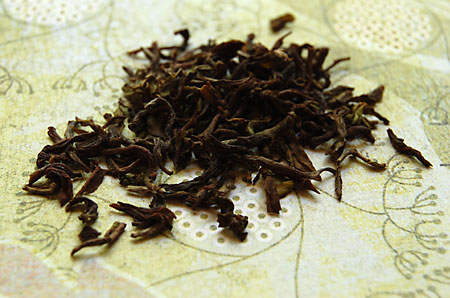
Unlike other first flush teas, its leaves are darker with less green bits. I steeped the leaves for 3 minutes in 212 degree F (boiling) water.

PuttabongFFSteeps053009

As I lifted the infuser basket from the teapot, the tea’s fruity aroma greeted me immediately. I looked forward to my first sip and was delighted with the lively taste of the cup. While it was bright, it wasn’t as characteristically astringent and seemed more like a second flush with its muscatel flavor.

PuttabongFFTeacup053009

Ok, I’m already sipping my third cup and the tea is still very smooth. Sometimes Darjeelings will reveal their bite as the tea cools. Not this one.

It is a delight!

I’m also enjoying it at a cooler temperature and would recommend it as a wonderful iced tea. With the leaves I have left in my sample packet, I think I’ll steep them in the fridge overnight for a glass of iced tea tomorrow morning. We are anticipating warming temps this weekend after a cool, rainy week.

Have you noticed the background in my tea photos? It is a background paper that I picked up the other day at A.C. Moore to use in my art journal. It’s called “In the Forest”. I’m expecting little fairies to shyly reveal themselves in its beautiful depth of pattern.

I’m discovering a whole new world of art supplies. Joy!

Just trust yourself, then you will know how to live.

~Johann Wolfgang von Goethe