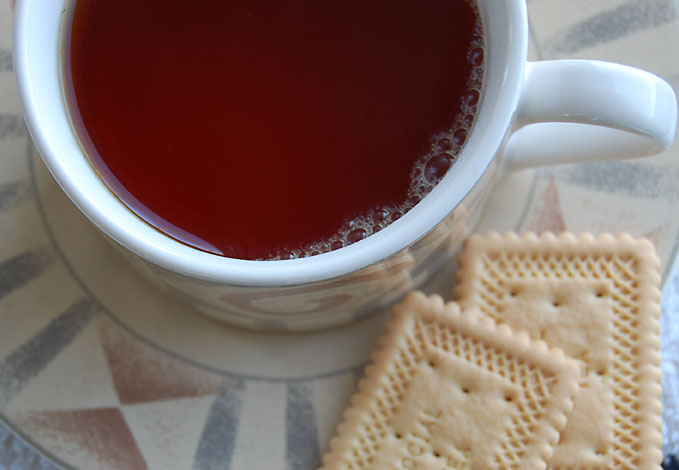
Tea and Cheese Pairing

As a prelude to everyone’s Thanksgiving feast, we had a tea and cheese pairing at work last Wednesday. The cheeses were carefully chosen to represent a variety of offerings, from mild to strong flavor, representing different countries.

A variety of teas to compliment the cheeses were then chosen and prepared to offer each participant the opportunity to see which pairings appealed to them the most.

All of our cheeses were purchased at Wasik’s in Wellesley, MA.

Teas:
Wang Pu-Erh, Formosa Oolong Spring Dragon, Hao-Ya ‘A’ Superfine Keemun, Organic Australian Lemon Myrtle, Organic Lapsang Souchong Gao Ji, Japanese Premium Fukamushi Cha, Sree Sibbari Estate SGFTGFOP Cl., Namring Upper Estate FTGFOP1 First Flush (EX-1).

Cheeses:
Camembart Le Rustique (Normandy, France), Gorgonzola Dolce (Lombardy, Italy), Wasik’s Mountain Harvest Goat Cheese (Vermont, USA), Brie de Lyon (Lyon, France), Swiss Gruyere (Swiss Alps), Goudden Kaas (Holland), Vermont Cheddar (Vermont, USA), Wasik’s Equinox Goat Cheese (Vermont, USA).

Armed with my notebook, I fully intended on trying each cheese with each tea, all the while taking copious notes to share with you. Unfortunately, as it was during a workday, time didn’t allow for me to do this and the reality was that I tried all of the cheeses, 4 of the teas, in random order, and took no notes at all! That being said, here are my thoughts on my favorites.

The strong musky flavor of both the Wasik’s Equinox Goat Cheese and the Gorgonzola went very well with both the malty Assam and the smoky Lapsang Souchong. I especially enjoyed the mild, buttery flavor of the soft cheeses: the Brie, the Camembart and the Mountain Harvest Goat Cheese, with the crisp flavor of the Namring first flush Darjeeling. I also liked the combination of the salty, earthy Gruyere with the very earthy Pu-ehr.

For my very first time partaking in this wonderful experience, I found the prospect of 8 teas and 8 cheeses very daunting indeed. If you would like to try this, I would recommend starting out with only 3 or 4 choices. Perhaps a mild, a medium and a strong flavor, both in cheese and in tea. Try pairing the same flavors together at first and then mix and match to your own taste.

Here’s a great post from a tea lover who was much more organized in his approach than I.
I don’t think that there are any rules here, only room for a lot of fun and enjoyment!

Saturday Morning Tea

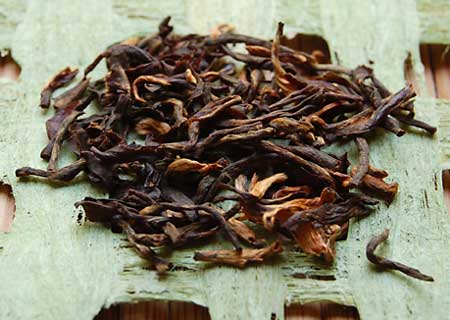
MelengAssamDry092609

As our weather changes over from the warmth of summer to the crispness of autumn, I’ve been thinking about exactly what is the most ideal weather conditions for growing tea.

A study conducted at Zhejiang Agricultural University on famous tea growing areas in China came up with these ecological climactic characteristics:

“…more amounts of clouds and fog, less percentage of sunshine, abundant rainfall and high relative humidity in the air, temperatures that rise and fall slowly, daily and annual temperature ranges that are smaller, more days that are suitable for tea growing and low wind speeds in the lee-sides and valleys of mountains. All of these factors are favorable for growth of tea trees.”

It appears that high humidity, abundant rainfall, and a smaller range of temperature variables that rise and fall slowly are key to producing the best quality tea.

Another reason I was thinking about the weather is that the conditions in the Assam tea growing region in India this year were not ideal. Drought conditions resulted in a smaller crop and tea that has a harsher, much more intense and astringent flavor to it.

MelengAssamSteep092609

My morning tea is a black tea called Meleng estate Assam. The Meleng tea estate, founded by a Mr. J.E. Jood in 1852, takes its name from a river that runs through the garden. Tea is planted on both sides of the river.

I find myself gravitating towards darker teas as the weather gets cooler and the light levels fall. Why is that, I wonder? Darker weather, darker tea?

With the more intense, astringent flavor in mind, I steeped my Assam leaves in 212 degree F (boiling point) water for only 3 minutes instead of my usual 4-5 minutes.

MelengAssamWet092609

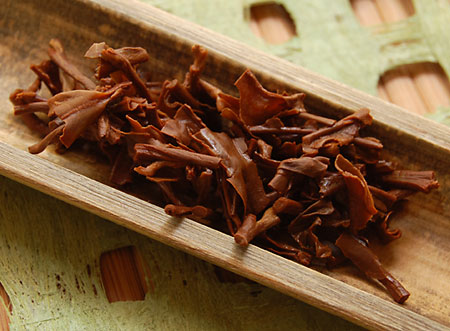
I was delightfully surprised by how much the astringent factor was mellowed out at the shorter steeping time. The flavor was much smoother, revealing a whisper of cocoa. The leaves have a rich, malty aroma and, after steeping, a cooked sugar note wafted up from my teapot.

MelengAssamTeapot092609

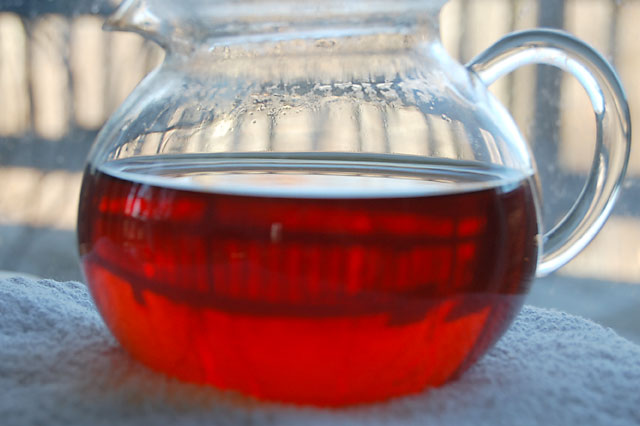
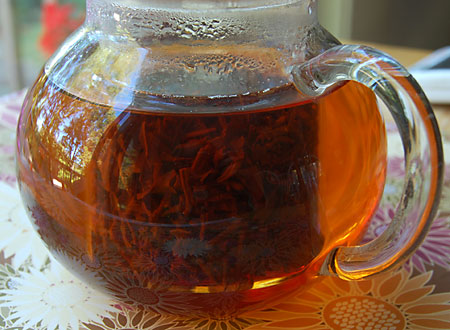
The deep russet color of the tea blends with the glorious blue sky reflection in my teapot resulting in a dreamy lavender patch.

I love the colors of tea.

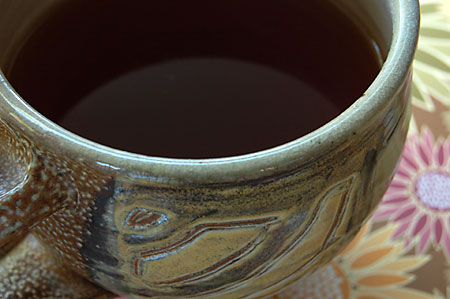
MelengAssamTeacup092609

I drank the whole pot of tea without a drop of milk. That said, my second pot will be steeped longer and enjoyed with milk.

Ah, the variations and joys of tea experimentation…

Only the heart knows how to find what is precious.

~Fyodor Dostoyevsky

Saturday Morning Tea

HalmariAssamDry080109

Happy first day of August to you!

It’s a perfect day to celebrate the start of the arrival of the 2009 Assams.

This morning I am sipping a cup of black tea, an Assam from the Halmari estate in northeastern India. The dry leaf is quite dark with a sprinkling of golden leaf tips. A beautiful, earthy variegation.

HalmariAssamSteep080109

I steeped the leaf for 4 minutes in boiling hot (212 degree F) water. The malty aroma is rich and dark.

HalmariAssamWet080109

Although you can drink an Assam tea at any time of the day, as you prefer, they are best known as a breakfast tea because of their hearty flavor which goes wonderfully with milk and sweetener. I wrote about another Assam tea here.

HalmariAssamTeapot080109

The steeped tea liquor’s gorgeous russet color speaks of harvest times and crisper fall days ahead.

The flavor of this tea is quite brisk and lively with notes of malt and a hint of bitter chocolate. As with most Assams, the astringency dries out my throat. Even though there have been reports that adding milk to tea reduces its health benefits, I am more interested in its taste so I will add a dollop of milk to my cup later to smooth out that astringency.

HalmariAssamTeamug080109

My DIL and granddaughter arrived this week for a visit from their home in New Mexico. We spent a wonderful day together yesterday enjoying each other’s company. At 9 months old, Ella is a delight! She’s constantly on the move, crawling, standing, exploring, laughing. I forgot how active a baby at that age can be! I was in heaven just being in her company and seeing the world through her eyes, so new and fresh and amazing. Even though she was sitting on the floor surrounded by colorful toys, her favorite thing to do was to crawl over to her car seat and play with its fascinating buckle. I am looking forward to my next visit tomorrow.

Ella073109

“Seek the wisdom of the ages,

but look at the world through the eyes of a child.”

~Ron Wild

Saturday Morning Tea on Sunday

banaspatyassamdry112308

This week we’ve experienced January weather with temps down into the high teens at night and a slight rise to the 20s during the day. Brrrrrr. A cold wind has swept all of the remaining leaves from the trees so I gaze out upon a stark, winter-like landscape as I sip my morning tea, a dark, rich Assam from the Banaspaty estate.

banaspatyassamwet112308The tea leaves are fully oxidized, giving the wet leaf a deep mahogany color. When I first opened my tea packet, I was treated to a darkly sweet, malty aroma with hints of fruit. This tea has been cultivated organically at the Banaspaty tea estate, located in the heart of the Assam Valley in northeastern India. Fair Trade certification has given estate workers the opportunity to establish a wide range of social initiatives such as a scholarship fund so their children may attend school and a local pharmacy that helps raise the standard of their healthcare.

Here is an interesting 1850 engraving showing the stages of Assam tea production.

assamteaproduction1850

banaspatyassamteapot112308The russet tea liquor glows like a rich jewel in my glass teapot. A strong malty aroma wafts up as I remove the lid to pour my first cup of the day. This tea is very full-bodied with a malty flavor and characteristic Assam astringency. To smooth out the astringency, I add a dollop of milk to my cup after a few sips. Even though I will add a little milk to most full-bodied black teas such as Assams, Ceylons and China blacks, I like to taste the tea plain first so I can detect some of the subtle flavor notes. This tea has a hint of fruitiness which I had originally detected in the dry leaf aroma.

banaspatyassamteacup112308I have a confession to make. I have developed quite a fondness for Social tea biscuits lately, especially for dunking in my milk laced black teas. I am discovering that there is an art to how long to leave the biscuit in the tea. Too short and the biscuit is still hard, too long and it falls in your teacup (oh my!). So, I have been working on my timing to achieve the right melt in your mouth softness to my biscuit.

My jewelry show yesterday went very well and I had a lot of fun. I caught up with old friends, made some new ones and sold a bunch of jewelry. My primary observation is that these challenging economic times have caused shoppers to be more discerning with their choices, with most looking in the lower end of the price range spectrum. I sold mostly earrings in the $5-$30 range and a few bracelets in the $40-$50 range. I didn’t sell any necklaces, including the faux jade chokers I created a couple of weeks ago. I have been considering opening an Etsy shop for awhile now and this just might be the right time to do it.

What is your Etsy experience?