Saturday Morning Tea

springdragonoolongliquor.jpg

Good morning, my dear tea friends. This morning I am headed out to my monthly polymer clay guild meeting in Rhode Island. I have resurrected a tea post from back when I lived in Upton. It’s a review of one of my most favorite Oolong teas. Enjoy this blast from the past and I’ll see you back here next week when I review a brand new tea!

This morning there is a very cool breeze coming in my windows. As I gaze out over the treetops, I see a variety of reds, oranges, maroons and golds blooming amongst the greenery. October is one of my favorite months because I love so much about this autumn time of year – the aroma of dry leaf as it dances across my path, the explosion of color across the landscape, the crisp, tart taste of a just picked apple, the bright orange pumpkins displayed in wooden carts along the side of the road. This morning, however, I am feeling wistful as the memory of summer slips away. So, in light of my mood, I have brewed up a green Formosa Oolong called Spring Dragon.
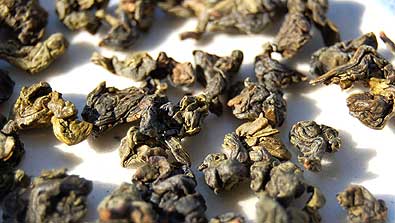
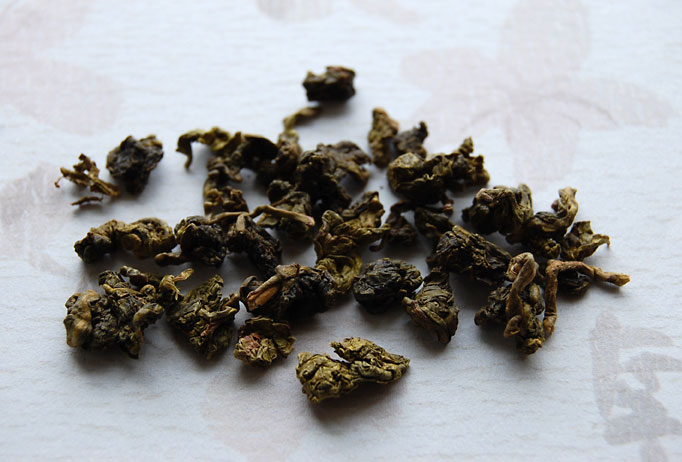
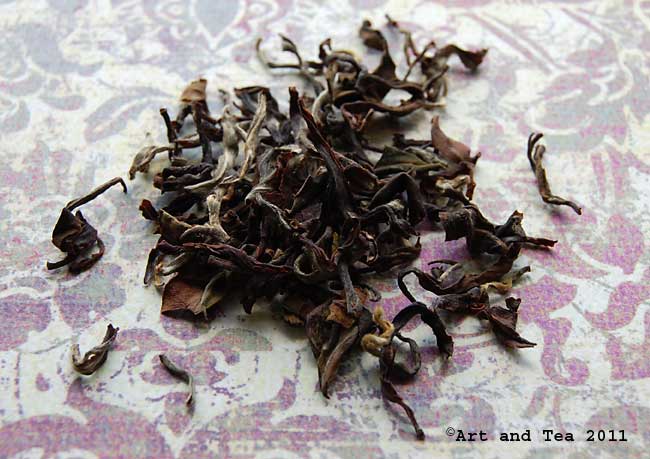
springdragonoolongdryleaf.jpg

After plucking the new growth (2 leaves and a bud), the leaves are spread out to dry and oxidize. They are shaken periodically during this drying period to bruise the leaf and release its volatile oils for flavor. This also helps in the oxidation process, the turning brown process of the leaf. This Oolong is only lightly oxidized so it is carefully monitored during this time. Once the tea master judges the oxidation to be sufficient, the leaves are pan roasted to halt oxidation. Then they are rolled and dryed some more.

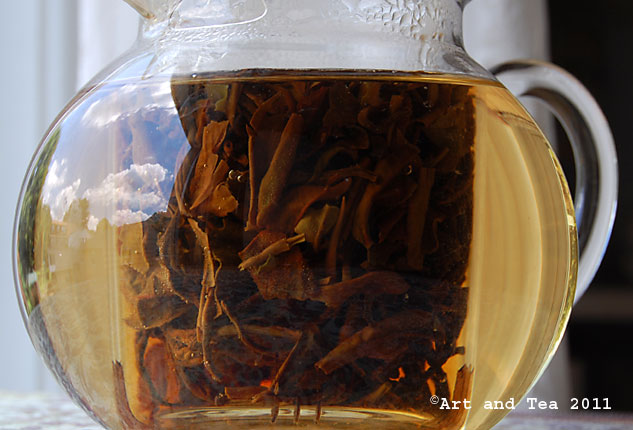
springdragonoolongwetleaf.jpg

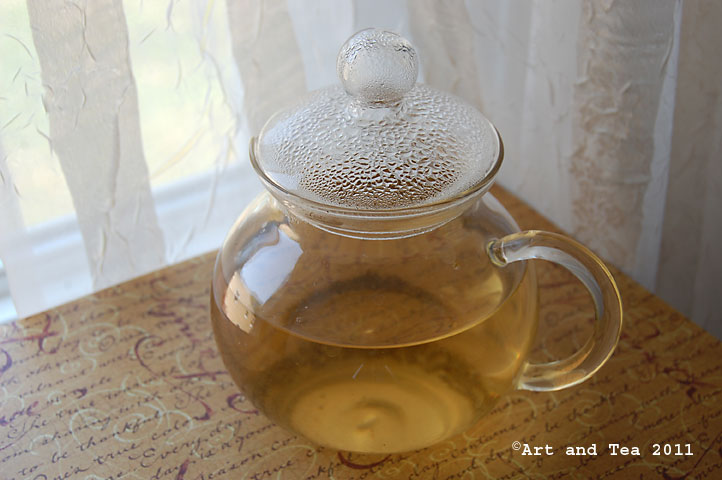
It is amazing that you can see the serration on the edges of the intact leaf that I have spread out after I steeped the tea. I left a portion of one leaf still rolled up a little so you can see how it has opened up. The aroma is sweet and delicately flowery. The light honey colored liquor is also sweet with lilac flavor notes. Mmmmmmm….
Saturday Morning Tea

I’m back from vacation and feeling rejuvenated despite a busy return to work this week. I’d like to share an interesting experience I had a few days ago. My colleague brewed a pot of a newly arrived Castleton estate second flush Darjeeling and the first word that popped into my head as I took my first sip was

PHENOMENAL!

It had a honeyed peach aroma with rich peach and muscatel flavor notes.

Ambrosia.

Naturally, we all requested it for our morning tea the following day. As I took my first sip that morning, I thought I had poured the wrong tea into my cup. While it was a very good Darjeeling, all of the wonderful flavor notes I had experienced the day before weren’t there. As my tea cooled, however, I detected them but they were very subtle.

So, what happened?

Different steeping times.

The first cup was steeped at 4 minutes and the second at 3 minutes. What a difference a minute makes, huh?

Look at this gorgeous leaf. It’s huge and chock full of tips/intact leaf sets.

Just like your water source can make all the difference in your resulting cup of tea so too can your steeping time. In light of my recent experience (and it’s happened to me before), I highly recommend that you experiment with different steeping times to find what works best for you. A tea you don’t like with your first cup could end up being your favorite tea by just making an adjustment to the steeping time!

This is the tea steeped for 3 minutes in boiling point water – a glowing medum amber hue.

The cup on the right is the tea steeped for 4 minutes. The color goes deeper and the peach/muscatel aroma and flavor are much more pronounced.

As my tea cooled, I was expecting the longer steeped tea to develop that characteristic “bite” but it never did. I might even try this tea steeped for 30 seconds longer. I like to push the steeping time to just before it develops that bitterness, that well known bitterness of being oversteeped.

So, I encourage you, dear tea friends, to experiment with the steeping times for your tea. That being said, however, I think that it’s best not to change the water temperature or the amount of tea leaves used per cup.  Those should remain consistent.

For this tea, I used 2 teaspoons of leaf per cup since the leaf is so huge and boiling point water.

Do you have a story similar to mine? If so, please share!

Enjoy your weekend!

Saturday Morning Tea

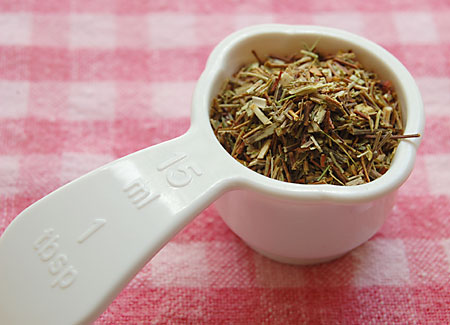
Iced-TeaDry062709

It’s that time of year again when my company shuts down and we all get 9 glorious days off from our regular work schedule. I’m leaving for the airport shortly to go visit my family in Michigan so I’ll leave you with my favorite method for making iced tea.

Have a wonderful holiday weekend, dear tea friends!

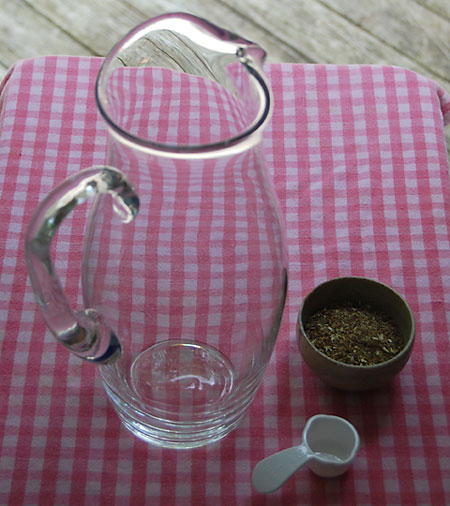
IcedTeaPrep062709

I make iced tea with the “cold brew” method. It’s so easy to make iced tea this way. Gather up your supplies either in the morning before work or in the evening before bedtime. This will give the leaves sufficient time to steep either all day or all night.

You’ll need a container, a tablespoon and some tea leaves. For my iced tea, I use a glass pitcher I purchased at Target and some organic green South African Rooibos. I’ve written about this herbal before here and here.

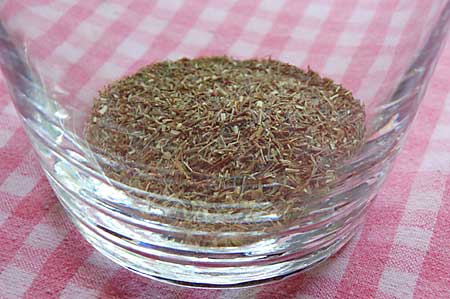
IcedTeaPrep2062709

Spoon your tea leaves into your pitcher, using one tablespoon for every 6-8 ounces of water. Next, pour your water into your pitcher. I recommend either bottled spring water or filtered tap water. Hard water can definitely affect the taste of your tea.

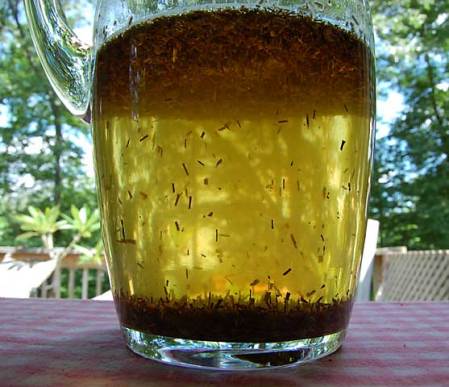
IcedTeaSteep062709

Now all you have to do is place your container in the fridge. That night or the next day, strain the tea into another container to remove the leaves. I use a large Pyrex measuring cup to strain my tea into. Then I clean the leaves out of my pitcher and pour the tea back into it. You can also use an infuser or tea filter papers to put your loose leaves into, making cleanup easier.

IcedTeaGlass062709

There are so many variations with iced tea creation. You can put lemon or orange slices in either while the tea is steeping or after you strain it. Or, you can fill your glass halfway with iced tea and then pour some flavored seltzer water in for a fizzy iced tea. The possibilities are endless!

IcedTeablueberries062709

I’m enjoying my iced tea plain with ice and a bowl of fresh blueberries on plain yogurt. Mmmmm…. I’ve been exploring ways in which I can remove sugar from my diet because I believe there is just way too much of it in the food we buy. Even my Stonyfield Farm yogurt cup, while it’s very delicious and organic, has sugar added to it. So, I’m now buying plain yogurt and mixing it with fresh fruit, depending on what’s in season.

Saturday Morning Tea

Good morning, dear tea friends! This morning I am on my way out the door to my polymer clay guild meeting, travel mug in hand. I leave you with a post I did to welcome in spring, with the lovely Magnolia Blossom Oolong. Enjoy!

The crocus I planted last fall are pushing their way up through the earth and their leaf blanket. As the days lengthen and warm, they are drawn to grow and burst into bloom. A big welcome to Spring this weekend!

To celebrate the first day of Spring, my morning tea is a scented tea from China called Magnolia Blossom Oolong. Grown and processed in the Guangdong province in South China, this tea is often described as “Orchid Oolong” as the flowers come from a tree that native Chinese call “yulan”, meaning jade orchid. Despite its translation, yulan is actually a type of magnolia tree (Magnolia denudata) which originated in southern China.

The leaves look very much like a Jade Oolong to me, rolled into compressed shapes. I steeped them for 3 minutes in 190 degree F water.

The shapes released as they steeped, giving off a wonderful fragrance. As I lifted the lid from my glass teapot, it was like putting my face into a bouquet of freshly cut flowers!

I find the floral flavor to be similar to a jasmine tea. The flower notes are very strong and sweet but not cloying. The flavor of the Oolong tea comes through the scenting, adding a fuller, silky smooth mouth feel. It doesn’t have the delicacy of a jasmine tea though.

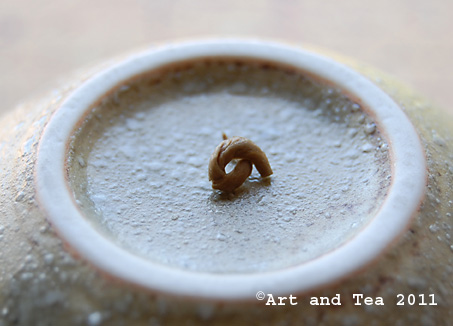
I was able to find out more information about my Hawaiian teabowl. Created by Clayton Amemiya on the Big Island, it was fired in a traditional Japanese kiln called an anagama. Clayton’s work combines Japanese tradition with the unique style of the Big Island. What I thought was glaze on the bowl is actually ash and wood. From his brochure:

“No glaze has been used. A glazed appearance is made by the firing process. Flying ash and wood particles fuse to the clay as they draft through the kiln. Because this is done by the fire, no two pieces can ever be the same. Individual woods have many of their own firing properties. This understanding gives Clayton the opportunity to collaborate with a force of nature.”

Knowing this makes my teabowl that much more special to me. As tea drinkers, we also collaborate with nature when we steep our leaves and transform them into a cup of tea.

Happy Spring!

“All you need is deep within you waiting to unfold and reveal itself.  All you have to do is be still and take time to seek for what is within, and you will surely find it.” ~Eileen Caddy

Unless otherwise noted, all text and photos are the property of Art and Tea at http://www.artandtea.wordpress.com, copyright 2007-2011.

Saturday Morning Tea

With summer officially arriving on Tuesday at 5:16pm, I’m hoping that it heralds warmer, sunny days. Aside from a brief hot spell in May, it’s been mostly cool and rainy this spring in MA. I find it interesting that the start of the warmest season also brings the start of the sun’s descent southward, shortening our days until winter solstice in December when they start lengthening once again.

Last week I reviewed a white tea scented with jasmine flowers. This week I’ve decided to brew up another jasmine tea, this time a green tea called Jasmine Pi Lo Chun.

You probably recognize the second part of the tea’s name as it’s a very famous green tea from China. You may read more about Pi Lo Chun tea here.

While many of the green leaves unfurled from their distinctive curled shape, I found this little guy in my pile of wet leaves.

I didn’t find one single blossom in either one of these teas. That’s because they remove all of the spent blossoms after each scenting cycle. Wow, if you think about it, that’s amazingly tedious work to pick the flowers blossoms out only to do it all over again the next day. For a week!

Sometimes I will talk to someone who is only interested in a jasmine tea that still has the dried flowers mixed in with the tea leaves. I think that there are some available like that. Perhaps they feel it lends the tea a more attractive appearance, looking more like the tea has been actually scented with flowers because they’re visible. Perhaps they feel it lends a more “jasmine-y” flavor to the tea. I’m not sure but I think that both of these teas, the Silver Needles and the Pi Lo Chun, have quite a pronounced jasmine flavor without any dried blossoms at all.

That being said, I find the green tea to be stronger in flavor overall than the white which gives the feeling of a stronger jasmine flavor. Candy sweet and quite floral. Very, very nice…

Next week I have an art guild meeting on Saturday so I’m going to try something that I’ve never tried before. In my 4 years of reviewing teas, I’ve never repeated a post before! Well, I’m going to give it a go next Saturday. I certainly have a library of tea reviews to choose from!

Have a great week, dear tea friends. I hope that you are able to carve out a moment to sit down and relax with a wonderful cup of tea.

“Within your heart, keep one still, secret spot where dreams may go.”   ~Louise Driscoll