Saturday Morning Tea

Taxation without representation.

238 years and one day ago, a group of colonists in Boston made a choice that changed the face of history. They refused to pay tax on tea without fair representation in the government and when the governor refused to allow the tea to be returned to England, they took matters into their own hands by dumping all the tea into Boston Harbor.

Boston Tea Party by Nathaniel Currier

All of the tea thrown into the harbor was from China. The bulk of the shipment was called “Bohea tea”, a common China black tea. John Adams recorded in his diary on December 17, 1773:

“Last Night 3 Cargoes of Bohea Tea were emptied into the Sea. This is the most magnificent Movement of all. There is a Dignity, a Majesty, a Sublimity, in this last Effort of the Patriots, that I greatly admire.

However, true Bohea tea is in a class by itself, being grown and handcrafted in Wuyi Shan (the Bohea Hills) in Fujian Province. So, without any further ado, I introduce you to Bohea Imperial Organic, the tea I’m enjoying in my cup this morning.
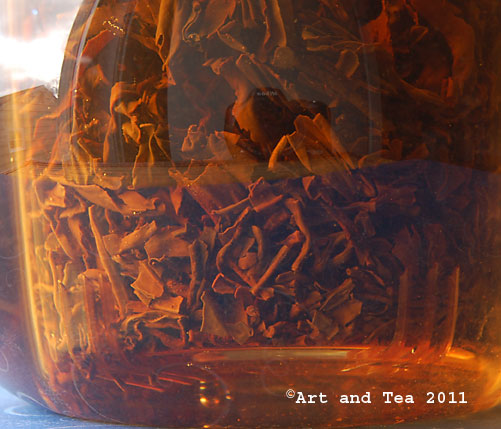
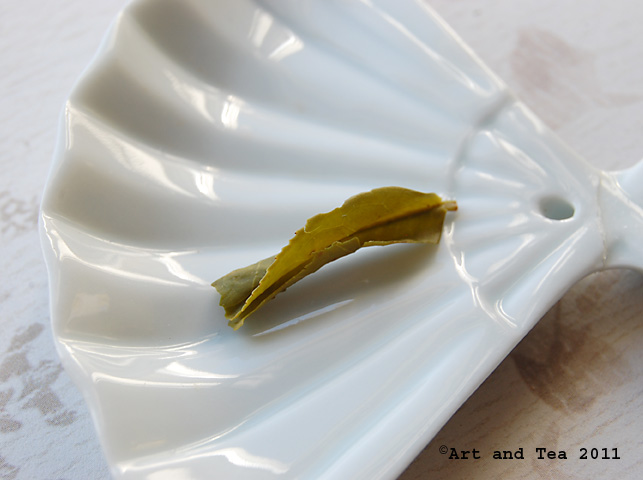
The beautifully handcrafted leaf is rather large and twisted. I steeped it for 4 minutes in boiling point (212 F) water.
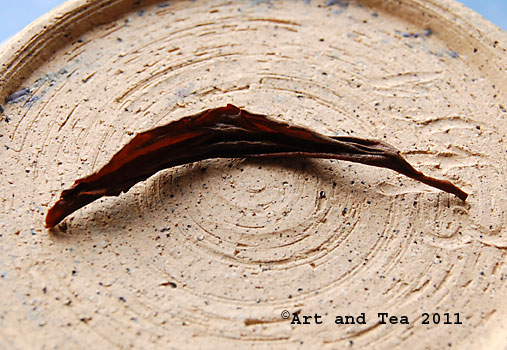
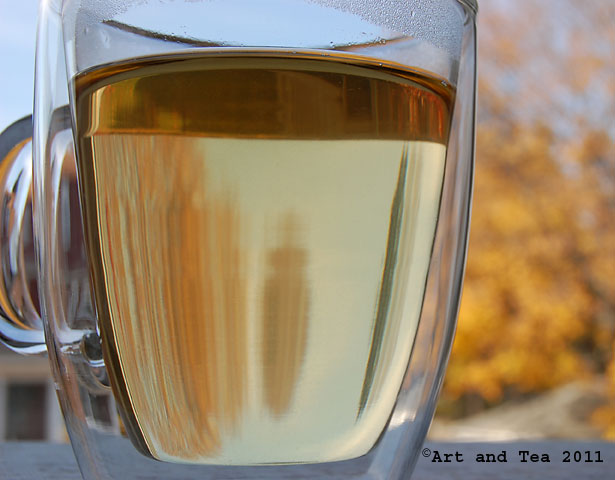
As I poured the tea into my mug, a Keemun-like burgundy aroma greeted me. I also detected an underlying smokiness which reminded me of Lapsang Souchong.
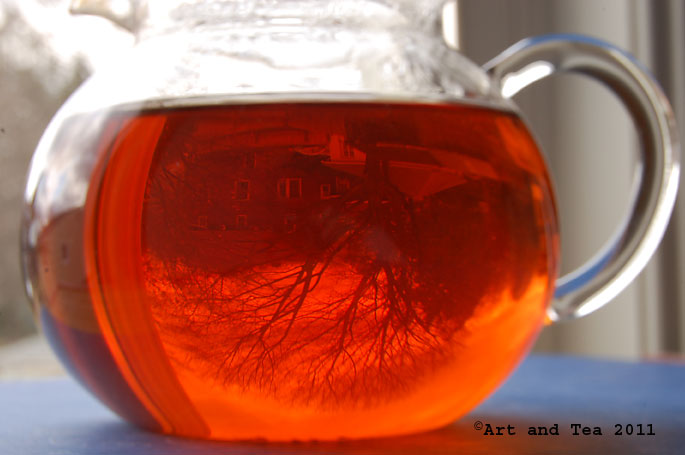
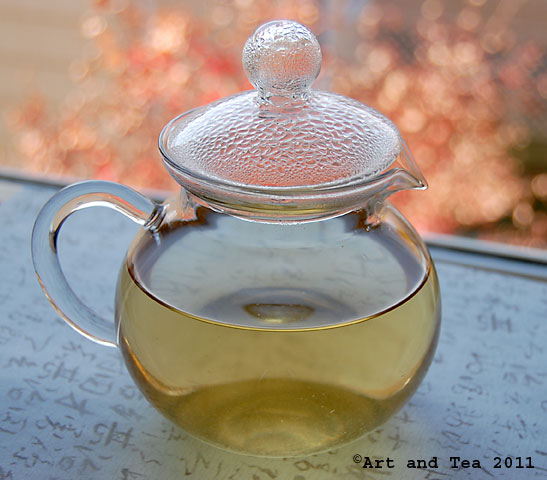
I love the way the bare winter branches are reflected in the deep amber liquor in my glass teapot.
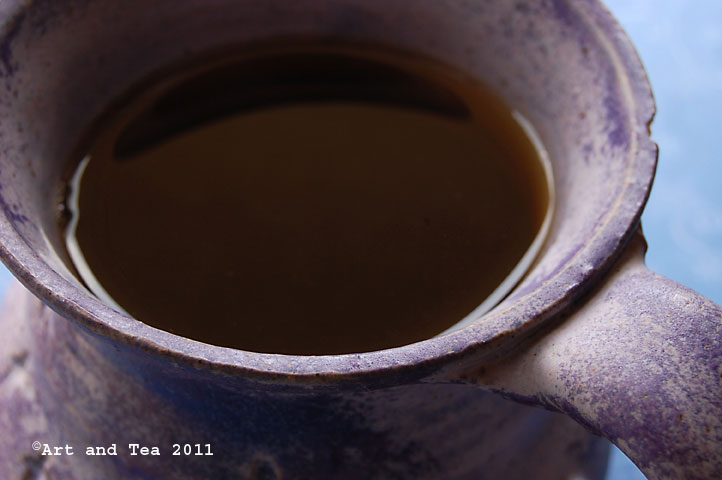
The flavor is rich and smooth with pronounced flavor notes of burgundy and smoke. This would be a most excellent choice for those wanting a tea a tad less smoky than regular Lapsang Souchong. I think it would also stand up very well to any additions like a splash of milk and pinch of sweetener. It does have its own dark sweetness so I would first try it without.

The holidays are fast approaching and I’m looking forward to celebrating with my family in Michigan. I hope that in this bustling time that you are able to find some quiet peaceful moments with a cherished cup of tea.

“You can have anything you want if you want it desperately enough.  You must want it with an exuberance that erupts through the skin and joins the energy that created the world.”  ~Sheila Graham
Saturday Morning Tea

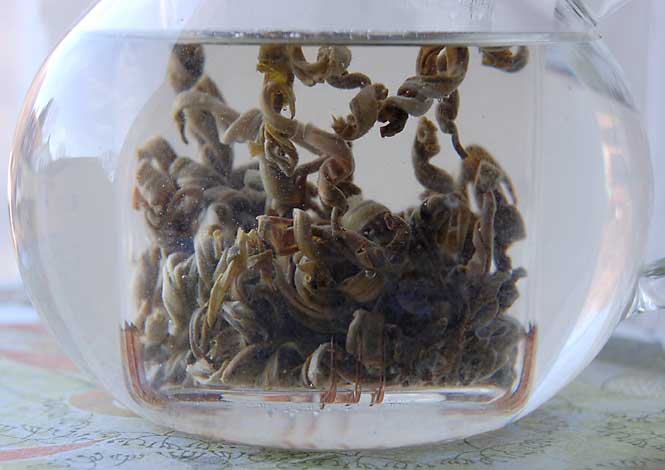
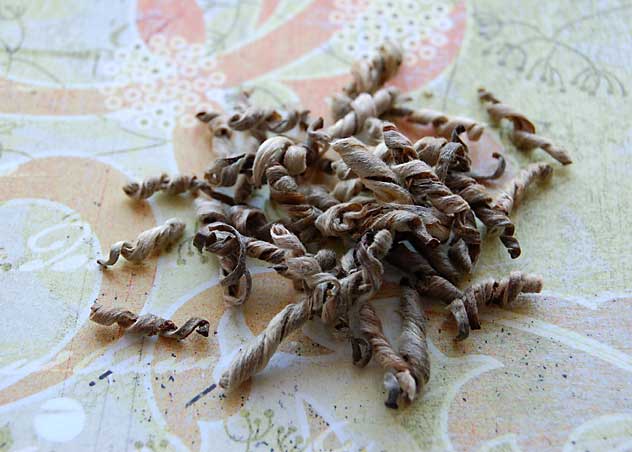
I experienced sheer joy in taking photos of this morning’s tea, a green tea from the Yunnan province in China. It’s called Yunnan green Snow Dragon.

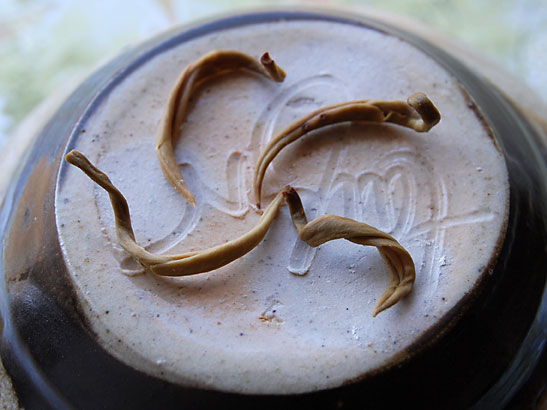
I don’t think that anyone rivals the tea artisans of China in their tea leaf rolling techniques. Corkscrews? Unbelievably amazing, huh?

With such an auspicious name, I wondered where this tea came from so I looked up if there were any mountains called Snow Dragon in Yunnan.  Here’s what I discovered.

Jade Dragon Snow Mountain, located in northern Yunnan province, is the southernmost glacier in the Northern hemisphere. It consists of 13 peaks, the highest one being 18,360 feet. It’s never been climbed. Wow. You can see photos of the area and read about the legend of the creation of Snow Dragon mountain here.

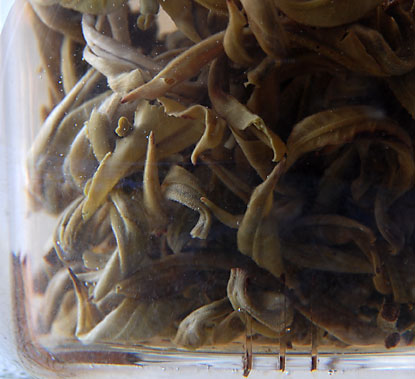
I steeped the little corkscrews for 3 minutes in 180 degree F water. Their shape relaxed considerably towards the end of their steeping time.

As I removed the infuser basket from my glass teapot, I was struck by an intense aroma of fresh pear. This distinct note carried on into the flavor.

These steeped leaves remind me very much of a white tea, consisting of mainly leaf buds, the newest growth on the tea plant. That said, the further manipulation of the leaf into a shape is the mark of a green (or black or Oolong) tea, not a white tea.

The straw colored liquor is as pale as a white tea though.

The flavor is very soft and delicate with notes of pear and fruit. As the tea cools, its sweetness becomes more defined and lingers in my mouth.

As I watched the leaves steep and release their shape, I thought of how we all have a tendency to hold on to things – people, situations, even sickness and emotional wounds – because we get so comfortable with them, even if it is time to move on and change our shape. Even though the unknown is scary, if we are just able to release and let go, we can discover the beauty in a new way of being. Just like the corkscrew tea leaves released their shape and transformed into a delicious cup of tea.

“People have a hard time letting go of their suffering. Out of a fear of the unknown, they prefer suffering that is familiar.” ~Thich Nhat Hanh

Saturday Morning Tea

This morning’s tea is a decadent treat.

At approximately $2.25 per cup, it is also an expensive treat! It’s name is quite fitting. Meet Extra Fancy Oolong from Taiwan (Formosa). Extra Fancy indeed.

It is described as a “style of Oolong often referred to as ‘Champagne Oolong’, and exemplifies the art of fine tea manufacture”. We can see how carefully this tea was processed by the full leaf sets still intact.

This tea has been entirely hand processed. From the careful picking of the first two leaves and bud on the tea plant to the drying and shaking of the leaf every hour to bruise and encourage oxidation to the pan roasting that halts the oxidation, the Tea Master who created this tea has synchronized all of these steps perfectly as an art form.

Because Oolong tea is not fully oxidized as is black tea, I steeped the leaves in cooler than boiling point water – about 190 degrees F for 5 minutes.

The deep sherry-colored tea liquor smells like ambrosia, giving off an aroma of fresh peaches. I can’t wait to take my first sip which fills my mouth with notes of ripe fruit, rich and syrupy. Oh, what a treat!

I know it’s a tradition to have a glass of champagne at midnight on New Year’s Eve. Why not enjoy a cup of “champagne” tea instead?

What a wonderful way to welcome in a brand new year!

Until next time, dear tea friends…

To listen to the songs of birds, I skipped the evening meditation,
enjoyed a patch of grass by the edge of an ancient mountain stream.
Pleasure recollected depends on a beautiful phrase;
the appreciative mind meets with a close friend.
Spring water cries out in a rocky valley;
pine trees echo when wind is coming.
I drank a cup of tea and watched the flowing and stillness.
Quietly and naturally I seemed to forget the return of time.

Cho-ui
1786-1866

Saturday Morning Tea

Good morning, dear tea friends! This morning I’ve brewed up a pot of another green tea, this one from Korea called Jung-Jak. Interestingly enough, I did review the 2008 version of this tea here.

This spring harvest tea is usually plucked sometime during the month of May. Its name translates to “medium sparrow tongue”, a colorful reference to the appearance and shape of the leaf.

What do you think?

I’ve been looking for a  comparable alternative to our Japanese teas as my company decided to take a cautious stance and not purchase any 2011 teas from Japan.

I steeped the leaf for 3 minutes in 180 F water. I noticed that I used 160 F water back in 2008. I think that I’ll steep another pot using that temp as, right away, I taste a bit of a tang on my tongue. Have you ever had a cup of green tea that you thought was too pungent? More than likely, the water temp was too hot for steeping the leaf.

The warm sunlight in the photo above tints the tea liquor golden but it is the color of light jade. The aroma has a pronounced vegetal quality, like fresh spring asparagus, which carries over into its flavor. This tea makes my mouth feel very fresh.

I don’t consider myself a green tea connoisseur at all, drinking it probably several times a week. That said, if I didn’t know that this tea came from Korea, I would guess that it’s a Japanese sencha. I’d love to hear your feedback if you’ve tried this tea.

Next weekend I’m attending my 35th high school reunion. I’m amazed at that incredible number and am looking forward to seeing my former classmates and hearing about their life journeys since our graduation many moons ago. So, I won’t be reviewing a new tea next Saturday but I’ll be back in 2 weeks to enjoy a cup of tea with you again.

Happy Thanksgiving to one and all!

“Words have no wings but they can fly a thousand miles.”

~Korean Proverb

Saturday Morning Tea

As promised, I’ve brewed up a pot of this year’s Pi Lo Chun Bao Wei. In comparing the dry leaf, while I could find some slightly curled bits, it doesn’t seem to be as spiral shaped as last year’s lot. That said, there’s quite a bit of downy tips, the new growth of the tea plant.

The steeping leaf reveals many shades of olive green and brown, very similar to last year. I steeped it for 3 minutes in 180 F water.

Now that the leaf has unfurled during steeping, it looks very similar to last year with the same amount of broken leaf bits.

The tea liquor is a beautiful golden straw color, also very similar to last year. So far, it is quite similar with the exception of less curled bits.

Now comes the test. Is the flavor similar?

Personally, I don’t think so. The pronounced anise/licorice flavor note I found so appealing (and others didn’t) last year is not there at all. I found the aroma sweet with a note of fresh corn which carried over into the flavor.  The vegetal quality is more pronounced. As the tea cooled, a hint of smokiness came out which lingered in my mouth for quite some time. It reminded me of the smokiness of a gunpowder tea.

In conclusion, I think that I preferred last year’s lot even though I find this tea to be very pleasant. Such is the nature of tea – variations always happen from year to year.

Today is a wonderful day – we are celebrating my grandchildren’s birthdays. Ella is 3 and Landon is 1. I am looking forward to giving them each a big hug (and some fun gifts) from Gran! 🙂

“An open home, an open heart, here grows a bountiful harvest.”

~Judy Hand