Saturday Morning Tea

NahorhabiDry022313

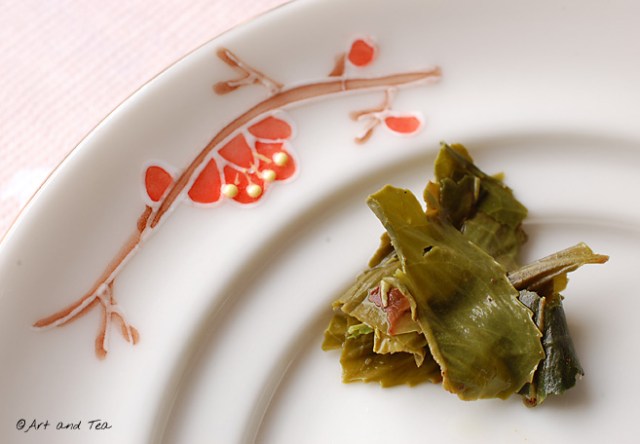
Good morning, dear tea friends! Today we’ll talk about the northeast of India, the Assam region to be precise, and a rich, dark cup from the Nahorhabi Estate. I have read that this tea estate, one of several owned by Jay Shree Tea, got its name because it used to be the site of a forest of “Nahor” trees, a tree native to that area of the world. The tea leaf is quite tippy, as you can see from my photo.

NahorhabiSteep022313

The Assam tea growing region lies on either side of the Brahmaputra river, one of the major rivers of Asia. That area of the world has a monsoon period when they can receive up to 10-12 inches of rain per day. Wow, that’s a lot of water.

Speaking of water, I used boiling point (212F) water to steep this tea for 4 minutes.

NahorhabiWet022313

If you’re going to add milk or cream to this tea, I recommend steeping for 5 minutes. We’ve been enjoying this tea with half and half at work the past several days. What a treat!

NahorhabiTeapot022313

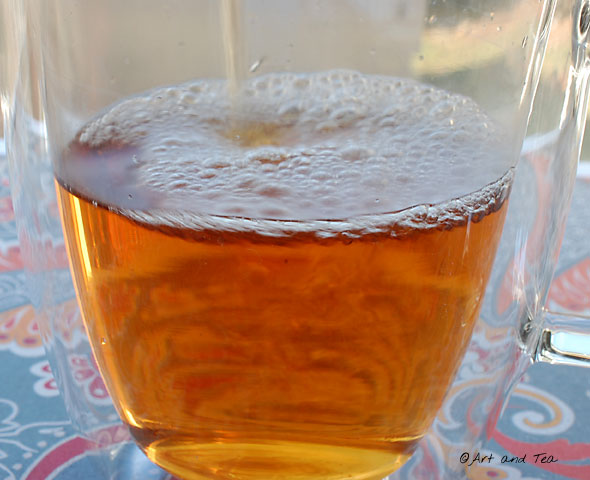
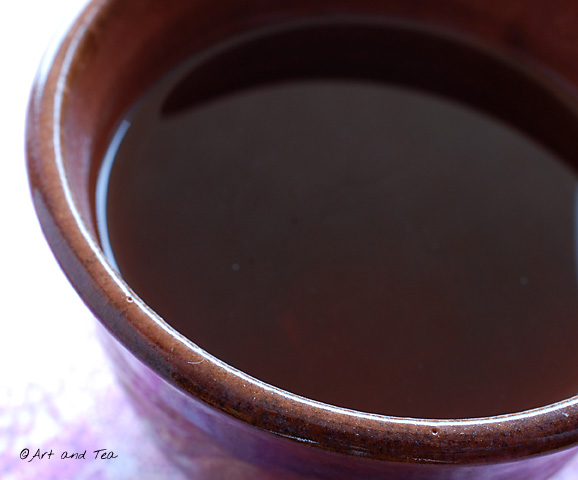
The aroma is rich and toasty, malty. The flavor is quite stout but with a smoothness I didn’t expect. So flavorful and complex, I am already on my second cup!
NahorhabiTeabowl022313

The day outside is cold and gray with about 6 inches of snow expected to fall in our area later on. It’s one of those forecasts that change every time I watch the news – will it be rain or snow and when? Well, I’m all cozy and warm here with my pot of tea and the farthest I’m going to travel is into my studio to work on a new necklace design.

Have a lovely week!

“Being with people who warm us, who endorse and exhault our creativity, is essential to the flow of the creative life. Otherwise we freeze…When women are out in the cold, they tend to live on fantasies instead of action.”

~Clarissa Pinkola Estes, Jungian Analyst and Writer

Saturday Morning Tea

GuranseDry021613

Good morning, dear tea friends! After last week’s blizzard that dumped 2 feet of snow on us, it’s great to be back with you sharing a cup of tea. Today’s cuppa is a black tea from the Guranse Estate in Nepal. The beautifully intact leaves have been hand-rolled and processed.

GuranseSteep021613

From the tea estate’s website:

“Guranse Tea Estate is situated at an altitude between 3300 and 7300 feet above sea level. Probably the highest tea garden in the world which produces one of the best teas. In order produce exquisite tea enriched with delectable ‘muscatel’ flavor with superb aroma, the bushes need to grow breathing pure mountain air, filled with just the right combination of sun, shade and rain that are abundant in the eastern hills of Nepal, below the majestic Mount Everest and mount Makalu.”

I steeped the leaves for 3 minutes in boiling point (212F) water.

GuranseWet021613

Look at this fine plucking of the top two leaves and bud. Amazing.

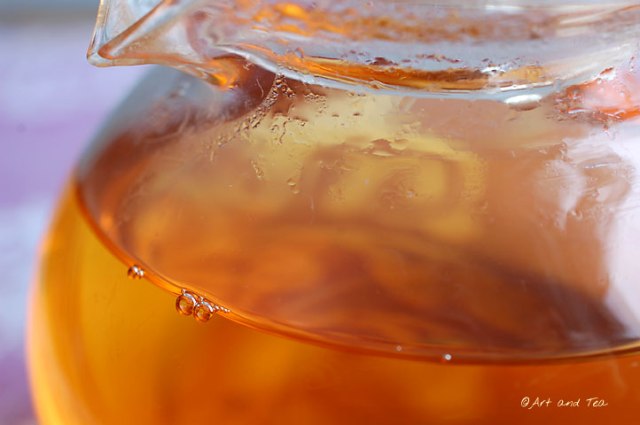
As I lifted the infuser from my glass teapot, a fresh floral aroma wafted up.

GuranseTeapot021613

The glowing amber tea liquor is silky smooth with sweet, floral notes. It’s mellow and light.

GuranseTeacup021613

There’s more snow falling this afternoon, flakes gently floating to earth, no accumulation, thank goodness. This is the perfect tea, the perfect moment to sit and gaze out at the world of white.

“There are only two ways to live your life. One is as though nothing is a miracle. The other is as though everything is a miracle.”

~Albert Einstein

Saturday Morning Tea

SteinthalSunriseDry020213

Good morning, dear tea friends! As I gaze out my window at the puffs of clouds floating across the cold, blue sky, I’m enjoying a very special tea called Sunrise.

From the 1,662 acre Steinthal Estate, located in the Darjeeling district in northeast India, the leaves were plucked at sunrise during the second flush season. I have been told that the dew that collects on the leaves overnight delays the photosynthesis process. This delay causes maximum flavor retention in the leaves so plucking in the early morning hours is desirable for optimum flavor.

SteinthalSunriseSteep020213

Sunrise is such a hushed, magical time when the world still sleeps and beautiful colors bloom across the sky. During the week, I rise at 5:30am so I’m able to see the sunrise most mornings. The beauty of nature is truly awe-inspiring.

I steeped the leaves for 3 minutes in boiling point (212F) water. The aroma was quite fruity as I lifted the infuser from my glass teapot.

SteinthalSunriseWet020213

I have read that the Steinthal Estate is actually called the Singtom-Steinthal Estate. The word Steinthal comes from the German Jesuit missionaries that developed different areas of the tea garden.

This special Sunrise tea was handcrafted in honor of the 160th Jubilee celebration of the tea estate.

SteinthalSunriseTeapot02021

The color of the tea liquor reminds me of the blazing dark-orange that lights up the sky at sunrise. If there are clouds in the eastern sky right before the sun peeks over the horizon, it looks like their undersides have been stroked with a paintbrush.

The flavor is quite fruity, with a dominant note of fresh apricots. The rich body is silky smooth. If you prefer your Darjeeling to be on the astringent side, I recommend pushing the steeping time a little.

SteinthalSunriseTeamug02021

I had some fun taking photos as I poured the tea! Now the tea is all gone and I’m craving another cup…

On the studio side of things, I’ve created some polymer clay sheets with the technique I spoke about previously and now it’s time to play around with cutting some shapes for my beadwork. While I love my job, sometimes it’s frustrating having to wait for an afternoon of free time to play in my studio. Does anyone else have that experience?

As always, thanks for stopping by and sharing my tea time!

“I may not have gone where I intended to go, but I think I have ended up where I needed to be.”

~Douglas Adams, The Long Dark Tea-Time of the Soul

Saturday Morning Tea

BlackMonkey012613

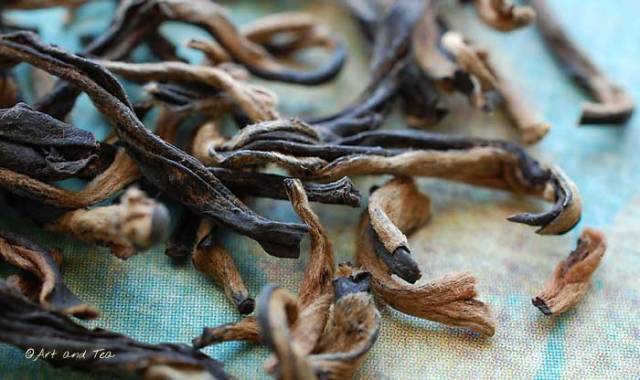
Good morning, dear tea friends! I hope that you had a great week and stayed warm if you’re experiencing a bitterly cold winter as we are here in New England. Oh my. Each day has started with these numbers – 3, 8, 10…brrrr! I need some serious warmup here! So, with that in mind, I chose a dark, rich China black tea to grace my teabowl this morning. Meet Organic Black Monkey, with its fuzzy golden tips threading through long, twisted, dark leaves.

BlackMonkeySteep012613

I steeped the leaves for 5 minutes in boiling point (212F) water. As I lifted the infuser from my glass teapot, a strong aroma of sweet pipe tobacco greeted my senses. With the name “Monkey”, I thought this tea might be more like a Golden Monkey, with those rich, cocoa notes, however, I found this tea to be more like a Bohea in aroma and flavor.

BlackMonkeyWet012613

The long, twisted leaf reminds me of a dark Oolong tea, one that has been oxidized at 40-50%, in fact, there are some of those toasty, woody nuances in the flavor as well.

BlackMonkeyTeapot012613

The dark-russet tea liquor is thick and bittersweet, like a very dark chocolate, leaving the suggestion of cocoa in my mouth. The tobacco notes that I found so pronounced at first mellowed out as the tea cooled. Aside from that cocoa bitterness, the tea is quite smooth, leading me to think that this tea would be fun to “monkey” around with the steeping times.

BlackMonkeyTeabowl012613

This tea did a great job of warming my bones, a perfect cuppa for a frigid, mid-winter’s day.

I started playing around with my polymer clay stash last weekend and want to continue that this weekend. I had purchased a DVD from polymer clay artist, Barbara McGuire, on her version of mokume gane, involving gold leaf, alcohol inks and poking the clay with geometric shapes. I’ve been imagining ways to combine the beautiful, watercolor effect of this technique with either free-form beading or bead embroidery. Stay tuned to see what manifests!

As always, I so enjoy our time together, sharing a cup of tea. Thanks for stopping by!

“I dream a lot. I do more painting when I’m not painting. It’s in the subconscious.”  ~Andrew Wyeth

Saturday Morning Tea

SpringHarvestSenchaDry01191

Good morning, dear tea friends! As the wind howls outside my windows, I dream of spring and those thoughts have led me to my morning tea – a Japanese green tea called Spring Harvest Sencha. This tea is a rare treat as a tea of this high grade is usually not exported outside of Japan.

SpringHarvestSenchaSteep011

As the name suggests, it is a spring harvest, like a first flush Darjeeling. The most well known Japanese green tea is Sencha, which is harvested after Shincha, the very first tea of the spring. With each subsequent harvest, the tea becomes stronger and darker with leaves of lesser quality and price. The exceptional quality of this tea shows that it was an earlier harvest.

SpringHarvestSenchaWet01191

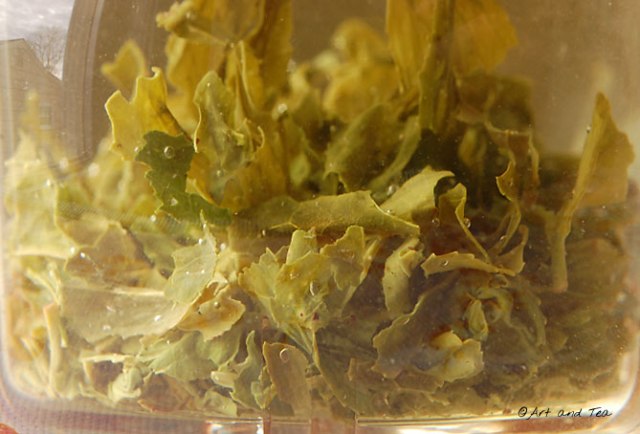
Japanese teas are recognizable by their grassy, needle-like shape. The shape is attained by sending the leaf through a series of rolling machines. Paddles move the tea back and forth over metal ridges while heat is applied so the leaf is slowly formed into its needle shape.

I steeped the leaf for 2 minutes in 175 degree F water. Some Japanese tea lovers will use a lower temp and steeping time when preparing their tea. I have found that this works best for my taste.

SpringHarvestSenchaTeapot01

The tea liquor is a pale spring green with a delicate vegetal aroma. The flavor is quite sweet and light with only a whisper of a vegetal note. I usually find Japanese green teas to be much more vegetal tasting than this tea is.

SpringHarvestSenchaTeamug01

This tea allows me to show off my new Cherry Blossom mug, a wonderful birthday gift from my lovely daughter. It came with a ceramic infuser basket but I don’t really see myself using that basket as the holes are much too large.

I’ve been fighting off a virus this week, which has left me feeling tired and washed out. I feel refreshed and rejuvenated after several cups of this wonderful tea.

As always, thanks for stopping by and sharing a cuppa with me!

“If we had no winter, the spring would not be so pleasant: if we did not sometimes taste of adversity, prosperity would not be so welcome.”

~Anne Bradstreet